
Top 5 Ways DevOps Accelerates Digital Transformation

Delivery Manager
15th April, 2026
Executive Summary
- DevOps helps businesses turn digital plans into steady execution.
- It improves how software is built, tested, released, and managed.
- It supports faster software delivery, better teamwork, and more reliable operations.
- It helps businesses manage cloud migration, modernization, and ongoing change with less friction.
- In 2026, DevOps for digital transformation goes beyond CI/CD and increasingly includes platform engineering, self-service delivery, policy-based security, stronger observability, LLM-driven operational insight, and autonomous support for selected operations workflows.
- Its impact can be tracked through deployment frequency, lead time, change failure rate, recovery time, and environment setup time.
DevOps helps businesses deliver software faster, manage change more safely, and keep operations reliable as systems grow more complex. That is why digital transformation with DevOps is not only about speed. It is also about improving execution with better control, stronger governance, and more repeatable delivery. Many businesses already know what they want to modernize. They want better customer experiences, faster product updates, smoother cloud adoption, and more efficient internal systems. What slows them down is not always strategy. It is execution. Releases take too long, teams work in silos, environments become harder to manage, and even small changes start to feel risky. DevOps addresses that gap. It improves how software moves from idea to production. It reduces manual work, improves visibility, and helps teams deliver change in smaller, safer, and more repeatable steps. That is the clearest answer to how DevOps accelerates digital transformation in real business settings. To see how that works in practice, let us look at the specific ways DevOps supports digital transformation.
What Is Changing About DevOps in 2026?
DevOps is no longer seen only as CI/CD and collaboration between development and operations. It is now part of a broader delivery model that includes internal platforms, self-service workflows, policy-based automation, stronger observability, and AI-driven operational support. This shift matters because businesses now manage more services, cloud environments, APIs, and compliance requirements than before. They need speed, but they also need control. They want teams to move faster without creating more delivery risk. That is why DevOps now works more closely with platform engineering. Instead of asking every team to build delivery practices from scratch, businesses increasingly use reusable templates, standard pipelines, approved tools, and self-service environments. In many cases, DevOps services also help businesses put these systems in place and scale them more effectively with the right security and governance guardrails. AI is also changing the way DevOps works in a more practical way. Teams are beginning to use LLMs to analyze observability data, identify patterns, and support faster incident response. In some environments, businesses are also exploring autonomous agents for limited operational tasks, such as handling routine Level 1 remediation steps under defined policy and approval boundaries. This is an important shift because it moves AI in DevOps from passive assistance to more active operational support. It also shows why governance matters even more as automation becomes more capable. Businesses need stronger policy checks, clearer approval logic, better auditability, and more visible operational guardrails so teams can benefit from these systems without losing control.
How DevOps Speeds Up Digital Transformation?
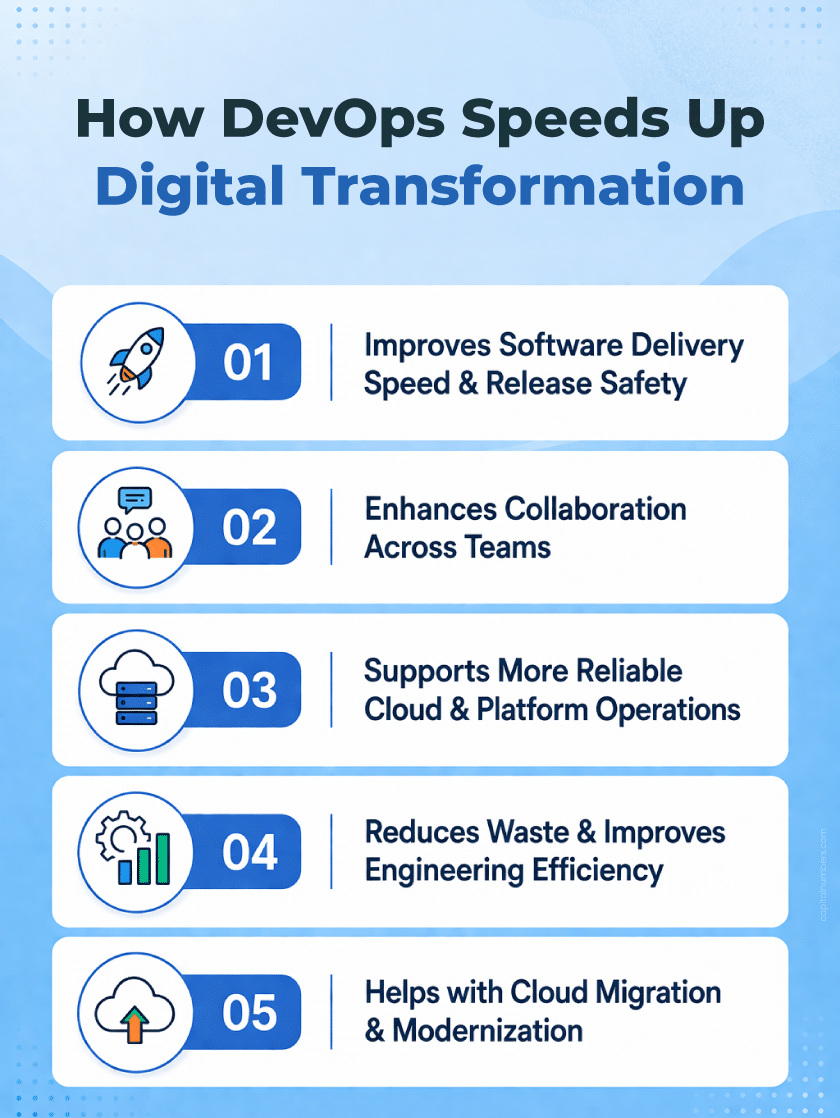
DevOps speeds up digital transformation by making change easier to deliver, safer to manage, and simpler to scale. Instead of treating software delivery as a set of disconnected tasks, it creates a more connected system for building, releasing, and running software. That matters because most transformation programs do not struggle only because of vision or budget. They struggle because day-to-day execution becomes slow, fragile, or hard to coordinate. DevOps helps remove that operational drag.
1. Improves Software Delivery Speed and Release Safety
DevOps helps teams release software faster without turning every deployment into a risk event. Many digital initiatives slow down because releases are still manual, too large, or difficult to coordinate. Testing happens too late, approvals are inconsistent, and small updates get bundled into larger releases that are harder to validate. That increases delay and risk at the same time. DevOps improves this by helping teams move in smaller, more controlled steps. CI/CD in digital transformation plays a major role here. It automates build, test, and deployment work so updates can move from development to production with fewer delays and fewer manual errors. Standard release workflows also make it easier to trace changes, validate them, and roll them back when needed. At a larger scale, this can have a much bigger impact than a small time-saving example suggests. A business that once depended on fragile, weekend-long monolith deployments can move toward more automated, lower-risk rollout patterns, including zero-downtime microservice deployments where the architecture supports it. That kind of shift helps reduce disruption, improve recovery readiness, and make modernization easier to sustain. This leads to:
- Faster releases
- Smaller and easier-to-test updates
- Fewer manual deployment mistakes
- Better release confidence
- Quicker recovery when something goes wrong
For business leaders, this improves time-to-market and helps teams respond faster to changing customer or market needs. For technical leaders, it improves release discipline without adding unnecessary process overhead.
2. Enhances Collaboration Across Teams
DevOps improves collaboration by reducing handoff delays and giving teams a more shared way of working. Digital transformation often slows down when development, QA, operations, and security still work in separate stages. Development finishes the build, QA tests it later, operations handles deployment separately, and security reviews happen near the end. Even if each team works well on its own, the overall process becomes slower and harder to manage. DevOps improves this by creating better visibility across the delivery lifecycle. Teams can see what is changing, what is being released, and what is happening in production. Problems are easier to catch earlier, and ownership becomes clearer. When this is supported by platform engineering and policy-based controls, collaboration becomes easier to scale. Shared workflows, reusable templates, and standard guardrails help teams reduce avoidable friction without losing governance. This usually results in:
- Fewer handoff delays
- Better visibility across teams
- Faster issue resolution
- Earlier security involvement
- Clearer ownership over delivery outcomes
This is one of the strongest DevOps benefits for business. Better coordination reduces confusion, avoids rework, and helps teams turn strategy into execution with less friction.
3. Supports More Reliable Cloud and Platform Operations
DevOps helps make cloud and platform operations more consistent, visible, and easier to control. As businesses move more workloads to the cloud and modernize older systems, operations become more complex. There are more environments, dependencies, and services to manage. Without strong delivery practices, this often leads to instability, configuration drift, weak visibility, and slow issue resolution. DevOps brings structure to that environment. Infrastructure as code makes setup more repeatable. Monitoring and observability help teams detect issues earlier and understand root causes faster. Automated checks improve consistency and reduce manual intervention. This also becomes more valuable when businesses are building internal platforms and self-service workflows. DevOps provides the delivery discipline, operational standards, and policy guardrails that help those systems stay useful and manageable over time. This helps businesses in several ways:
- Environments become more consistent
- Configuration drift is reduced
- Issues are easier to detect and diagnose
- Teams gain better visibility across cloud and hybrid systems
- Operations become easier to scale
This also connects directly with platform engineering. Many businesses now use internal developer platforms, reusable templates, and self-service workflows to reduce delivery friction. DevOps provides the automation, standards, and release discipline that make those platforms useful in practice.
4. Reduces Waste and Improves Engineering Efficiency
DevOps improves engineering efficiency by reducing avoidable manual work and delivery friction. A lot of digital transformation slows down because teams spend too much time on repetitive setup, unstable environments, manual deployment work, and broken handoffs. These may look like small process issues, but together they reduce delivery speed, create frustration, and limit how much useful work teams can complete. DevOps helps reduce that waste. When repetitive work is automated, and workflows become more consistent, teams spend less time fixing avoidable problems and more time improving products, systems, and customer-facing experiences. That often means:
- Less manual setup work
- Fewer repetitive deployment tasks
- Fewer delays caused by environmental issues
- Less rework across teams
- Faster movement from idea to release
- More time for higher-value engineering work
For business leaders, this is where DevOps benefits for business become easier to measure. It improves engineering output by reducing wasted effort, shortening delivery cycles, and lowering the cost of avoidable friction.
5. Helps with Cloud Migration and Modernization
DevOps helps businesses execute cloud migration and modernization with more consistency and less disruption. Cloud migration and modernization are rarely simple one-time projects. Most businesses need to modernize legacy systems while maintaining live operations. Old and new environments often need to work side by side for some time, which adds risk and complexity. DevOps makes that change easier to manage. It supports repeatable deployments, better visibility, and more controlled releases while systems are being updated. It does not replace architecture planning or migration strategy, but it makes those efforts easier to execute in practice. This helps businesses:
- Manage changes more safely during migration
- Support old and new systems at the same time
- Improve delivery consistency during modernization
- Handle APIs and distributed services more smoothly
- Build stronger long-term delivery practices
This is why DevOps for digital transformation matters so much during modernization. It helps businesses handle change in a way that is practical, stable, and easier to sustain over time.
How DevOps Works in Practice?
DevOps works by making software delivery more automated, repeatable, and visible. Instead of relying on slow handoffs and manual checks, teams use shared workflows, repeatable environments, automation, and continuous feedback to move changes more efficiently. In practice, this often includes:
- Automated builds, testing, and deployments
- Version-controlled infrastructure
- Earlier security and compliance checks
- Monitoring and observability for faster response
- Safer release methods, such as canary or blue-green deployment
- Shared visibility across development, operations, QA, and security
- Self-service platforms and reusable deployment templates
- Policy-based controls that help teams move faster with better guardrails
In more mature environments, DevOps may also support LLM-based incident analysis, outage prediction based on observability patterns, and autonomous AI agents that handle lower-risk operational tasks such as Level 1 remediation within approved limits. The goal stays the same: help the business change faster without making delivery unstable, harder to govern, or riskier to manage.
How to Measure the Impact of DevOps?
The best way to measure DevOps is to look at delivery outcomes, not just tool adoption. Some of the most useful metrics include:
- Deployment frequency: How often teams release changes.
- Lead time for changes: How long it takes for code to reach production.
- Change failure rate: How often releases cause incidents, rollbacks, or urgent fixes.
- Mean time to recovery: How quickly systems recover after a production issue.
- Environment provisioning time: How long it takes to prepare working environments for teams.
In larger environments, businesses may also want to track governance-related indicators such as policy compliance, rollback readiness, environment consistency, and the time required to provision approved delivery templates or service environments. These metrics help both business and technical leaders see whether DevOps is improving speed, reliability, and execution quality. They also show whether delivery improvements are creating real operational value.
An Example
Imagine an enterprise modernizing a revenue-critical customer platform that supports live transactions, customer access, and core business workflows. Before improving its delivery practices, releases depended on long coordination cycles, manual deployment steps, and high-risk weekend release windows. A failed deployment not only delays a feature. It can disrupt customer experience, slow revenue operations, and create a long recovery process across teams. With DevOps practices such as automated pipelines, standardized infrastructure, enhanced observability, and stronger release controls, the business can move toward more frequent, lower-risk deployments. In some cases, that may also include zero-downtime microservice rollouts, clearer rollback paths, and better visibility during releases. The value is not only faster delivery. It is also lower release risk, better control, and a delivery model that is easier to scale across larger transformation programs.
How to Get Started with DevOps for Digital Transformation?
The right DevOps starting point depends on where delivery is slowing the business down today. For some companies, that means improving release automation. For others, it means reducing deployment friction, improving cloud operations, involving security earlier, or building stronger self-service workflows. A useful first step is to identify where software delivery is creating the most drag. That may be slow releases, poor environment consistency, weak visibility, repeated manual work, or difficulty managing modernization across old and new systems. Once that is clear, DevOps priorities become much easier to define. In many cases, the best starting point is not only choosing better tools. It is defining a more controlled delivery model with the right standards, guardrails, and operational ownership in place from the start. Want to make your digital transformation efforts more effective with the right DevOps approach? Get in touch with our expert DevOps developers at Capital Numbers. We can help you build a more reliable, scalable, and future-ready delivery process.
Frequently Asked Questions About DevOps and Digital Transformation
1. How does DevOps help digital transformation?
DevOps helps by improving how software is built, tested, released, and managed. It supports faster delivery, better teamwork, and more reliable operations, which makes business change easier to execute.
2. How does DevOps accelerate digital transformation in real business settings?
DevOps accelerates digital transformation by reducing manual work, improving visibility, and creating more repeatable delivery workflows. This helps businesses release changes faster, lower delivery risk, and manage modernization with more control.
3. What are the main DevOps benefits for business?
The main benefits include faster software delivery, better reliability, improved engineering efficiency, lower operational friction, and stronger support for migration and modernization.
4. Why is CI/CD important in digital transformation?
CI/CD in digital transformation helps automate build, test, and deployment work. That allows teams to release software more quickly, more consistently, and with fewer manual mistakes.
5. What should leaders measure to see if DevOps is working?
Leaders should track deployment frequency, lead time for changes, change failure rate, recovery time, and environment setup time. These metrics show whether delivery is getting faster, safer, and more reliable.

Subhajit DasDelivery Manager
With around two decades of experience in IT, Subhajit is an accomplished Delivery Manager specializing in web and mobile app development. Transitioning from a developer role, his profound technical expertise ensures the success of projects from inception to completion. Committed to fostering team collaboration and ongoing growth, his leadership consistently delivers innovation and excellence in the dynamic tech industry.