

How to Choose an Offshore Software Development Company: A Practical Framework for CTOs (2026)
Table of Contents
Quick Summary
Selecting an offshore development company in 2026 shapes your delivery speed, software quality, security posture, and long-term control. The right offshore partner does more than supply developers – they fit your product context, delivery process, security expectations, and business goals. Evaluation in 2026 must go beyond price, location, and portfolio: assess engineering discipline, AI governance, security readiness, collaboration quality, and continuity. Offshore engagements most often fail not from lack of talent but from weak operational clarity once the work begins – making visibility and ownership the deciding factors between a vendor and a real partner.
Choosing an offshore software development company in 2026 is not just about lowering costs. It is about choosing a partner who can help your team ship faster, maintain quality, and scale without adding delivery risk.
That is why this decision goes beyond vendor selection. CTOs are looking for partners who can fit into their workflows, work transparently, and support delivery as priorities shift.
Many offshore engagements fail not because the team lacks talent, but because documentation weakens, ownership blurs, and problems surface too late once work begins.
This guide for CTOs offers a practical framework for evaluating global software development companies based on the factors that matter most in 2026: business fit, engineering discipline, AI governance, security readiness, delivery visibility, and continuity.
What Should You Compare Before Choosing an Offshore Software Development Company?
Older advice on offshore selection follows a familiar checklist: cost, location, portfolio, communication, and reviews. These still matter for creating a shortlist, but they do not tell you how the work will actually run after kickoff.
In 2026, offshore teams are expected to work inside cloud-native environments, faster release cycles, tighter security expectations, and AI-assisted development workflows. A vendor can sound compelling in a sales meeting and still create significant delivery friction later.
That is why you need to compare delivery quality, not just company credentials. Specifically, look at:
- How engineering quality holds up under delivery pressure
- How AI is used in development and where human review is mandatory
- How code, access, and environments are controlled
- How visible work is across sprints, releases, and risk areas
- How well the team fits your tools, workflows, and architecture
- How the engagement can scale, pause, or transition cleanly
- How well the team works asynchronously through clear tickets, written updates, and usable documentation
- How transparently the vendor handles staffing continuity and delivery model fit
Offshore software vendor selection today is not about outsourcing work. It is about choosing a partner you can actually build with.
What Should You Clarify Before Shortlisting Offshore Development Companies?
Before shortlisting offshore companies, get clear on what you actually need — many partnerships become difficult not because the vendor is weak, but because the problem is defined too loosely before the search begins:
- Are you solving for speed, specialization, modernization, or sustained capacity?
- Is this staff augmentation, a product build, a platform transformation, or ongoing engineering support?
- Which risks matter most right now – missed deadlines, weak quality, security exposure, poor documentation, or vendor dependency?
- Which systems, tools, and workflows must the offshore team integrate with?
- How much visibility do you need into code, releases, testing, and engineering decisions?
- Which pricing model fits your risk tolerance best: Fixed-Bid, Time and Materials, or a Dedicated Team structure?
How to Evaluate an Offshore Software Development Company Step by Step
To evaluate an offshore software development company effectively, start with the business need, shortlist vendors based on fit, then assess quality, security, visibility, and continuity.
- Define the real need — Be clear on whether the priority is speed, specialized expertise, modernization, scale, or continuity.
- Shortlist based on fit, not just pricing — Use domain relevance, delivery model fit, and engineering maturity to narrow the list.
- Evaluate the six core areas — Review business fit, engineering quality, AI governance, security, delivery visibility, and continuity.
- Ask how delivery works day to day — Ask how code quality, releases, documentation, and risks are handled in practice, not just in the pitch.
- Watch for black-box warning signs — Weak visibility, vague process, and unclear ownership almost always become bigger problems once delivery is underway.
- Choose the partner you can scale with — The right team should be safe to start with, safe to grow with, and safe to transition from if your delivery structure changes.
How to Choose an Offshore Software Development Company
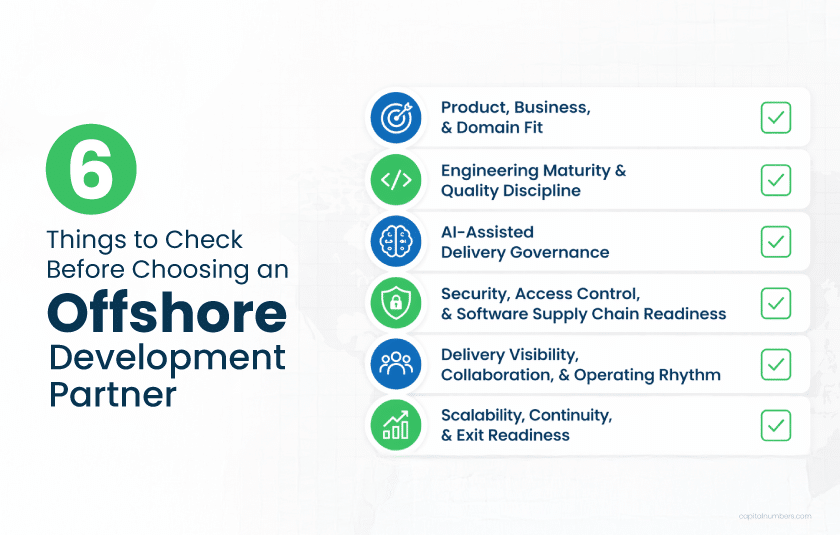
The simplest way to evaluate an offshore software development company is to review six areas together: business fit, engineering discipline, AI governance, security readiness, delivery visibility, and continuity. When assessed together, these areas give a clear picture of how well an offshore partner can support execution, reduce delivery risk, and scale alongside the business.
1. Product, Business, and Domain Fit
A strong offshore partner understands more than the technical scope. They understand the business context, product logic, and user workflows behind the work. Look for domain familiarity, product thinking, the ability to challenge assumptions constructively, and comfort with ambiguity and shifting priorities.
When this fit is strong, teams typically see fewer misunderstandings, less avoidable rework, and faster decisions during delivery.
Use Case Example A vendor building a fintech dashboard, a healthcare workflow tool, or a marketplace back office needs to understand the operating constraints of that domain — not just complete tasks from a backlog.
2. Engineering Maturity and Quality Discipline
What matters is whether engineering quality holds up under increased delivery pressure, not just how confident the team sounds in a proposal. Look for active code review practices, meaningful testing standards, CI/CD discipline, documentation kept up to date throughout delivery, and a clear approach to technical debt and performance.
Strong engineering discipline leads directly to smoother releases, less firefighting, and lower rework costs over time.
3. AI-Assisted Delivery Governance
The question in 2026 is no longer whether a vendor uses AI in development. It is whether they use it with discipline. Look for clarity on which AI tools in development are being used, where human review is mandatory, how sensitive code and data are protected, and what governance exists for prompts, generated code, and third-party model usage.
Weak AI governance can create hidden quality issues, introduce risky automation behavior, slow code reviews, and generate cleanup work that erases the productivity gains, especially when building workflow-level AI, retrieval-backed systems, or customer-facing automation.
4. Security, Access Control, and Software Supply Chain Readiness
If an external team will work on your code, environments, or integrations, they become part of your software delivery chain. Look for secure SDLC practices, role-based access control, proper secret handling, third-party dependency awareness, IP protection, auditability, and clear separation of development, testing, and production environments.
Security review should also cover data residency and compliance requirements. Look for a partner that understands where sensitive data can be accessed, processed, stored, and transferred, especially in relation to regulations such as GDPR and CCPA. They should also be clear about how your proprietary code, business logic, and internal data are protected, and confirm that they will not be used in public AI model training or unmanaged external tools.
Stronger security discipline produces fewer avoidable incidents, fewer release blockers, and more confident deployments.
5. Delivery Visibility, Collaboration, and Operating Rhythm
A strong offshore partnership should not feel like guesswork. Look for real access to repositories, sprint boards, pipelines, and release status; a regular reporting rhythm; clear issue escalation paths; meaningful overlap hours; and a team that operates as an extension of your engineering function rather than a separate unit.
Overlap hours still matter, but they are not enough on their own. Look for a team that also works well asynchronously through clear ticketing, written decisions, usable runbooks, and documentation that helps work move forward without constant meetings.
Strong teams surface problems early, reduce coordination drag, and keep handoffs clean – translating into lower management overhead, better release predictability, and fewer late surprises.
6. Scalability, Continuity, and Exit Readiness
The best offshore partner is not just easy to start with. They should also be safe to scale and safe to transition from if your delivery structure changes. Look for ramp-up ability without quality drop, replacement plans for key engineers, knowledge continuity, strong documentation standards, and a deliberate approach to avoiding operational lock-in.
CTOs should also watch for a common staffing risk: some vendors present senior talent during the sales process but replace them once the engagement begins. Look for contractual clarity around key team members, approval for major staffing changes, and a clear continuity plan if named engineers leave or are reassigned.
Strong continuity practices make scaling easier, reduce dependency risk, and support cleaner handovers when priorities shift.
Which Offshore Engagement Model Is Right for You?
Cost matters, but the most cost-effective model is not always the lowest-risk option. In offshore software development, the engagement model affects how much flexibility, visibility, and control you have throughout delivery.
- Fixed-Bid works best when your scope is clear and unlikely to change. It gives you more cost predictability, but it can become restrictive if priorities shift once the engagement is underway.
- Time and Materials is a better fit when your requirements are still evolving. It gives you more flexibility, but it also requires stronger visibility and closer coordination from both sides during the engagement.
- Dedicated Team model is usually the right choice when you need continuity, long-term collaboration, and deeper alignment with your internal workflows. It may feel less fixed from a budgeting perspective, but it often provides greater stability and better knowledge retention over the course of the engagement.
The right choice depends on what matters most to you: budget predictability, flexibility, or sustained engineering capacity.
Questions CTOs Should Ask Before Signing with an Offshore Development Partner
Before signing with an offshore software development company, ask questions that show how the team handles quality, visibility, security, and continuity when real delivery pressure starts:
- How do you protect code quality as the team grows or priorities change?
- What access will we have to repositories, sprint activity, testing, and releases?
- How are AI tools used in development, and what review controls exist?
- How do you manage access, credentials, and secure engineering practices?
- How do you handle data residency and compliance requirements?
- Will our code or data be used in any public AI tools or model training?
- What happens if key engineers leave the project?
- Which team members will stay on the project after kickoff?
- How do you handle documentation, handover, and continuity?
- Can you work within our current stack, cloud setup, and delivery workflow?
- How do you support async work across time zones?
- How are delivery risks surfaced, escalated, and resolved?
These questions move evaluation past sales confidence and into execution reality. For guidance on the operational side, once you have signed, this guide on managing an offshore development team covers the day-to-day practices that keep delivery on track.
Red Flags to Watch for When Evaluating Offshore Software Development Companies
- A vague delivery process with no specifics on how quality is enforced
- No visible QA or code review discipline
- Unclear or evasive answers on AI usage and governance
- A weak or undocumented security posture
- No clear answer on data residency, compliance, or AI usage limits
- Little or no transparency into the repository or sprint activity
- Too much knowledge or delivery ownership concentrated in a few individuals
- Poor documentation practices – especially for onboarding, handover, and async work
- Too much dependence on live meetings for routine execution
- “Yes to everything” sales behavior with no pushback or qualification
- No clarity on who will actually stay on the account after signing
- No transition or exit plan if the engagement structure changes
These are not minor concerns. Over time, each one tends to grow into delivery friction, quality issues, and long-term dependency, all harder to unwind than they look at the start.
Choose the Offshore Development Partner You Can Build With
Choosing an offshore software development company in 2026 is not just about picking a vendor. It is about choosing a partner your team can work alongside, trust over time, and scale with as your delivery needs grow.
The best offshore partner is not simply the lowest-cost option. It is the one that helps you move faster without losing quality, visibility, or delivery confidence. When work stays visible and risks surface early – before they become delivery crises – offshore development becomes significantly easier to manage and easier to scale.
Work with Capital Numbers If you are looking for an offshore development partner that brings engineering strength, delivery transparency, and long-term flexibility, get in touch with us. Our engineers help businesses build reliable digital products, modernize existing systems, and scale delivery without losing visibility or control. Visit capitalnumbers.com/contact-us to start the conversation.
FAQs about Choosing an Offshore Software Development Company
1. How do you handle changing requirements during offshore development?
A capable offshore team should be able to adjust priorities clearly, explain the impact on scope and timelines, and keep delivery moving without confusion. Look for partners with structured processes for backlog changes, shared planning, and visible decision-making rather than teams that absorb changes informally.
2. How long does it usually take to onboard an offshore development team?
In most cases, an offshore team can begin contributing meaningfully within two to four weeks. The timeline depends on project complexity, access provisioning, documentation quality, and how clearly priorities are shared from the start.
3. Can an offshore development team work effectively alongside an in-house team?
Yes, if the setup is right. The best offshore teams integrate into your existing tools, meetings, and delivery cadence rather than operating as a separate unit. Overlap hours, shared repositories, clear ownership boundaries, and strong async documentation are key enablers.
4. What should CTOs check before hiring an offshore development partner?
CTOs should check business fit, engineering maturity, AI governance, security practices, delivery visibility, and continuity planning. These factors show how the engagement will work after kickoff, not just how the vendor performs during sales conversations.
5. How can businesses maintain security when outsourcing software development?
Assess how the vendor handles access control, credential management, code repository security, environment separation, audit trails, data residency obligations, and restrictions on how AI tools interact with proprietary code and internal data. A reliable partner will have clear, documented security practices and be able to explain them plainly, not treat them as secondary concerns.


 Web Development
 Cloud Engineering
 Mobile App Development
 AI/ML/GenAI
 E-commerce
 Software Development
 UI/UX
UI/UX QA
QA Dedicated Teams