The Complete Guide to Hiring Remote Developers in 2026: Costs, Risks, and Best Practices
Table of Contents
Quick Summary
Hiring remote developers in 2026 is not only about saving money. It is about building the right delivery setup. CXOs need to compare cost, control, continuity, security, communication, and ownership before choosing a remote development team. A freelancer may work on a small task. But for product development, modernization, SaaS platforms, or AI-enabled work, a structured offshore team, Agile Pod, or managed outsourcing partner is often safer.
Most companies no longer struggle to find remote developers. They struggle to make remote development work.
In 2026, you can hire developers from almost anywhere, compare rates quickly, and start fast. But speed does not guarantee delivery. A remote developer can write code and still leave you with missed deadlines, rework, unclear ownership, and security concerns.
For CXOs, the real decision is no longer just location or hourly rate. It is the structure. Do you need one developer, a dedicated offshore team, an Agile Pod, or a managed outsourcing partner? Who owns QA, code reviews, documentation, releases, and IP protection?
This guide answers those questions. It breaks down remote developer costs, engagement options, risks, and best practices for 2026 so you can hire for delivery capability, not just developer capacity.
Why Companies Hire Remote Developers in 2026
If you are trying to scale an engineering team, you may already know the problem: the right talent is not always available where your business is located.
ManpowerGroup’s 2026 Global Talent Shortage Survey found that 72% of employers globally struggle to find the skilled talent they need. For companies building modern software products, that shortage shows up in delayed hiring, higher salary pressure, and limited access to specialists.
Remote hiring or outsourcing software development gives you a practical way to broaden your talent pool without relying only on your local market.
It helps companies:
- Access global engineering talent
- Scale teams without waiting months for local hires
- Find niche skills in AI/ML, cloud, DevOps, data, QA, mobile, and SaaS development
- Reduce delivery costs when the model is structured well
- Support modernization, SaaS builds, and AI-enabled product work
- Add flexibility without increasing permanent headcount too quickly
For companies modernizing legacy systems, launching SaaS platforms, or adding AI-enabled workflows, this flexibility can directly affect product speed and competitiveness.
Capital Numbers InsightAt Capital Numbers, we often see CXOs choose remote hiring not because they cannot hire locally, but because local hiring alone cannot support the speed, skill variety, and cost structure their roadmap demands.
The key is to avoid treating remote hiring as a shortcut. It works best when you choose the right engagement option, assign clear ownership, manage the team, and ensure proper delivery.
Engagement Options for Hiring Remote Developers
Before you think about individual developers, you need to decide what kind of engagement fits the work. This is the step most companies skip, and it is usually where remote hiring strategies start to break down.
There are four main options, each suited to a different level of ownership and risk tolerance.
| Engagement Type | Avg. Hourly Rate (USD) | Hidden Costs | Best Fit |
|---|---|---|---|
| Freelancer / Platform-Based Developer | $35–$80 | High churn, limited continuity, extra management effort | Short-term, isolated tasks |
| Offshore Agency / Dedicated Remote Team | $25–$55 | Low if the partner has strong delivery governance | Product development, scaling, and long-term support |
| Nearshore Development Team | $60–$110 | Moderate; usually higher rates but easier collaboration | Time-zone-sensitive and collaboration-heavy work |
| In-House Remote Developer (US/EU) | $90–$160 | Benefits, equity, HR overhead, and long hiring cycles | Core IP-sensitive roles and strategic engineering leadership |
Freelancers are the most flexible on paper but require the most internal management — every coordination point, every quality check lands on your side. Offshore dedicated teams offer a better balance when the partner has mature delivery governance. Nearshore works when real-time collaboration genuinely matters. In-house remote is best reserved for IP-sensitive or strategically critical roles.
CXO Insight: The lowest hourly rate does not always mean the lowest delivery cost. A $20/hour developer may look more affordable than a $50/hour dedicated developer, but if they need more supervision, create rework, or lack continuity, the total cost of delivery rises fast.
The Real Cost of Hiring Remote Developers
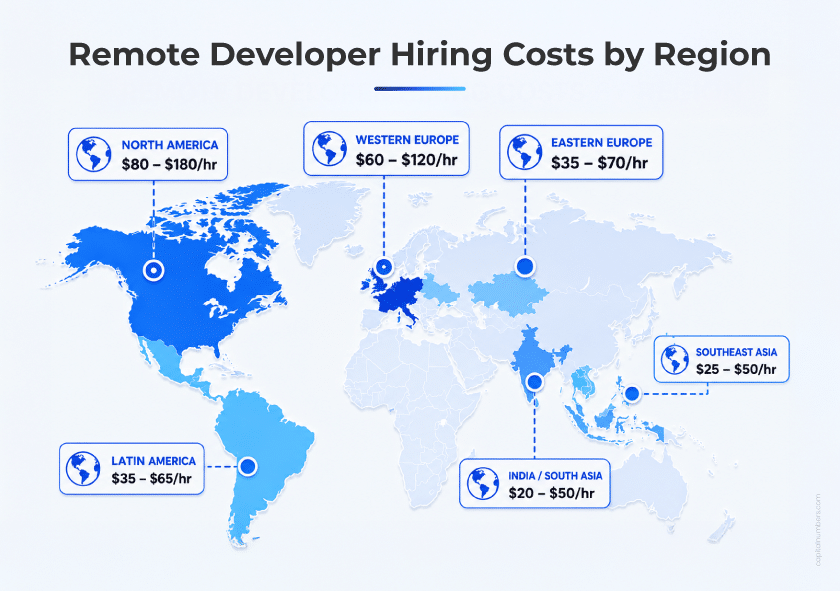
Remote developer cost depends on region, experience, skill set, project complexity, and the support structure around the developer.
Here are common planning ranges:
| Region | Typical Hourly Range | Common Fit |
|---|---|---|
| India / South Asia | $20–$50/hr | Offshore teams, web, mobile, cloud, AI, QA |
| Southeast Asia | $25–$50/hr | Web and mobile development |
| Eastern Europe | $35–$70/hr | SaaS, backend systems, complex engineering |
| Latin America | $35–$65/hr | Nearshore teams for US companies |
| Western Europe | $60–$120/hr | Senior engineering and niche expertise |
| North America | $80–$180+/hr | Local senior consulting and strategic roles |
What none of these numbers include is the rest of the delivery cost — QA, DevOps, sprint planning, code review, architecture guidance, documentation, and rework. If you are budgeting for developer hours, you are not budgeting for a working product.
The real cost of offshore software development is what it takes to get a usable, secure, tested, maintainable product into production.
Here is a simple example.
A company hires one remote developer at $20/hour for 160 hours per month.
Monthly developer cost:
$20 × 160 = $3,200/month
That looks efficient. But if the project also needs QA, DevOps, sprint coordination, and code review, and those responsibilities quietly fall to someone internally, the cost is hidden, not gone.
Now factor in a bad hire. If poor code quality generates 100 hours of rework at $45/hour:
Rework cost: 100 × $45 = $4,500
Effective total: $3,200 + $4,500 = $7,700/month
That is already more than a mid-range experienced developer would have cost.
Now compare with a structured Agile Pod:
| Role | Monthly Cost Estimate |
|---|---|
| 2 Developers | $6,400 |
| QA Engineer | $3,000 |
| Part-time DevOps Support | $2,500 |
| Project Manager / Scrum Support | $2,000 |
| Total | $13,900/month |
One developer is cheaper on paper. But an Agile Pod typically delivers faster, generates less rework, and produces more reliable releases, because QA, DevOps, and coordination are built in.
The decision is not about developer cost. It is about the delivery cost.
Hiring Models for Offshore Software Development Teams
If you choose offshore development only by hourly rate, you may miss the bigger question: who owns delivery?
A remote developer can add capacity, but an offshore software development team needs the right structure. Before you hire developers, decide how much responsibility your internal team can carry and how much ownership you expect from the external partner.
| Hiring Model | Best For | Main Risk |
|---|---|---|
| Staff Augmentation | Filling skill gaps inside an existing team | Works only if internal leadership is strong |
| Agile Pods | Cross-functional delivery with developers, QA, DevOps, and PM support | Higher cost than hiring one developer |
| Managed Outsourcing Partner | End-to-end delivery ownership | Vendor selection becomes critical |
If your internal team can manage delivery, staff augmentation may work. If your team is already stretched, Agile Pods or a managed outsourcing partner are safer.
Capital Numbers Insight Staff augmentation works well when you have internal direction but need skilled support to move faster. For example, we helped an international cinema chain strengthen its web, mobile, and cloud platforms through staff augmentation while working closely with its internal team.
How to Evaluate Remote Developers in 2026
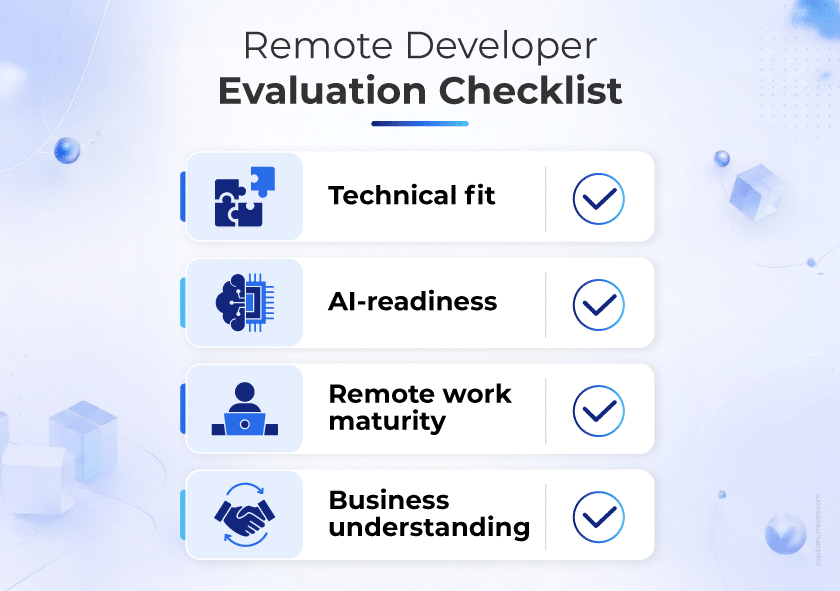
A strong remote developer is not just someone who knows a programming language or framework. In 2026, you need to check how they think, communicate, use AI tools, and support the business goal.
1. Technical fit
Check whether the remote developer or development team has experience with projects similar to yours. Do not hire only by keywords on a resume. Look for:
- Clean coding habits
- Debugging ability
- Testing discipline
- API understanding
- Architecture thinking
- Maintainability mindset
- Experience working on production systems
2. AI-readiness
AI is becoming part of everyday software development. Google’s 2025 DORA report found that AI adoption among software development professionals has reached 90%, with teams typically spending a median of two hours a day working with AI. So, the question is not whether a developer uses AI. The real question is whether they use it responsibly.
In 2026, companies should also define what developers can and cannot share with AI tools, especially when working with proprietary code, client data, or production systems.
Check whether they can:
- Validate AI-generated code
- Avoid insecure shortcuts
- Protect proprietary code
- Review outputs before shipping
- Use AI to support, not replace, engineering judgment
3. Remote work maturity
Strong remote software developers communicate clearly. They document decisions, share blockers early, and work well asynchronously. Silence creates risk in distributed teams. You should also check whether they can work with limited supervision without becoming disconnected from the team.
4. Business understanding
A good offshore software developer should understand what the product does, who uses it, and why the work matters. Developers with product context usually make better technical decisions. They are more likely to question weak requirements, suggest practical improvements, and avoid building features that do not support the business goal.
Common Remote Hiring Risks and How to Avoid Them
Remote hiring does not fail because people work from different locations. It fails when the process is unclear. If ownership, communication, security, and quality checks are weak, even a skilled remote developer can struggle.
The biggest remote hiring risks include:
- Poor delivery visibility:
You cannot see progress until deadlines start slipping. Without sprint updates, demos, or clear reports, problems stay hidden. - Weak communication:
Updates are unclear, blockers are not raised early, and time zone overlap is not planned. This can lead to delays, repeated work, and confusion. - Security and IP exposure:
Access rules, data privacy, NDAs, device standards, and AI tool usage are not clearly defined. This is risky when offshore developers work with customer data, proprietary code, or production systems. - Inconsistent code quality:
There is no clear process for QA, testing, code review, or architecture oversight. The work may move fast at first, but technical debt builds quietly. - Wrong hiring model:
You hire one remote developer when the project needs a team, or choose staff augmentation when your internal team is not ready to manage delivery.
To reduce these risks, set the basics early:
- Sprint visibility
- Regular demos
- Clear reporting cadence
- Code review access
- QA and testing standards
- Role-based permissions
- Documentation standards
- Escalation paths
- Clear ownership for releases
Capital Numbers Insight At Capital Numbers, we see remote offshore development teams perform best when expectations are clear before the first sprint. When ownership, reporting, and quality checks are defined early, the team moves faster with fewer surprises.
Best Practices for Hiring Remote Developers
Hiring remote developers works best when you are clear about the outcome, ownership, and process from the start. Here are the best practices to follow:
1. Start with the business goal
Do not begin with “we need three developers.” Start with what you want to achieve: launch an MVP, modernize a system, improve release speed, add AI-enabled workflows, or reduce technical debt.
2. Choose the model based on risk
Use freelancers for isolated tasks, offshore dedicated teams for ongoing development, Agile Pods for coordinated delivery, and managed outsourcing when you need broader accountability.
3. Set security rules early
Define NDA terms, IP ownership, repository access, role-based permissions, AI tool usage, data security standards, and release approvals before work begins.
4. Make communication predictable
Agree on async updates, overlap hours, sprint demos, escalation paths, QA standards, release process, and knowledge transfer expectations.
5. Track quality, not just hours
Measure release frequency, defect rate, sprint predictability, rework, code review quality, technical debt reduction, and business outcomes.
What Should You Do After Deciding to Hire Remote Developers?
Once you decide to hire remote developers, start with one clear business goal. Define what you need to build, which skills are required, who will manage delivery, and how much ownership the remote team should carry.
Then plan what decides success: onboarding, communication, security, QA, code reviews, delivery tracking, knowledge transfer, and release ownership.
After work begins, measure whether remote hiring is improving delivery speed, reducing backlog pressure, improving product quality, and giving your internal team more flexibility. Remote hiring only works when it turns into reliable execution, not just extra capacity.
Work with Capital NumbersCapital Numbers helps businesses build and scale remote software development teams structured for real delivery. We help you choose the right engagement model, set up dedicated developers or Agile Pods, and align the team with your roadmap, systems, and delivery goals.From hiring and onboarding to QA, DevOps coordination, project management, and long-term support, we help you move from hiring decisions to measurable software delivery.Schedule a discovery call →
Frequently Asked Questions
1. How do I know if a remote development partner is the right fit before signing a contract?
Ask for a short paid trial — one to two weeks on a real piece of work. See how they communicate blockers, document progress, and handle code review. A good software development partner will welcome it. One that pushes back is worth questioning.
2. What happens if a key remote developer leaves mid-project?
With a dedicated team or managed partner, the vendor handles continuity, backfill, and handover. With a freelancer, that risk is entirely yours. Either way, documentation and knowledge transfer should be in the contract from day one, not something you ask for when someone is already leaving.
3. Can a remote development team work alongside our existing in-house engineers?
Yes, and it is increasingly the norm. The key is clear ownership from the start — who reviews code, who owns architecture decisions, and how the two teams communicate. Most friction comes from unclear boundaries, not from the remote setup itself.
4. How do I protect our IP and source code when working with an offshore team?
Start with NDAs and IP clauses enforceable in the developer’s country. Limit repository access to what each role actually needs, use role-based permissions, and regularly audit access. Also, set a clear policy on AI tool usage — particularly regarding which proprietary code can and cannot be used with third-party tools.
5. What KPIs should I use to measure the performance of a remote development team?
Ignore hours logged and tickets closed. What matters is release frequency, defect escape rate, sprint predictability, rework percentage, and time from feature request to production. These tell you whether the team is actually delivering or not.


 Web Development
 Cloud Engineering
 Mobile App Development
 AI/ML/GenAI
 E-commerce
 Software Development
 UI/UX
UI/UX QA
QA Dedicated Teams