
Custom Software Development: 7 AI-Driven Shifts for Tech Leaders
Table of Contents
Executive Summary
- AI is now embedded in the development process itself, not just the product, which is changing how code is written, reviewed, tested, and deployed.
- McKinsey found top-performing organizations achieved 16–30% improvements in productivity and 31–45% gains in software quality, but only after overhauling processes, not just adopting tools.
- Security, code review governance, and QA architecture all need to change before AI tooling delivers its full value.
- Leaders seeing the best outcomes plan for process and team changes first, and tooling decisions second.
Most teams get AI adoption backward. They roll out coding tools first and then try to redesign delivery processes around the gains. That sequencing is the single biggest reason why AI in custom software development produces incremental wins rather than compounding ones.
McKinsey analyzed data from nearly 300 publicly traded companies and found that top-performing organizations achieved 16–30% improvements in productivity, time to market, and customer experience, with 31–45% gains in software quality. But those gains did not come from tool adoption alone. They required changes to processes, roles, governance, and ways of working.
Without a proper long-term strategy, AI can introduce security gaps, compliance exposure, shadow AI risks, and hallucination-driven bugs that accumulate quietly until they become hard to ignore. Many teams adopt AI coding tools first and redesign delivery processes later. That sequencing is why AI often produces incremental gains instead of broader improvements in speed, quality, and risk control.
How Is AI Changing Custom Software Development in 2026?
In AI-driven custom software development, artificial intelligence is embedded into the development process rather than added as a feature in the final product. AI can support the entire development lifecycle in 2026, from requirements analysis and architecture planning to code generation, security testing, deployment, and post-launch monitoring. Modern AI tools can understand project context, automate complex tasks, and assist with changes across multiple files, going far beyond basic code suggestions.
For instance, adding a GPT-powered chatbot to an existing product is a feature decision. But integrating GitHub Copilot into your engineers’ daily workflow, running Snyk in your CI/CD pipeline, or using Mabl for AI-driven test automation are process decisions. The second scenario can influence every project your team delivers. Stack Overflow Developer Survey found 84% of organizations are now using or actively planning to use AI across their software delivery lifecycle.
The question is no longer whether to adopt. It’s whether the adoption is structured around tools or around process. Most organizations are getting that sequencing wrong, and the gap shows up in delivery outcomes, security posture, and team capacity.
7 Operational Shifts That Change How AI-Powered Custom Software Development Works
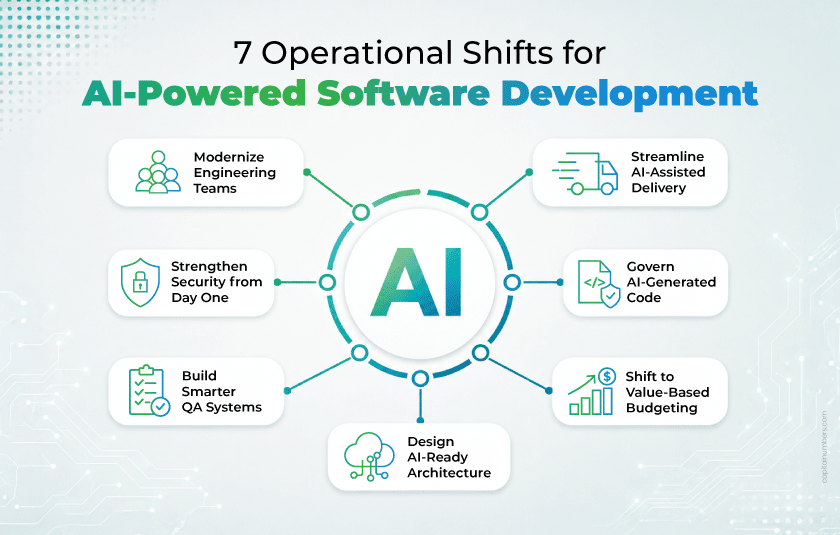
Shift 1: Rethinking the Engineering Team Model Before Adopting AI Tools
Restructuring the engineering team model before adopting AI tools leads to better delivery outcomes. AI changes the ratio of senior to junior engineers needed, reduces onboarding time, and redefines team capacity. A smaller, well-structured team using AI-powered software development can outperform a larger team that hasn’t restructured around it.
The planning question isn’t “which AI coding tool should we adopt?” It’s “what does our current team composition assume about how code gets written, and does that need to change?”
Shift 2: Restructuring Delivery Pipelines for AI-Assisted Parallel Development
Traditional delivery pipelines were built around human limitations, making sequential workflows necessary. Requirements gathering, architecture reviews, and development typically happened one after another. With AI-assisted development, these activities can often run in parallel, allowing teams to shorten delivery timelines instead of simply speeding up individual tasks.
For example, AI can generate scaffolding for data ingestion and normalization layers before API contracts are fully finalized, as long as assumptions are documented and updated as requirements evolve. This parallel approach can reduce delivery timelines by several weeks on integration-heavy projects.
Shift 3: Embedding Security Scanning Before AI Scales Code Output
Embedding security scanning at every stage of the pipeline is essential when AI increases code output velocity. Higher output means a larger surface area of vulnerability. A single endpoint scan before release isn’t enough with AI-assisted development volumes.
Security checks need to move earlier into the workflow:
- Snyk at the pull request stage
- SonarQube or Checkmarx inside CI/CD
- Dependency scanning before merge
- Security review before staging, not only before release
If the security review process was designed before the team adopted AI generation tools, it needs to be updated before scaling AI adoption, not after.
Shift 4: Redesigning Code Review Governance for AI-Generated Codebases
As AI-assisted development becomes more common, code review governance must adapt before senior engineers become the bottleneck. GitHub’s Octoverse report found that 80% of new developers use Copilot in their first week, and 43.2 million pull requests were merged per month in 2025. Code review workflows built for human-paced output were not designed for this level of volume.
Tools like CodeRabbit and GitHub’s native Copilot review analyze every pull request before a human sees it, flagging security vulnerabilities, performance anti-patterns, and logic errors. As agentic workflows enter software delivery, AI reviewers may also help triage pull requests, suggest fixes, update documentation, and route risky changes for human review. This allows senior engineers to focus on architecture and business logic rather than syntactic issues.
The governance challenge is to define which issues AI reviewers should automatically flag, which they can only recommend, and which must always be escalated to human reviewers. Those policies need to align with the organization’s stack, coding standards, and risk requirements. When configured correctly, AI review reduces review workload and improves consistency. When configured poorly, it adds process without improving code quality.
Shift 5: Building QA Infrastructure That Learns Across Release Cycles
AI-driven QA infrastructure becomes more valuable over time because it continuously learns from defects, test failures, and production issues across release cycles. This benefit is only realized when testing is treated as an ongoing capability that evolves with the product.
Machine learning makes QA in software development more adaptive by helping test suites learn from defects, failed releases, and recurring risk patterns over time. QA tools like Mabl and Testim automatically generate test cases from the codebase and learn which areas pose the highest risk of defects over time. Applitools adds visual regression detection across device and browser combinations that would take a manual QA team weeks to execute.
In regulated industries, such as healthcare platforms under NHS digital standards and fintech systems under FCA operational resilience requirements, this approach also produces a compliance audit trail that manual QA processes can’t generate at scale.
Shift 6: Moving from Fixed Cost Estimates to Value-Phased Cost Modeling
AI-assisted custom software development can reduce delivery effort and cost, but the savings are not automatic. They are most often realized when projects, including legacy system modernization or MVP development, are structured in phases rather than estimated as a single fixed scope.
Traditional cost models assume a predictable relationship between scope, engineering hours, and labor costs. AI changes that equation by affecting productivity, effort, and delivery timelines throughout the development lifecycle.
The ranges below are directional and depend on the clarity of requirements, integration complexity, compliance needs, team structure, and the maturity of the AI-assisted delivery workflow.
| Project Type | Traditional Timeline | AI-Driven Timeline | Cost Reduction |
|---|---|---|---|
| MVP / Proof of Concept | 16–24 weeks | 8–14 weeks | 25–35% |
| Mid-complexity web or mobile app | 6–10 months | 4–6 months | 25–40% |
| Enterprise platform | 12–24 months | 8–15 months | 20–35% |
| Regulated software (healthcare/fintech) | 18–30 months | 12–20 months | 20–30% |
| Legacy modernization | 18–36 months | 12–24 months | 20–35% |
Shift 7: Specifying the AI Operations Layer as a Day-One Architecture Requirement
Organizations integrating AI in custom apps should define their RAG architecture, vector database strategy, and AI observability framework from the outset. These foundational decisions affect system accuracy, performance, monitoring, and scalability. Delaying them until after launch often increases costs and creates technical debt that is difficult to unwind.
Day-one architecture for AI-enabled products should define:
- RAG framework: LangChain or LlamaIndex, depending on workflow complexity and integration needs
- Vector database: Pinecone, Milvus, or Weaviate, depending on scale, query patterns, and retrieval performance
- Observability layer: Datadog AI, New Relic AI, or Dynatrace Davis to detect anomalies before they affect users
- Model evaluation and retrieval metrics: Regular checks for hallucination, drift, failed retrieval, latency, and response consistency
- Human-in-the-loop review: Clear escalation rules for uncertain, sensitive, or high-impact AI outputs
In one AI-powered teleradiology project, Capital Numbers built a platform that processes up to 10,000 medical scans daily across CT, MRI, X-ray, ultrasound, and mammography workflows. The solution combined AI-assisted report generation with radiologist review, role-based access controls, secure cloud storage, and enterprise-grade scalability. The project reinforced that successful AI software requires more than model integration. Workflow design, human oversight, security, compliance, and operational reliability must be built into the architecture from day one.
Where AI-Driven Custom Software Development Still Goes Wrong
- Poorly defined requirements become more expensive: AI generation tools produce code. But when requirements are unclear, they may also lead to incorrect code. Projects with poorly defined scope see AI tooling accelerate the accumulation of technical debt, not eliminate it
- Governance gaps become security risks: IBM’s 2026 X-Force Threat Intelligence Index found a 44% increase in attacks exploiting public-facing applications, driven largely by missing authentication controls. Without governance frameworks covering access controls, credential hygiene, and code provenance in CI/CD pipelines, higher output velocity creates more entry points than security teams can close. Speed without governance isn’t a productivity gain but a deferred liability.
- Code review processes fail to scale: Generating code faster does not automatically improve delivery speed. Teams that adopt AI Copilot without restructuring review workflows often find that review queues absorb much of the productivity gain.
- Domain expertise remains essential: AI-driven testing can miss business-critical edge cases, especially in industries such as healthcare, insurance, and finance. Human reviewers with domain knowledge must remain part of the quality assurance process.
- ROI takes time: AI tools need time to learn a codebase, security controls require tuning, and test suites become more effective as they accumulate data. Organizations that expect immediate productivity gains often overlook the setup and calibration period required to realize long-term value.
Conclusion
AI is fundamentally changing custom software development, but the benefits do not appear automatically. The organizations seeing the biggest gains have restructured how they build software, not simply adopted new tools. That applies both to internal teams and the development partners they work with.
Before launching an AI-assisted project, evaluate readiness from both perspectives. Internally, are the requirements clear enough to prevent AI from amplifying ambiguity? Have security, governance, and review processes been updated for AI-generated code? Externally, has your development partner redesigned its delivery model around AI, or merely added AI tools to a traditional workflow?
FAQs
1. What does AI-driven custom software development mean?
AI-driven custom software development means using AI across the software delivery lifecycle, including requirements analysis, architecture planning, code generation, testing, security review, deployment, and monitoring. It is different from simply adding an AI feature to a product because it changes how the software is built and maintained.
2. How does AI-driven development affect project timelines?
AI-driven development can shorten project timelines when teams restructure the delivery process around AI rather than just adding coding tools. The biggest gains usually come from faster scaffolding, earlier testing, automated documentation, and parallel workflows across planning, development, security, and QA.
3. Does AI-generated code increase security risk?
It can, if security checks are not embedded into the development pipeline. Higher code output increases the volume of code that must be reviewed. Teams need pull request scanning, CI/CD security checks, dependency scanning, and human review for high-risk changes.
4. How much does AI-driven custom software development cost?
The cost depends on scope, data readiness, integrations, security requirements, compliance needs, and delivery model. AI-driven development can reduce effort in areas such as boilerplate coding, testing, documentation, and defect detection, but full-project savings depend on how well the work is phased and governed.
5. What should businesses prepare before starting an AI-driven software project?
Businesses should prepare clear requirements, documented assumptions, access rules, security expectations, integration details, and review workflows. If the project includes AI-powered features, it should also define early requirements for data quality, human review, observability, and model evaluation.
6. How do you measure whether AI is improving software delivery?
Businesses can measure delivery velocity, review cycle time, defect escape rate, security issues, post-launch incidents, and cost per release. Faster coding alone is not enough if review queues, defects, or post-launch incidents increase.


 Web Development
 Cloud Engineering
 Mobile App Development
 AI/ML/GenAI
 E-commerce
 Software Development
 UI/UX
UI/UX QA
QA Dedicated Teams