
How to Build an Enterprise AI Roadmap: A Step-by-Step Guide for Business Leaders
Table of Contents
Quick Summary
Most enterprises investing in AI aren’t failing because they chose the wrong tools. They’re failing because they started in the wrong order. Only 1% of business leaders say their companies are mature in AI deployment – not because AI doesn’t work, but because pilots launch before data is ready, governance gets added after problems appear, and scaling begins before anyone has proven value. An enterprise AI roadmap fixes the sequence. This guide walks through six steps – from readiness assessment and use-case selection to pilot delivery and scaling – so AI investment moves from planning to measurable business outcomes.
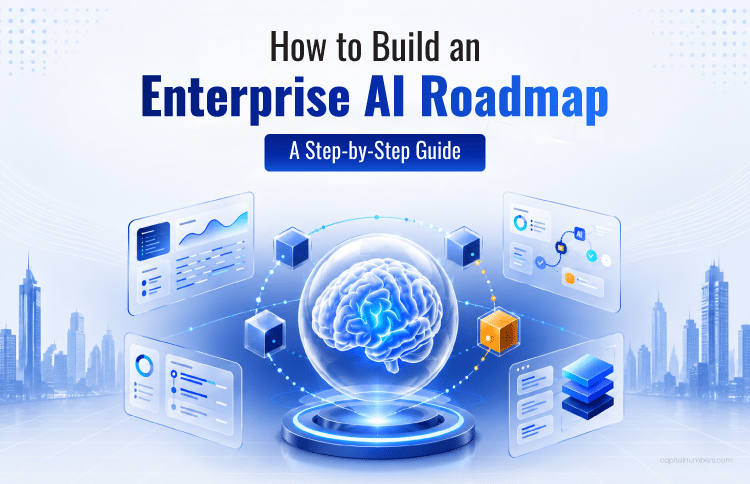
An enterprise AI roadmap helps businesses move from AI ideas to production-ready outcomes. It helps leaders identify AI opportunities, prepare the right foundations, manage risks, and move successful pilots into production.
Many AI projects fail because teams choose tools over outcomes, launch pilots before data is ready, or scale before governance is in place. This guide helps business leaders get the sequence right, so AI investment turns into practical, measurable business value.
What Is an Enterprise AI Roadmap?
An enterprise AI roadmap is a structured, phased plan that aligns AI initiatives with business outcomes, defines the sequence from readiness through scaling, and sets governance expectations before implementation begins. It is not a list of AI tools to adopt or a technology migration plan. It is a sequencing document that sits atop the broader enterprise AI development effort, determining the order in which the work is done.
That last part matters. The organization that gets AI into production is not always using more advanced models than those stuck in pilot. They are often doing things in the right order.
McKinsey & Company’s 2025 research shows that nearly all companies are investing in AI, yet only 1% of leaders say their companies are mature in AI deployment. The gap between investment and maturity is often a planning and sequencing problem.
A well-built roadmap gives you four things:
- Use-case clarity: which problems to solve, and in what order
- Infrastructure logic: what needs to be in place before pilots begin
- Governance foundations: built before deployment, not added after issues appear
- Shared direction: a common language between business and technical teams when priorities, risks, and trade-offs need to be decided
4 Questions to Ask Before Building an Enterprise AI Roadmap
The organizations that struggle most with enterprise AI roadmaps are not always short on ambition. More often than not, they move too quickly into use cases, tools, or pilots without first asking four questions.
1. Do you have a named business problem — or just interest in AI?”
AI should solve specific, costly business problems, such as slow decisions, expensive manual processes, poor forecasting, customer service delays, or high error rates. If the starting point is “we should do more with AI,” the problem is still too broad.
Scope definition should come before tool selection. CXOs need to know which business outcome AI is expected to improve before deciding which AI model, platform, or vendor to use.
2. Is your data ready for AI?
AI roadmap planning depends heavily on data readiness. Enterprise AI needs data that is accurate, accessible, governed, and usable across the right systems.
IBM’s 2025 CDO study found that only 26% of Chief Data Officers are confident their data capabilities can support new AI-enabled revenue streams. For many enterprises, that is a serious AI readiness gap.
Unstructured, siloed, duplicated, or poorly governed data should be flagged before scoping AI use cases. If these issues are discovered mid-pilot, the project often slows down, costs more, or fails to scale.
3. Is there a named executive sponsor with budget authority?
An enterprise AI roadmap needs a senior sponsor who can make decisions, protect the budget, and bring business, data, security, legal, and IT teams together.
Without this sponsor, AI projects can slow down when decisions are needed around governance, integration, or ownership.
4. What AI capabilities exist internally, and where are the gaps?
Before building the roadmap, leaders should know what AI skills already exist and where support is needed, such as data, cloud, MLOps, governance, security, or training.
This assessment helps determine what should be handled internally and where AI consulting services can provide specialized expertise, accelerate planning, and reduce execution risk.
How Do You Build an Enterprise AI Roadmap Step-by-Step?
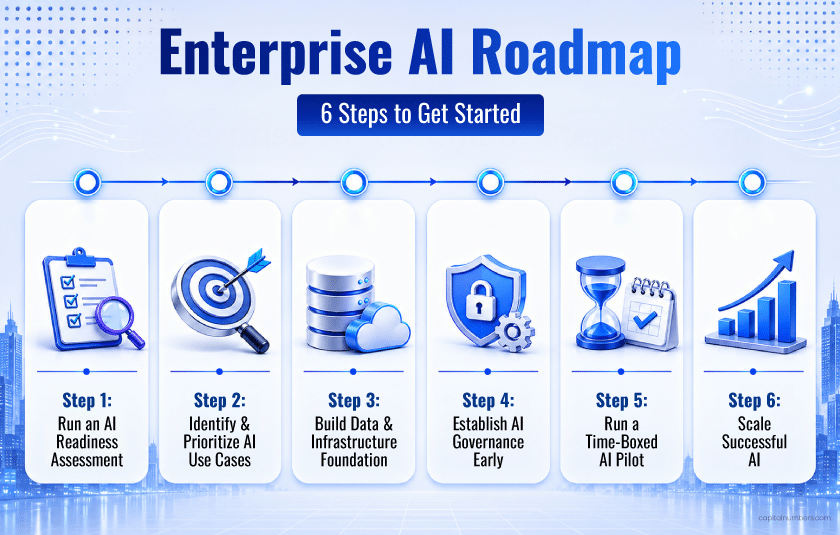
An enterprise AI roadmap should follow a clear sequence. Start by checking readiness, then choose the right use cases, prepare the data and technology foundation, set governance, test with a focused pilot, and scale what works. This helps leaders avoid scattered experiments and move AI toward real business value.
Step 1: Run an AI Readiness Assessment
An AI readiness assessment tells leadership what the organization can actually support right now — not what teams assume is ready. Without it, AI projects are scoped against an imagined baseline rather than a real one, and the gaps surface mid-pilot when delays and costs are harder to control.
A proper assessment covers five areas: business alignment, data maturity, technology stack, talent gaps, and governance posture. It should include stakeholder interviews, a data quality review, and a current-state systems assessment. It is not a one-day workshop, and it should not be treated like one.
The output is a readiness scorecard. It tells leadership what can support AI now, what needs to be fixed first, and which use cases should wait until the foundation is stronger. Organizations that skip this step usually find the same issues later, often mid-pilot, when delays and costs are harder to control.
| Dimension | What to Assess | Red Flags |
|---|---|---|
| Business Alignment | Are AI initiatives tied to clear business problems and measurable outcomes? | No sponsor, success metric, or business owner |
| Data Maturity | Data quality, completeness, governance, and accessibility across key systems | Siloed data, unclear ownership, poor data quality |
| Technology Stack | Cloud infrastructure, integration capability, APIs, and existing AI/ML tooling | No API layer, fragmented systems, and limited cloud readiness |
| Talent and Skills | Internal skills across data engineering, ML, governance, and change management | No clear AI ownership, limited data skills, and reactive change management |
| Governance Posture | Policies for data privacy, model risk, AI ethics, and compliance | No AI policy, unclear GDPR position, no audit trail |
Step 2: Identify and Prioritize AI Use Cases
The right AI use cases are identified by scoring business impact against delivery feasibility, not by brainstorming the most technically interesting ideas. High-impact, high-feasibility cases go first. Everything else gets sequenced for later or dropped entirely.
Score each candidate on two simple factors: business impact (cost reduction, revenue generation, risk reduction) against feasibility (data availability, integration complexity, change management effort). High-impact and high-feasibility cases go first. High-impact but complex cases get sequenced for later cycles once the infrastructure is proven. Low-impact cases get dropped, however technically interesting they might be.
The output of this step is a prioritized portfolio of three to five use cases for the first cycle. Not twenty experiments running at once. A focused set of bets with clear success criteria attached to each one.
Sequence quick wins early. Organizational confidence in the program matters as much as technical delivery in the first cycle. If the first twelve months produce nothing visible, the roadmap loses sponsorship. That is a political reality worth planning around.
Capital Numbers Insight: In our AI consulting engagements, the workshops that produce the sharpest shortlists are the ones where a P&L owner is scoring rather than just observing. When the person accountable for the outcome has a vote, the list of twenty candidates gets to five and stays there. When a central technology team drives it, it tends to grow back.
Step 3: Build Your Data and Infrastructure Foundation
AI pilots fail in production, not in demos — when the data and infrastructure foundation isn’t ready. Connecting systems, cleaning pipelines, defining ownership, and preparing MLOps practices before the first pilot launches is what separates a demo that works from a deployment that holds.
But without the right foundation, AI pilots often work only in demos and fail when connected to real business systems. Gartner predicts that through 2026, organizations will abandon 60% of AI projects that are not supported by AI-ready data.
At this stage, the work includes:
- Connecting data across ERP, CRM, and operational systems
- Building clean and governed data pipelines
- Defining clear data ownership
- Setting up cloud or hybrid infrastructure for AI workloads
- Preparing MLOps practices for deployment, monitoring, and model updates
For practical GenAI use cases for enterprise teams, this foundation may also include vector databases, RAG pipelines, enterprise search, API orchestration, prompt/version management, and observability tools. These capabilities help AI systems use the right business context, connect with daily workflows, and stay monitored after deployment.
MLOps should not be added after a pilot succeeds. It is easier and safer to prepare production standards early than to fix them later when the system is already live.
Step 4: Establish AI Governance Early
AI governance defines who owns the system, what data it can access, which decisions need human approval, and how risks will be monitored. It should be planned before the first pilot goes live. If it is added later, the project can slow down when legal, security, risk, and IT teams review data access, approvals, compliance, and responsible AI deployment practices.
A simple AI governance model should define:
- Who owns the AI system
- What data can the AI access
- Which decisions need human review
- How risks, bias, errors, and ethical concerns will be monitored
- What approval process is needed before production
If your roadmap includes intelligent agents that can query data, trigger actions, update records, or hand off tasks across business systems, governance should clearly define what AI can do on its own and when a human must approve the action.
For companies working in or serving the EU, the EU AI Act also matters. It classifies AI systems by risk level, so leaders should know whether a use case is low-, limited-, or high-risk before development begins.
Governance is not extra paperwork. It helps AI move from pilot to production safely and responsibly.
Step 5: Run a Time-Boxed AI Pilot
A pilot tests whether AI creates measurable business value when real users apply it to real data in a real workflow, not whether the model works technically. That distinction is what separates a pilot from a proof of concept, and getting it wrong is one of the most common reasons AI projects stall before production.
| Area | Proof of Concept | Pilot |
|---|---|---|
| Purpose | Tests technical feasibility | Tests business value |
| Data Used | Sample or synthetic data | Real business data |
| Users | Technical or internal team | Real users from the target team |
| Success Criteria | Does the model or approach work? | Does it improve a business outcome? |
| Output | Technical validation and recommendations | ROI signal, integration needs, and user feedback |
| Typical Duration | 2–6 weeks | 60–90 days |
Before the pilot starts, set baseline metrics. Then measure progress at 30, 60, and 90 days. The 90-day mark helps you understand whether the pilot is moving in the right direction. For complex workflows, full ROI may take longer, so avoid judging too early.
A well-run AI pilot should produce four clear outputs:
- A working solution in a real workflow
- A confirmed or rejected ROI hypothesis
- A list of integration needs for full deployment
- Adoption feedback from the team using it
Capital Numbers Example: In a recent AI consulting engagement with a mid-market operations-led business, our team helped narrow a broad “add AI across systems” request into a single measurable pilot focused on manual document review and response preparation. By testing it with real business data, approval rules, and human review, the client reduced manual effort, improved response consistency, and identified the integration work needed before the production rollout. The takeaway: AI delivers greater value when it starts with a single focused workflow, demonstrates impact, and then scales carefully.
Step 6: Scale What Works
Scaling AI requires a clear operating model that assigns ownership, defines MLOps practices, manages change, enforces governance, and tracks business performance, because getting a pilot into production and scaling it across the business are two entirely different challenges.
To scale successfully, you need a clear operating model that covers:
- Ownership: Who is responsible for the AI system after launch
- MLOps: How the model will be deployed, monitored, updated, and improved
- Change management: How business teams will adopt the new workflow
- Governance: What standards, approvals, and risk controls must be followed
- Performance tracking: How business and technical results will be measured
A practical model is to keep governance, standards, and tools centralized, while business units own the use cases they understand best. This prevents two common problems: every team building AI differently, or every decision getting stuck with one central team.
Leaders should also track business KPIs. Useful metrics include:
- Cost savings
- Productivity gains
- Revenue impact
- Error reduction
- Customer experience improvement
- Model drift or performance decline
Many organizations support this through an AI Center of Excellence. This is a small central team that manages standards, governance, and tooling, while business teams lead use-case delivery.
Capital Numbers Insight: The scaling failures we see most often are not model problems or data problems. They are ownership problems. A pilot succeeds, the team moves on, and nobody can answer who is responsible for retraining or monitoring. The organizations that scale reliably assign a named business owner to each use case before the pilot launches.
How Does a Realistic Enterprise AI Roadmap Timeline Look?
A realistic enterprise AI roadmap usually moves in three phases: readiness, foundation, and scaling. The exact timeline depends on data maturity, system complexity, governance needs, and how many teams are involved.
| Timeline | Focus | Key Activities |
|---|---|---|
| Months 0–3 | Readiness and prioritization | Assess data, systems, governance, skills, and shortlist use cases |
| Months 3–9 | Foundation and pilots | Build data/infrastructure foundations, launch governance, run 1–2 pilots |
| Months 9–18 | Production and scaling | Move validated use cases into production, monitor performance, improve adoption, and scale what works |
Enterprise AI Roadmap Mistakes to Avoid
The biggest mistakes in enterprise AI roadmaps happen when teams move too fast without the right order. Business leaders should avoid choosing tools too early, skipping data readiness, adding governance late, running too many pilots, and measuring only technical performance.
- Starting with tools, not business problems: Choose AI tools only after you know what problem you want to solve and what outcome you expect.
- Skipping data readiness: AI needs clean, accessible, and governed data. If the data foundation is weak, pilots may fail when connected to real systems.
- Adding governance too late: Data access, human review, compliance, AI ethics, and risk controls should be planned before deployment.
- Running too many pilots at once: Start with a few high-value use cases instead of many disconnected experiments.
- Measuring only model performance: Accuracy matters, but business impact matters more. Track cost savings, productivity, revenue, risk reduction, or customer experience improvement.
Turn Your AI Roadmap Into Business Value
An enterprise AI roadmap should help leaders make better decisions about where AI belongs, what should come first, and how to move from pilots to real business impact.
Start with one clear goal. Then build the right sequence around it: readiness, use-case selection, data, governance, pilot delivery, and scaling. This gives AI a practical path from idea to production.
Work with Capital Numbers Capital Numbers helps businesses move from AI planning to execution. We assess readiness, identify high-value use cases, plan the right foundation, and support implementation from pilot to scale. Schedule a discovery call →
Frequently Asked Questions
1. How long does it take to build an enterprise AI roadmap?
Most enterprise AI roadmaps take four to eight weeks to create. The full journey from planning to production can take 12 to 18 months, depending on data readiness, governance, system complexity, and the number of teams involved.
2. What is the difference between an AI roadmap and an AI strategy?
An AI strategy explains why your business wants to use AI and what outcomes you want to achieve. An AI roadmap explains how to get there. It shows the right order of steps, from readiness and use-case selection to pilots, governance, and scaling.
3. How do you prioritize AI use cases?
Start with business value and feasibility. The best AI use cases usually solve a real problem, have available data, carry manageable risk, and can show measurable value. At Capital Numbers, we help teams shortlist use cases that are practical, not just exciting on paper.
4. Do you need a dedicated AI team to build an enterprise AI roadmap?
Not always. Many companies start with a small group that includes a business sponsor, data lead, technology owner, and AI consulting partner. A dedicated AI team or AI Center of Excellence becomes more useful later, when you start scaling AI across departments.
5. Why do most enterprise AI pilots fail to reach production?
Many AI pilots fail because they start before the data, governance, integration, and ownership are ready. Some work technically but do not improve a real business outcome. A strong roadmap helps avoid this by choosing the right use cases, setting clear success metrics, and preparing the foundation before scaling.


 Web Development
 Cloud Engineering
 Mobile App Development
 AI/ML/GenAI
 E-commerce
 Software Development
 UI/UX
UI/UX QA
QA Dedicated Teams