
Staff Augmentation vs Dedicated Teams vs Agile Pods (2026)
Table of Contents
Quick Summary
Most offshore projects slow down not because the talent is wrong, but because the team structure is. This blog breaks down the three dominant outsourcing models – staff augmentation, dedicated teams, and Agile Pods – explaining what each one delivers, where each one breaks down, and how to choose the right fit before the first sprint locks you in.
You can hire the right people and still build the wrong team.
Three months into a new offshore engagement, something familiar happens. The team is capable. The status reports are green. And yet delivery is slipping, decisions are stalling, and your managers are spending their mornings chasing updates instead of moving the product forward. The talent was never the problem. The structure was.
Deloitte’s 2024 Global Outsourcing Survey found that the biggest outsourcing challenges are internal: 55% of executives cite a lack of benefit realization tracking and reporting, and 70% admit their vendor management function is not fully mature. [1] That matters even more now, as AI-assisted development speeds up output and puts more pressure on review, testing, and release decisions. When the delivery structure is weak, faster output does not help much. It simply exposes bottlenecks sooner.
The three models differ primarily in accountability: staff augmentation keeps control with your internal team, dedicated teams share it, and Agile Pods vest it in the pod itself. This blog breaks down offshore software development engagement models, including staff augmentation, dedicated teams, and Agile Pods – what each one actually delivers, where each one breaks down, and how to choose before the first sprint locks you in.
Staff Augmentation, Dedicated Teams, and Agile Pods at a Glance
Before comparing outsourcing engagement models, it helps to be precise. These three models get mixed up in vendor conversations all the time – sometimes by accident, sometimes not.
-
What is Staff Augmentation?
Staff augmentation brings individual external specialists into your existing team. They work under your direction, follow your processes, and stay on the vendor’s payroll. Think of it as adding seats to a table you are already running. -
What is a Dedicated Development Team?
A dedicated development team goes a step further. Instead of individual contributors, you get a fully assembled, cross-functional group – developers, QA engineers, a project manager – working exclusively on your product over the long term. They are not a short-term fix. They are meant to feel like part of the company. -
What is an Agile Pod?
An agile pod is the most self-contained of the three. A pod is a compact, autonomous unit – typically five to nine people – built around a specific product area or business outcome. With built-in roles like a product owner, scrum master, and engineers, it is designed to move fast and own its results end to end, without depending on your internal structure to keep it organized.
The distinction matters because each model creates a different accountability structure to enhance the development process. Choosing the wrong software development engagement model does not just slow you down; it quietly shifts ownership in ways that are genuinely hard to reverse once a project is mid-flight.
⚠️The model you choose does not just affect speed — it determines who is accountable when delivery drifts.
Staff Augmentation: The Right Call When Structure Is Already in Place
Sometimes you do not need a whole new team. You just need the right person in the right place, quickly.
Staff augmentation works when your internal delivery structure is already functioning, and the gap is specific – a missing skill, a short surge in workload, a niche capability your team does not carry in-house. It is the right fit when your internal team already owns planning and quality oversight, and the engagement is time-bound and skill-specific.
Experis’ Q2 2026 Tech Talent Outlook found that 74% of Tech & IT Services employers report talent shortages, showing that businesses are still struggling to find both strong technical talent and critical AI capabilities. [2]
For businesses in the US and Western Europe, staff augmentation is a practical way to bring in niche skills like AI/ML, DevSecOps, and cloud-native development without the delay of a full hire. For businesses in the Middle East, it can also be a useful way to access specialized talent while local talent pipelines continue to grow.
Where it falls short: The hidden cost of staff augmentation is coordination. When your internal managers are spending hours each week directing, briefing, and realigning external contributors, that time has real value, even when it never shows up on an invoice. If your team lacks the structure or bandwidth to integrate outside contributors smoothly, you end up with more people and less progress. If you are already working through the challenge of managing an offshore development team, adding augmented staff without a clear integration plan only compounds it.
Dedicated Teams: Built for Depth, Not for Pivoting
Dedicated teams are built for the long game. If your product roadmap spans multiple quarters and you need a group that grows with the product – learning its architecture, quirks, and business logic over time – this model is worth the commitment.
This model for outsourcing engagement works best when your roadmap is stable, the scope is broadly defined but unlikely to shift dramatically, and you want delivery accountability shared at the team level rather than sitting entirely with your own leadership.
For European businesses managing complex platform environments, dedicated teams from the right development partner offer the stability needed to build compliance, auditability, and architectural consistency into daily work. This is especially important as GDPR enforcement tightens and the EU AI Act introduces new auditability requirements for AI-generated code.
Where it falls short: Dedicated teams are optimized for consistency, not for turning on a dime. When product direction changes sharply, the team composition often cannot keep pace. If you are in a period of strategic pivoting and still paying for a fixed team built around an earlier direction, that gap quietly drains value without anyone raising a flag.
When Are Agile Pods the Right Choice
Here is what most teams discover too late: the block is not headcount. It is how work moves or fails to move between people.
Agile Pods were designed for exactly this problem. Not a shortage of developers, but a breakdown in flow: too many handoffs, unclear ownership, review queues that take days, and coordination overhead that nobody signed up for but everyone is managing.
A typical pod contains a front-end developer, a back-end developer, a QA engineer, and a UI/UX specialist. DevOps or cloud support and a delivery coordinator come in when the workload calls for it. The team is small on purpose. And the defining feature is not the headcount; it is that everyone in the pod owns the outcome, not just their piece of it.
This outsourcing engagement model is the right fit when delivery is slowing due to fragmented ownership, priorities shift faster than your current structure can adapt, or you need parallel workstreams running independently without creating bottlenecks. Agile Pods are not the default answer for every business. If the work is clearly scoped, internally managed, and skill-specific, staff augmentation may still be the leaner option.
Why this matters more in 2026: GitHub’s Octoverse 2024 report recorded a 59% year-on-year surge in generative AI project contributions, with AI copilots now embedded in most professional development environments. [3] More code is being produced in less time — which only helps if your team can review, test, and ship at the same pace. Agile Pods are built for that reality. Fragmented team structures are not.
The regional compliance context for Gulf markets is covered in the AI section below, which connects directly to the governance argument.
The Real Cost Is What Doesn’t Appear on the Invoice
Rate-per-role comparisons make for clean spreadsheets. They also make poor decisions.
The number that actually matters is the total cost of delivery, and that includes things that never appear on a proposal: hours your team spends coordinating, features that get rebuilt because ownership was unclear, and releases that slip because handoffs broke down. Those costs are real. They just get absorbed quietly, rather than showing up on an invoice.
The model that looks cheapest today is often the most expensive at the six-month mark. Management overhead, rework, and delayed releases are real costs; they just never appear on a vendor invoice.
| Cost Factor | Staff Augmentation | Dedicated Teams | Agile Pods |
|---|---|---|---|
| Direct team cost | Lower per role | Moderate, fixed | Higher per unit |
| Management overhead | High | Medium | Low to medium |
| Cost of rework | Higher (unclear ownership) | Medium | Lower (accountability built in) |
| Cost of slower releases | Variable | Low (stable teams) | Lowest |
| Cost of coordination gaps | High in fragmented setups | Medium | Lowest |
Source note: Cost comparisons reflect typical patterns observed across engagement structures. Actual costs vary by team size, project complexity, and internal management capacity.
In simple terms, an Agile Pod may cost more upfront but still cost less overall if it helps you ship faster, reduce rework, and improve release confidence. But if the work is well-defined and your internal team already manages delivery well, staff augmentation can still be the more efficient choice.
Staff Augmentation vs Dedicated Teams vs Agile Pods: Key Differences
| Aspects | Staff Augmentation | Dedicated Teams | Agile Pods |
|---|---|---|---|
| Best for | Closing specific skill gaps quickly | Long-term, stable product development | Fast-moving products need speed and clear ownership |
| Who drives daily work | Your internal managers | Shared between client and team leads | The pod, with outcome-level accountability |
| Management effort | High | Medium | Medium to low |
| Flexibility | High at the role level | Moderate | High at the delivery level |
| AI-assisted development fit | Good where internal processes are already strong | Good for stable, ongoing work | Strong — built for high output with review discipline |
Which Offshore Development Model Is Right for You?
| Business Pain Point | Best-Fit Model |
|---|---|
| Need skilled talent fast | Staff Augmentation |
| Stable roadmap, limited internal capacity | Dedicated Teams |
| Too many handoffs are slowing progress | Agile Pods |
| Delivery lacks clear ownership | Agile Pods |
| Multiple workstreams need to run in parallel | Agile Pods |
| AI-assisted work is increasing review pressure | Agile Pods |
| Scaling the team is adding complexity, not speed | Agile Pods |
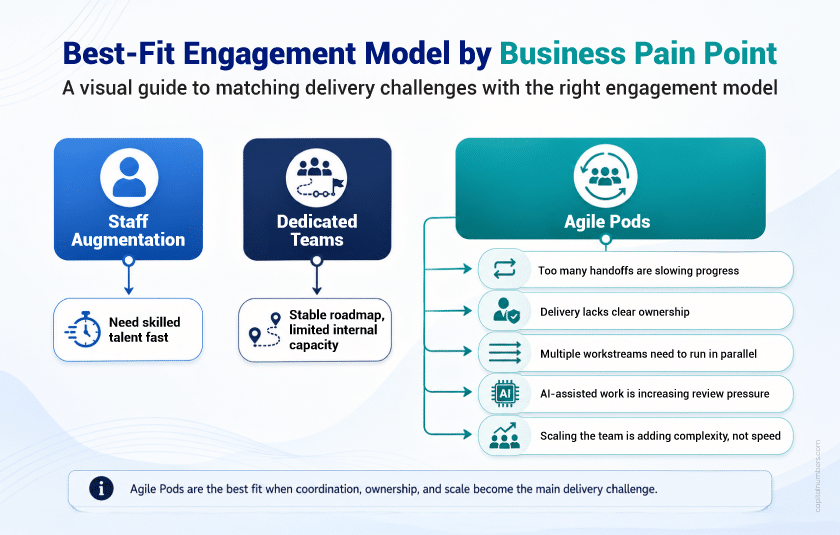
This table is only a guide. Agile Pods work best when coordination and ownership are the main challenge, while staff augmentation or dedicated teams may be better for simpler or more stable work.
How AI Is Changing Offshore Software Development Models
AI-assisted development is no longer an edge practice; it is mainstream. GitHub Copilot reports that developers completed tasks 55.8% faster in a controlled experiment. [4] But faster output does not automatically mean faster delivery. It means more code arriving at review, testing, and integration — faster. If the team structure creates a bottleneck at any of those stages, AI tools do not fix the problem. They just reveal it sooner. The challenge is no longer just writing code faster. It is governing how that code is reviewed, approved, and moved into release without creating quality or compliance gaps.
Agile Pods handle this more naturally. The QA role, the delivery coordinator, and the shared ownership model are designed to absorb higher output without sacrificing quality at the edges. That becomes even more important in delivery environments shaped by automation, AI-assisted workflows, and higher release frequency.
For businesses in regulated industries — financial services in the City of London, healthcare technology in Germany, financial infrastructure in the UAE — there is also a compliance dimension. AI-generated code carries auditability requirements, and the engagement model needs to account for that. Choosing a structure that does not, is not just a quality risk. In some markets, it is a regulatory one.
Five Questions to Answer Before the First Sprint Locks You In
Before committing to a software development engagement model, it is worth sitting with these questions honestly, but as a way to surface what your organization actually needs right now:
- Who owns delivery outcomes — your internal team, the vendor team lead, or a shared structure?
- How much internal management bandwidth do you realistically have to direct this engagement?
- How stable is your roadmap over the next six to twelve months?
- What does a delayed release actually costyour business?
- How is AI usage governed within your vendor’s team — and does their review process hold up against your quality and compliance standards?
If your answers point to strong internal capacity, a clearly scoped deliverable, and a stable roadmap, staff augmentation or a dedicated team will likely serve you well. If priorities are shifting, internal oversight is stretched, or you need to tighten release cycles, an Agile Pod is almost always the stronger call.
Final Word: The Model Is Part of the Outcome
Choosing between staff augmentation, dedicated teams, and agile pods is not a formality you handle after the real decisions are made. It shapes how fast your organization moves, how much your partners own, and how much friction your internal teams are quietly absorbing every sprint.
The organizations that consistently get more from their offshore partnerships are not always working with more talented teams. They are working with better-structured ones. The right model, with clear ownership and genuine delivery accountability, is what separates an offshore engagement that compounds in value from one that slowly drains it.
Work with Capital Numbers Capital Numbers helps businesses across the US, Europe, and the Middle East structure offshore engagement models that deliver on the roadmap, not just on paper. Whether you need targeted skill augmentation, a long-term dedicated team, or a focused Agile Pod with full delivery accountability, we build engagements around your business goals and your team’s real capacity. Schedule a discovery call →
Frequently Asked Questions
1. Can a business switch engagement models mid-project?
Yes — it is more common than most expect. A good delivery partner manages that transition without requiring you to restart or lose work already completed.
2. Can an Agile Pod work alongside an existing internal team?
Yes. Pods own a defined scope and complement internal teams without requiring deep integration. The pod handles its area; your team focuses elsewhere.
3. Is staff augmentation suitable for startups?
Only if internal delivery leadership is already in place. Without it, adding contributors to an underdefined structure increases confusion rather than capacity. An Agile Pod is usually the better starting point.
4. Are Agile Pods better than staff augmentation?
Not always. Staff augmentation works best when your team already manages delivery well and just needs extra skills or support. Agile Pods are often a better fit when the bigger problem is coordination, ownership, or speed. The right choice depends on whether you need extra people or a better way to deliver work.
5. Which engagement model is most cost-effective?
It depends on the work. Staff augmentation is often cost-effective for specific skill gaps; dedicated teams work well for stable, long-term delivery; and Agile Pods can deliver greater value when speed, coordination, and reduced rework matter most.
References
| 1. | Deloitte — 2024 Global Outsourcing Survey: https://www.deloitte.com/us/en/services/consulting/articles/global-outsourcing-survey.html |
| 2. | Experis — Q2 2026 Tech Talent Outlook: https://www.experis.com/-/media/project/manpowergroup/experis/experis-us/documents/experis-us-tech-talent-outlook-q2_26-report.pdf |
| 3. | GitHub — Octoverse 2024: AI leads Python to top language as the number of global developers surges:https://github.blog/news-insights/octoverse/octoverse-2024/ |
| 4. | Microsoft Research — The Impact of AI on Developer Productivity: Evidence from GitHub Copilot: https://www.microsoft.com/en-us/research/publication/the-impact-of-ai-on-developer-productivity-evidence-from-github-copilot/ |


 Web Development
 Cloud Engineering
 Mobile App Development
 AI/ML/GenAI
 E-commerce
 Software Development
 UI/UX
UI/UX QA
QA Dedicated Teams