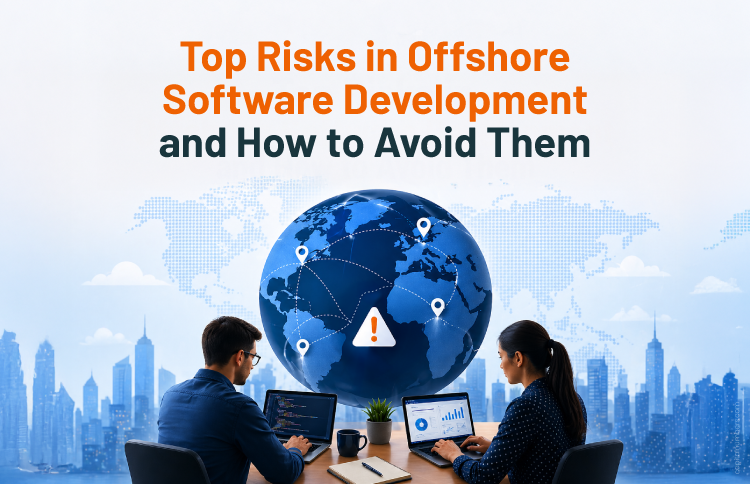
Top Risks in Offshore Software Development and How to Avoid Them
Table of Contents
Quick Summary
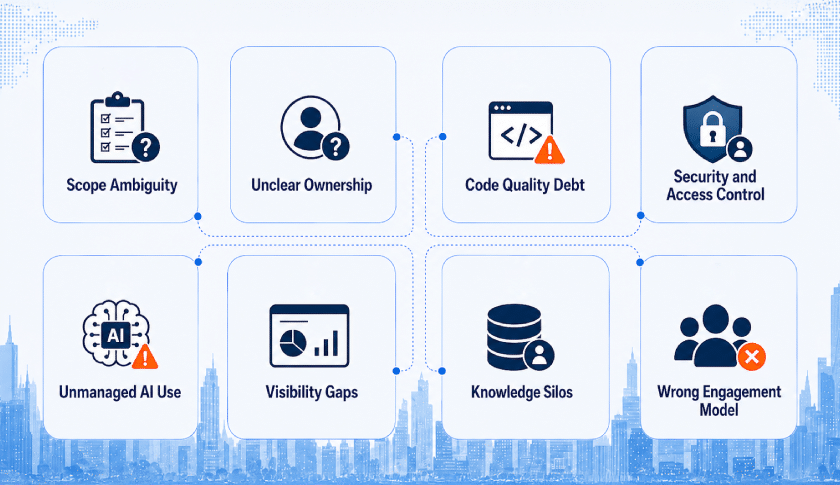
Most offshore projects don’t fail because of weak technical skills. They fail because of unclear ownership, poor governance, and gaps that are easy to ignore early and expensive to fix late. In 2026, the risk landscape has also expanded: AI-assisted development, tighter security requirements, and more connected delivery environments have raised the stakes considerably. This article outlines the eight most critical offshore software development risks — with evidence, regional context, and practical frameworks business leaders need to act on them.
Most Offshore Projects Don’t Fail on Day One. They Fail Slowly.
According to McKinsey, 70% of large-scale technology programs fail to meet their objectives — and a significant share of those failures trace back not to the offshore model itself, but to how it was governed. [1] Poor requirements, unclear ownership, and weak delivery structures are consistently at the root.
The software development outsourcing landscape in 2026 has shifted considerably. Offshore teams are no longer judged on cost and speed alone. They are expected to govern AI usage, meet tighter security standards, integrate into more complex delivery environments, and demonstrate consistent, measurable progress.
At the same time, the work itself has become more demanding. Offshore teams may be supporting AI agents, RAG-based internal knowledge workflows, cloud platforms, automation pipelines, and multiple system integrations. That creates more moving parts and review points, and a greater need for clear accountability.
This is where outsourcing risk starts to show up. And it is also where more careful business leaders separate themselves by asking better questions, setting clearer expectations, and choosing partners with stronger delivery discipline.
1. Scope Ambiguity: The Most Expensive Assumption in Software Delivery
Every feature looks straightforward at the concept stage. The real complexity lives in the business rules, user roles, integration points, and edge cases that only surface during development.
When these are not documented before work begins, teams fill the gaps with assumptions. Those assumptions lead to rework. And the further into the development lifecycle a problem is found, the more expensive it becomes to fix – revisiting both architecture and tested code compounds the cost far beyond the original oversight. For businesses, this means slower releases, higher delivery costs, and lower confidence in timelines.
What good looks like: Break requirements into small, testable units before a single line of code is written. Define acceptance criteria that product, engineering, and QA teams can interpret consistently. A structured discovery sprint is not overhead — it is insurance.
2. Unclear Ownership Stalls Decision-Making at the Worst Possible Time
In offshore engagements, decisions that take hours in a co-located team can take days when ownership is ambiguous. Developers either wait for clarification or move forward on assumptions. Work continues to appear on status reports, but actual progress slows.
This is one of the most underestimated challenges for organizations in the US and Europe, managing offshore development teams across multiple time zones, where a delayed decision at 9 AM local time may not surface until the following morning. Over time, this affects sprint predictability, slows release planning, and increases management overhead on both sides.
What good looks like: Assign a named product owner to requirements and priorities, and a delivery lead to execution. Define escalation paths in writing before the project starts, and log all significant decisions in a shared system — not in meeting notes or email threads.
3. Code Quality Debt: The Problem That Compounds Quietly
A team can deliver quickly in the early sprints and still be building a problem that slows everything down six months later. Without consistent code reviews, automated testing, and clear engineering standards, quality debt accumulates — and teams eventually spend more time fixing old issues than building new functionality.
In 2026, this risk escalates faster. The growing role of AI in software development means developer copilots and AI-generated code can accelerate output significantly, but without strong review practices, they also accelerate the accumulation of inconsistent logic, missed edge cases, and hidden technical debt. The same applies when teams depend on AI-assisted testing, automation workflows, or shared delivery tooling without enough release discipline.
What good looks like: Treat quality as part of daily delivery, not a phase at the end. Insist on coding standards, peer review, and automated test coverage for core flows from the first sprint — not after problems appear.
4. Security and Access Control: A Risk That Regulators Are Watching
Offshore teams require access to code repositories, databases, and deployment environments. Without proper governance, this creates exposure through broad permissions, shared credentials, and limited audit trails.
The financial stakes are significant. IBM’s 2024 Cost of a Data Breach Report puts the average global breach cost at $4.88 million — a 10% jump from the prior year — with third-party access consistently ranking among the top attack vectors. [2]
For businesses operating in Europe, this is not only a security issue — it is a compliance one. GDPR mandates that personal data accessed by offshore teams must be governed under strict data processing agreements. Enforcement is active and growing: a single 2023 ruling resulted in a €1.2 billion fine. [3]
In the Middle East, data residency requirements are tightening rapidly. The UAE’s Federal Decree-Law No. 45 of 2021 and Saudi Arabia’s Personal Data Protection Law both impose obligations on how personal data is processed by external parties. Businesses in these markets need explicit confirmation of where data is stored, who has access, and how access is logged.
In 2026, security risk also includes auditability, approval controls, and release governance across connected environments. When offshore teams work across cloud infrastructure, AI services, APIs, and internal systems, weak access design can affect not just security posture but compliance readiness and delivery trust.
What good looks like: Role-based access controls. Restricted production access. Credentials managed through vaults, not shared accounts. Every access event is logged and auditable. SOC2 Type II and ISO 27001 certifications from your partner are minimum expectations, not differentiators.
5. Unmanaged AI Use: The Newest Governance Gap in Offshore Delivery
AI-assisted development is now standard practice. GitHub’s 2024 Octoverse Report recorded a 59% surge in contributions to generative AI projects year-on-year, with a 98% increase in new AI projects on the platform. [4] Most offshore teams are already using AI tools — the question is whether that usage is governed.
Without governance, AI-generated code can introduce inconsistent logic, weak traceability, and exposure of confidential business information through prompts sent to third-party AI services. In regulated industries, that last point alone is a material liability.
In more advanced delivery environments, the issue goes beyond code generation. Teams may also rely on AI agents, RAG-connected knowledge tools, and automation chains that influence how work is interpreted, documented, or executed. Without review gates, audit trails, and clear usage policies, those systems can reduce visibility rather than improving productivity.
What good looks like: AI use should be part of the delivery workflow, not an informal side practice. Ask your offshore partner directly: what is your AI usage policy, and how is it enforced? Approved AI tools, restricted data sharing, and consistent review standards are the baseline.
6. Visibility Gaps: When Status Reports and Delivery Reality Diverge
It is not unusual for a project to show green on every weekly report and then surface significant problems at the testing or release stage. This happens when reporting is built around activity rather than outcomes.
A status update that says “development in progress” tells you very little. Completed deliverables, open blockers, risk flags, and readiness for the next milestone tell you what you actually need to know. Without that visibility, businesses lose forecasting accuracy, release confidence, and the ability to act early when delivery starts to drift.
What good looks like: Milestone-based reviews, shared dashboards, and sprint demos create real transparency. In 2026, visibility should also extend to how AI-assisted work is being reviewed and where automation dependencies may affect release confidence.
7. Knowledge Silos: When One Person Leaving Derails a Program
When critical project knowledge is held by two or three individuals, the engagement becomes hostage to their availability. This risk is especially acute in long-running offshore programs where key personnel carry undocumented context about architecture decisions, integration dependencies, and business logic.
In 2026, the scope of what needs to be shared has expanded. Teams now hold context not only around code, but around AI workflows, automation logic, and platform configurations. If that knowledge is not systematically distributed, continuity is fragile. That makes onboarding slower, support less stable, and product evolution harder to sustain over time.
What good looks like: Documentation is maintained continuously, not produced at handover. Structured onboarding for new team members. Important architectural and business decisions are recorded in shared repositories accessible to the client at all times.
8. The Wrong Engagement Model Creates Friction at Scale
A fixed-scope model delivers well when requirements are stable. It creates friction when the product is evolving — when user feedback, market shifts, or AI-enabled features demand frequent iteration. Businesses scaling digital products in the US, Europe, and the Gulf increasingly need flexibility built into their delivery structure.
Understanding the difference between staff augmentation, fixed-cost, and agile pod models before you sign is not a procurement detail — it directly determines how fast your team can adapt, how disputes are resolved, and how delivery accountability is shared.
Choosing the right engagement model for your product’s maturity and pace of change is one of the highest-leverage decisions you make before work begins. A poor fit can slow iteration, increase change friction, and reduce the business value of offshore delivery even when the team is technically capable.
What good looks like: Match the model to the product’s maturity and pace of change. Agile team models suit evolving products. The fixed-cost works for bounded, well-scoped deliverables. The wrong fit costs time and money on both sides.
Red Flags to Spot Before You Sign
When evaluating an offshore software development partner, small gaps during the assessment process are rarely one-off oversights. If you see two or more of these, treat them as predictors of delivery problems:
- Vague answers about process, testing standards, or release quality
- No named ownership on the vendor side for delivery or quality
- Limited access to code progress, sprint reviews, or reporting
- Weak documentation practices or no visible documentation culture
- No defined policy for AI usage, data access, or security controls
A Framework for Managing Offshore Development Risk
Businesses can reduce offshore software development risk by aligning scope early, continuously verifying quality and governance, and tracking delivery health through measurable outcomes rather than status-based assumptions.
| Focus | Action | Business Outcome |
|---|---|---|
| Align | Define scope, acceptance criteria, and named owners before execution begins | Eliminates rework from assumption-driven development |
| Verify | Enforce quality standards, access controls, and AI governance from sprint one | Reduces security exposure and post-launch technical debt |
| Observe | Track completed deliverables, open blockers, and delivery health — not just activity | Enables faster decisions and earlier course correction |
Final Word
Offshore software development remains one of the most effective ways to scale engineering capacity and accelerate delivery — in 2026, that is more true than ever. The organizations that succeed treat it as a managed operating model, not a cost arbitrage decision.
Governance is not bureaucracy. It is what separates a reliable offshore engagement from an expensive lesson.
Work with Capital Numbers Reducing offshore delivery risk starts with choosing a partner built for governance, not just execution. At Capital Numbers, we help businesses across the US, Europe, and the Middle East build and scale digital products with stronger engineering discipline, full delivery transparency, and accountability at every stage. Schedule a discovery call →
Frequently Asked Questions
1. What are the main offshore software development risks in 2026?
The primary risks are unclear scope, weak ownership, code quality debt, security and access gaps, unmanaged AI use, limited delivery visibility, knowledge silos, and mismatched engagement models. Each has a compounding cost if left unaddressed.
2. How should businesses govern AI use in offshore development teams?
Define approved tools, restrict sensitive data sharing, apply the same review standards to AI-generated code as to human-written code, and require your partner to maintain a documented AI usage policy.
3. What should European businesses ask offshore partners about GDPR compliance?
Request data processing agreements, confirm where data is stored and processed, verify that access is role-based and auditable, and check that the partner holds ISO 27001 certification as a minimum.
4. How can businesses in the Middle East protect data when working with offshore teams?
Confirm compliance with UAE and Saudi PDPL requirements, verify data residency policies, and require documented access controls and audit trails. Partners with SOC2 Type II and ISO 27001 certifications provide a higher baseline of assurance.
5. How do you evaluate an offshore development partner beyond pricing?
Assess how they handle scope definition, ownership structure, code quality, security practices, AI governance, reporting, and knowledge transfer. The right partner can explain each of these clearly — without being prompted.
6. Is offshore software development still effective in 2026?
Yes — when structured for accountability. Businesses that govern offshore engagements with the same discipline as internal delivery consistently outperform those that treat it purely as a staffing transaction.
Referance
| 1. | McKinsey & Company — “Common Pitfalls in Transformations”: https://www.mckinsey.com/capabilities/transformation/our-insights/common-pitfalls-in-transformations-a-conversation-with-jon-garcia |
| 2. | IBM — Cost of a Data Breach Report 2024 (Ponemon Institute / IBM): https://newsroom.ibm.com/2024-07-30-ibm-report-escalating-data-breach-disruption-pushes-costs-to-new-highs |
| 3. | European Data Protection Board — €1.2 Billion GDPR Fine (Meta / Facebook, May 2023): https://www.edpb.europa.eu/news/news/2023/12-billion-euro-fine-facebook-result-edpb-binding-decision_en |
| 4. | GitHub — Octoverse 2024: AI leads Python to top language as the number of global developers surges: https://github.blog/news-insights/octoverse/octoverse-2024/ |


 Web Development
 Cloud Engineering
 Mobile App Development
 AI/ML/GenAI
 E-commerce
 Software Development
 UI/UX
UI/UX QA
QA Dedicated Teams