

Post-Delivery Design Review: Learning from Each Project
Table of Contents
Every design project teaches a team something.
Sometimes the learning is about design quality. Sometimes it is about project understanding, internal communication, detailing, stakeholder feedback, revisions, timelines, or handoff. The challenge is that these lessons often stay scattered across individuals and are rarely discussed once the project is delivered.
That is where post-delivery design review becomes valuable.
A post-delivery design review is a simple but powerful practice where the team looks back at completed work to understand what went well, what created friction, and what should be improved in future projects. It is not about finding faults. It is about building a better way of working.
In many teams, delivery is treated as the end of the process. In reality, it should also be the beginning of reflection. Because when teams pause to review what they have completed, they do not just close a project. They carry its learning forward.
Why post-delivery review matters
A large number of delivery issues are not one-time problems. They are patterns.
A project may begin with unclear requirements. A design may look good overall but still miss consistency in smaller details. Feedback may arrive late. Handoff may happen, but without enough clarity. A useful solution may be discovered during the project, but it never becomes a shared team practice.
When these things are not reviewed, they tend to repeat.
Post-delivery review helps teams break that cycle. It creates a space to understand what actually happened during the project, not just whether the final output was delivered. Over time, this leads to stronger processes, better collaboration, fewer repeated mistakes, and better quality in future work.
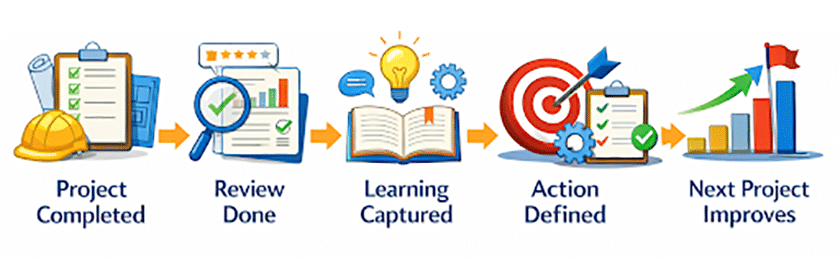
This is how design maturity grows over time.
Why teams often skip it
Most teams do not avoid reviews because they do not care about improvement. They skip them because day-to-day delivery pressure takes over.
Once a project is completed, another one is already waiting. Deadlines continue, revisions keep coming, and people move directly into execution mode again. In that kind of environment, reflection starts feeling optional.
There are usually a few common reasons behind this:
- the team is busy with the next deadline
- delivery is seen as the final step
- there is no fixed structure for review
- nobody owns the process
- learning is discussed informally, but not documented
This is exactly why review has to become part of the routine. If it is treated as something to do only when there is extra time, it will rarely happen. But when it becomes part of the discipline of working, it begins to create long-term value.
What teams can learn from post-delivery design reviews
A good review helps the team look beyond the final output and understand the project in a more complete way. It brings out lessons that are often missed during active delivery.
Some of the most useful learning areas include:
1. Requirement clarity
Many design issues begin much earlier than the design stage itself. Sometimes the brief is incomplete. Sometimes assumptions are made too early. Sometimes the team starts execution without enough clarity because of time pressure.
A review helps identify whether the project began with the right understanding and where that understanding may have been weak.
2. Design quality and detailing
This is one of the most important areas to examine after delivery. The team can look at whether the design maintained consistency in typography, spacing, layout, visual hierarchy, responsiveness, component usage, and overall detailing. Often, a project may succeed broadly but still reveal smaller areas where the final polish could have been stronger. These are the insights that help future work become sharper.
3. Speed versus quality balance
Fast delivery is important, but speed should not quietly reduce quality. A review helps the team understand whether the work was paced properly or whether too much pressure was pushed into the final stage.
This becomes especially useful in identifying whether earlier internal checks could have reduced rework later.
4. Communication and collaboration
Design work does not happen in isolation. The quality of a project is often influenced by how smoothly designers, developers, project managers, and stakeholders worked together.
A review allows the team to examine whether communication was timely, feedback was clear, and collaboration supported better delivery or created avoidable delays. A useful place to start is by reflecting on how the team approached managing client feedback effectively throughout the project – because how feedback is received and acted upon during delivery often determines how much rework follows after it.
5. Repeated issues
This is where the review becomes especially important. If the same type of issue appears across different projects, that means it is no longer just a project problem. It is a system problem.
Recognising repeated issues helps teams move from temporary fixes to stronger working methods.
6. Good practices worth repeating
Reviews should not focus only on gaps. They should also identify what worked especially well.
Maybe the team used a smarter review method. Maybe file organisation was better than usual. Maybe component thinking improved speed. Maybe a designer solved a recurring issue in a more practical way.
These are the kinds of things that should not stay limited to one project. They should become team-wide learning.
Problems these reviews can help prevent
When post-delivery reviews become consistent, teams begin to notice a reduction in many familiar issues.
These include:
- inconsistency across screens or pages
- weak detailing in final output
- rushed decisions near deadline
- repeated client comments on similar problems
- confusion during handoff
- unrealistic effort estimation
- gaps between design intent and final implementation
- learning being lost after project completion
- reliance on memory instead of process
These reviews do not remove every problem immediately. But they help teams reduce avoidable issues and improve with more awareness.
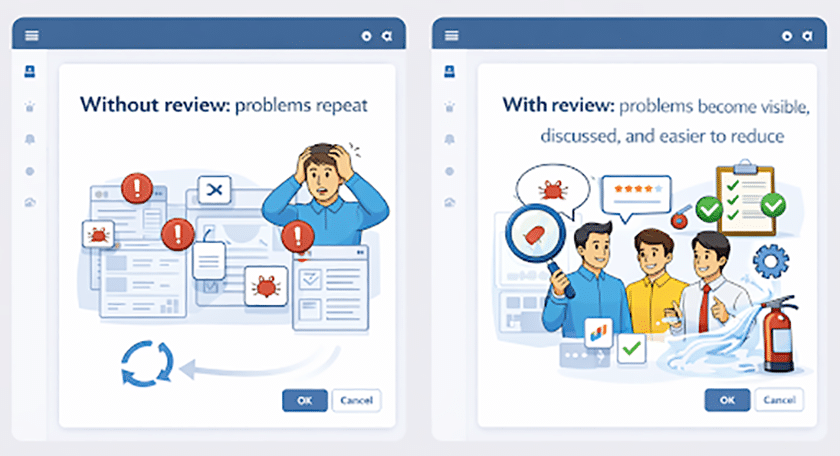
That shift is one of the biggest benefits of review culture.
Turning review into a working discipline
The biggest value of post-delivery review comes when it is treated as a regular discipline, not as an occasional exercise.
This does not mean every project needs a long session. What matters more is consistency than complexity. A team can build this habit through short but meaningful review cycles, such as monthly retrospective discussions around completed projects.
The goal is not to create extra process. The goal is to make improvement repeatable.
Once reviews become routine, something important changes inside the team. People begin to notice patterns faster. They become more thoughtful about detailing. They communicate better. They start solving problems earlier because they already remember what caused friction last time.
That is when review stops being an activity and starts becoming part of the team’s mindset.
A practical review template teams can use
For review discussions to be useful, they need some structure. Without that, conversations can remain too broad and end without any real action.
A simple template makes the process easier to repeat and more useful to document. It also helps teams compare projects over time and understand whether the same issues are reducing or continuing.
The purpose of a review template is not to make the discussion formal. It is to make the learning practical. A strong template should help the team look at the project from multiple angles, including requirement clarity, design quality, coordination, feedback patterns, delivery pressure, and future improvements.
Below is a simple format that can be adapted based on team workflow and project type:
| Review Area | Questions to Ask | Observation | Action for Future |
|---|---|---|---|
| Requirement Clarity | Was the brief clear from the beginning? | Some assumptions caused rework | Ask more questions before starting |
| Design Quality | Was the detailing strong enough? | Good overall, but some spacing issues remained | Add internal UI detailing checklist |
| Team Coordination | Was collaboration smooth? | Feedback came late from multiple stakeholders | Define one review owner |
| Delivery Process | Was the timeline realistic? | Work was rushed in the last stage | Start review checkpoints earlier |
| Client Feedback | What feedback repeated most? | Consistency and responsiveness | Review both before client submission |
| Learning | What should become standard? | Better component reuse helped speed | Add to team best practices |
This kind of table works well because it pushes the team to move from observation to improvement. It does not stop at identifying what happened. It also asks what should change next.
That final step is what gives the review its real value.
What strong teams do differently
Strong teams do not only deliver work. They improve how they deliver work.
They understand that quality is not built only through skill or effort. It is built through repeatable learning, shared understanding, and better systems. Teams that improve consistently are usually the ones that create space for reflection instead of moving from one deadline to another without pause.
They do not see review as a delay. They see it as part of professional growth.
This thinking can be seen across mature design, product, and creative environments where teams regularly reflect on completed work, discuss challenges honestly, and turn learning into process improvement. The structure may vary from one organization to another, but the principle remains the same: better work comes from better learning systems.
The role of leadership in making this successful
Post-delivery reviews do not become effective just because they are scheduled. They become effective when the culture around them is healthy.
That is where leadership matters.
The team should feel that review is a learning discussion, not a fault-finding session. People are far more likely to speak openly when they know the goal is improvement, not criticism. Reviews work best when the tone is constructive, balanced, and practical.
Strong leadership in creative teams is built on more than just managing timelines — it is about nurturing the kind of trust and collaboration that makes honest reflection possible. The unspoken rules that keep creative teams thriving offer a useful lens on what that kind of leadership looks like from the inside.
A few leadership habits can make a big difference:
- appreciate what worked well before discussing gaps
- focus on process instead of personality
- make observations specific and useful
- keep action points realistic
- revisit earlier action points to check whether they were actually followed
When leaders show that these discussions matter and that the insights will shape future work, the team starts taking reviews seriously. Over time, that builds trust, accountability, and a stronger delivery culture.
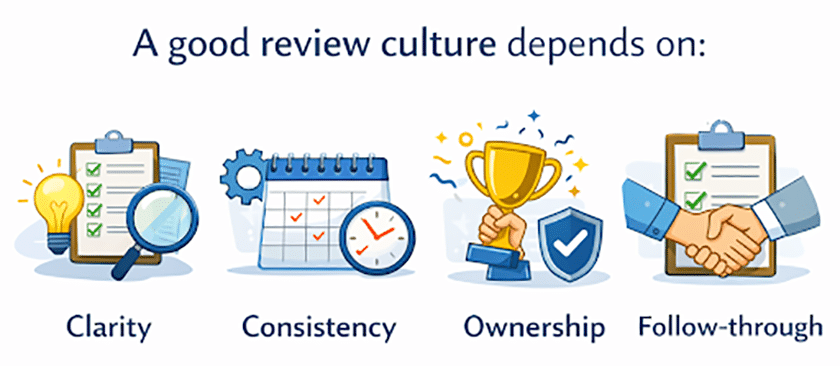
Without follow-through, reviews stay as conversations.
With follow-through, they become improvement.
Final thought
Every delivered project contains more than an outcome. It also contains lessons.
It shows where the team was strong, where it struggled, where communication helped, where process slowed things down, where detailing stood out, and where future work can become better. But these lessons only create value when they are discussed, documented, and carried forward.
That is why post-delivery design review matters so much. It is not just a useful habit. It is a practical way to help teams grow in quality, consistency, and confidence.
A team that reviews its work regularly becomes a team that learns regularly. And a team that learns regularly improves naturally over time.
That improvement can be seen not only in the final designs, but also in the way the team thinks, collaborates, and delivers.


 Web Development
 Cloud Engineering
 Mobile App Development
 AI/ML/GenAI
 E-commerce
 Software Development
 UI/UX
UI/UX QA
QA Dedicated Teams