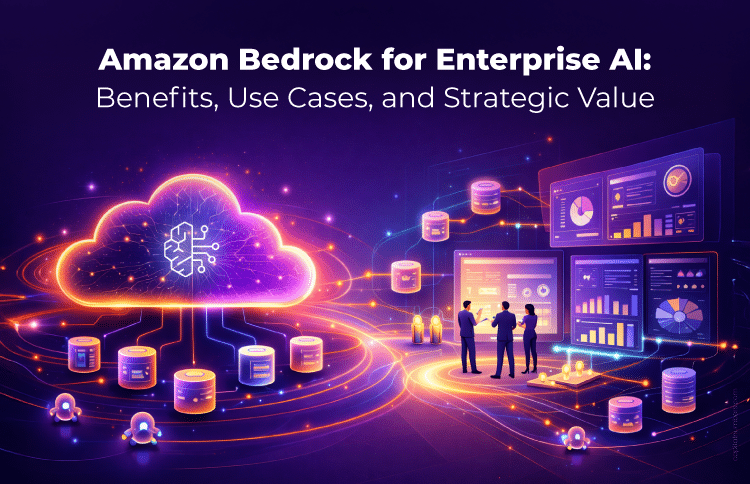

Amazon Bedrock for Enterprise AI: Benefits, Use Cases, and Strategic Value
Table of Contents
AI potential is easy to discuss. Turning it into business value is the real challenge. For many enterprises, the gap lies between ambition and execution. They want AI outcomes without the complexity, operational overhead, and governance challenges of assembling and managing model infrastructure on their own. Amazon Bedrock offers a more practical path to closing that gap by helping enterprises build and scale generative AI applications and agents more efficiently.
In this blog, we will look at the business benefits of Amazon Bedrock, the enterprise use cases it supports, and the strategic value it can bring to organizations looking to move beyond AI pilots and build for long-term adoption.
What Is Amazon Bedrock?
Amazon Bedrock is a fully managed AWS service for building generative AI applications. It gives businesses access to foundation models from Amazon and providers such as Anthropic, Meta, and Cohere. These models are available through AWS-managed APIs and infrastructure. So teams can stay focused on use cases, product goals, and rollout instead of spending time managing the full AI stack.
In practical terms, Bedrock helps enterprises build and scale AI applications without handling infrastructure, model hosting, or production setup on their own. It also gives teams more flexibility in model choice. This is important because one model may not be right for every business need. A team may use it for content generation, while another may need it for enterprise search, knowledge support, workflow automation, or AI agents.
Business Benefits of Amazon Bedrock for Enterprises
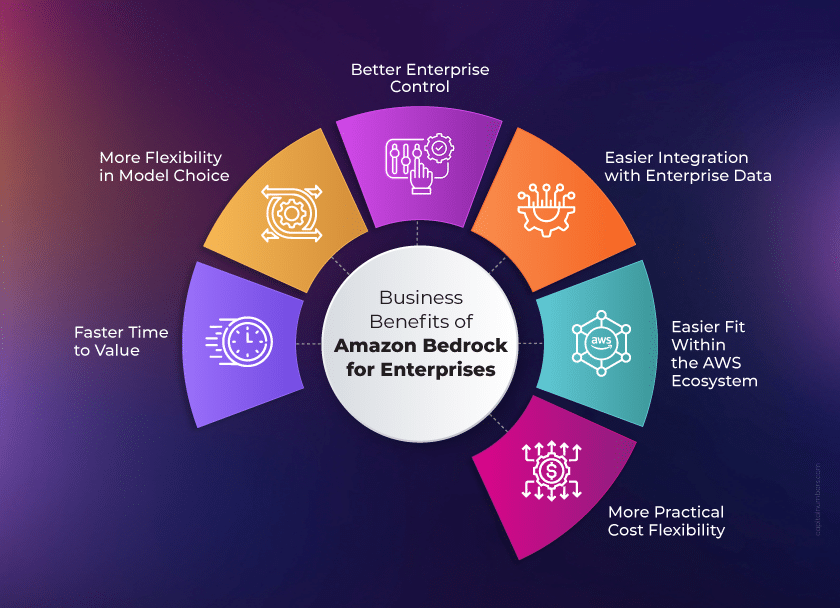
Amazon Bedrock offers more than access to AI models. Its business value comes from helping enterprises move faster, stay flexible, keep better control, use company data more effectively, and support automation in a more practical way.
1. Faster Time to Value
One of the biggest business benefits of Amazon Bedrock is speed. Bedrock helps reduce the time and effort needed to turn AI ideas into working business solutions.
How Bedrock helps:
- AWS manages the underlying infrastructure, so enterprises do not need to build and maintain the full AI setup on their own.
- This can make it easier to move from an AI idea to a pilot and then into production.
- Teams can focus more on use cases, user needs, and business outcomes instead of technical setup.
2. More Flexibility in Model Choice
Enterprise AI use cases are rarely uniform, and that is where model flexibility becomes important.
How Bedrock helps:
- Bedrock gives enterprises access to foundation models from Amazon and multiple third-party providers.
- This allows businesses to compare and choose models based on the needs of a specific workload.
- It reduces the pressure to build an entire AI strategy around a single model option.
3. Better Enterprise Control
For enterprise AI, control matters as much as capability. As AI moves closer to customers and core operations, businesses need stronger safeguards and better visibility.
How Bedrock helps:
- AWS highlights security, guardrails, observability, and compliance support as part of Bedrock’s enterprise value.
- These features can help businesses manage risk in customer-facing and regulated use cases.
- They also support stronger governance as AI becomes part of everyday business operations.
4. Easier Integration with Enterprise Data
AI delivers more value when it works with company knowledge, not just general model knowledge. That is why data grounding is an important business advantage.
How Bedrock helps:
- Bedrock Knowledge Bases support retrieval-augmented generation, or RAG, by grounding responses in enterprise data.
- This helps AI applications respond with more relevant business context.
- It can support use cases such as internal knowledge assistance, enterprise search, and support workflows.
5. Easier Fit Within the AWS Ecosystem
For many enterprises, AI adoption becomes easier when it fits into the cloud environment they already use. That is another reason Bedrock is attractive for AWS-based organizations.
How Bedrock helps:
- Bedrock fits more naturally into the broader AWS ecosystem.
- This can make it easier to connect AI initiatives with existing cloud services, data environments, and application workflows.
- It also helps teams build AI-powered solutions without creating a disconnected technology layer.
6. More Practical Cost Flexibility
Enterprise AI decisions are not only about capability. They also need to make financial sense as teams test, learn, and scale.
How Bedrock helps:
- Bedrock supports a pay-as-you-go approach, which gives enterprises a more practical way to get started without large upfront infrastructure commitments.
- This makes it easier to test use cases before expanding further.
- Teams can scale usage more gradually as they gain clarity on value and adoption.
Top Enterprise Use Cases for Amazon Bedrock
Amazon Bedrock can be used across a wide range of enterprise scenarios. In most cases, the value comes from combining foundation models with company data, enterprise controls, and workflow integration.
1. Internal Knowledge Assistants
Enterprise teams often lose time searching across policies, SOPs, internal documents, and operational knowledge spread across different systems. Knowledge Bases for Amazon Bedrock can help by grounding responses in company data, so employees get answers that are more relevant to the business context. This can improve productivity, reduce search time, and make it easier to find the information they need.
2. Customer Support and Service Automation
Support teams are under constant pressure to respond faster while still staying accurate and consistent. Bedrock can be used for response generation, case summarization, knowledge retrieval, and guided support workflows. This can help improve response quality, reduce manual effort, shorten handling time, and create a more efficient support experience for both customers and service teams.
3. Sales and Proposal Support
Sales teams often need to prepare quickly for meetings, respond to client requirements, and draft proposals using information spread across decks, case studies, credentials, and internal documents. Knowledge Bases for Amazon Bedrock can help teams retrieve the right internal content faster and support research summaries and response drafting. This can improve sales productivity, reduce preparation time, and lead to more informed and consistent client responses.
4. Process Automation with AI Agents
Many enterprise processes still depend on people moving between systems, collecting information, and completing tasks step by step. Agents for Amazon Bedrock can connect AI to APIs, CRM and ERP systems, and enterprise data sources so multistep tasks can be handled more efficiently. Instead of only answering questions, AI can help trigger actions across connected workflows. This can reduce repetitive manual work, improve process speed, and make AI more useful in real business operations.
5. Industry-Specific Assistants
Generic AI experiences are often not enough for enterprise use. Different industries need their own terminology, workflows, controls, and business context. Amazon Bedrock can support industry-specific assistants by combining foundation models with company data, security controls, and business workflows. This can make enterprise AI more relevant, more accurate, and better aligned with the needs of a specific business environment.
Common Amazon Bedrock Challenges
Poor Source Data Leads to Weak AI Answers
If the source data is outdated, incomplete, or poorly organized, the AI output will also be weak. AWS states that Bedrock Knowledge Bases improve responses by retrieving relevant information from enterprise data sources, so the quality of answers depends heavily on the quality of that source content.
AI Without Workflow Integration Delivers Limited Value
AI can look impressive in a demo, but the value is often limited if it is not connected to real workflows. For example, if it can answer a support question but cannot pull case data or trigger the next action, it remains more of an assistant than a business tool. That is why workflow integration is an important planning point.
Governance Cannot Be an Afterthought
Governance needs to be part of the plan from day one, especially when AI is used in customer interactions, internal decision support, or sensitive business workflows. If there are no clear controls over what the system can access, generate, or trigger, the risks can grow quickly as usage expands. Amazon Bedrock supports that need with features aligned to security, guardrails, and visibility.
Model Availability Can Vary by AWS Region
Model availability in Amazon Bedrock can vary by AWS Region, so enterprises need to check regional support before planning deployment. AWS’s supported models documentation explicitly lists model availability by Region and also distinguishes single-region and cross-region support.
How Capital Numbers Can Help Enterprises Adopt Amazon Bedrock
Capital Numbers can support enterprise adoption of Amazon Bedrock with a practical and structured approach:
- Identify the right use cases: We help teams map AI opportunities to real business needs such as internal knowledge search, customer support, sales enablement, and process automation.
- Define the right rollout path: We help plan the adoption journey from discovery and pilot to production rollout, with clear priorities, realistic scope, and measurable business outcomes.
- Design the solution architecture: We help shape the right architecture for Amazon Bedrock, including model selection, Knowledge Bases, Agents, and integration points with existing systems.
- Build secure AI assistants and agents: We can develop AI solutions with grounded responses, workflow-aware design, and the right focus on security, governance, and enterprise control.
- Integrate enterprise data and business systems: We help connect Bedrock with internal documents, knowledge repositories, APIs, and business platforms such as CRM, ERP, support systems, and internal portals.
- Support pilot-to-production execution: We work with enterprises to validate early use cases, refine performance, improve usability, and prepare the solution for broader rollout.
- Focus on business value, not just technology: The goal is not just to launch an AI feature, but to build something useful, scalable, and aligned with day-to-day business operations.
From strategy to execution, Capital Numbers can support enterprises through Amazon Bedrock consulting services, helping them move from use-case discovery and pilot planning to secure production rollout.
Final Thoughts
Amazon Bedrock is not just about accessing AI models. Its real value is that it gives enterprises a managed way to build AI applications and agents that are useful, governed, and ready to scale in real business environments. AWS presents Bedrock in that same direction today: as a fully managed platform with enterprise security, grounded knowledge capabilities, and support for production-ready applications and agents.
For CTOs, Product Leaders, and CXOs, the bigger takeaway is strategic. The opportunity is not just to experiment with AI, but to turn it into a practical business capability that supports teams, improves workflows, and creates long-term operational value.
Amazon Bedrock FAQ
1. What is Amazon Bedrock in simple terms?
Amazon Bedrock is a managed AWS service that helps businesses build generative AI applications without managing the underlying model infrastructure themselves.
2. How is Amazon Bedrock used in enterprises?
Enterprises use Amazon Bedrock to build tools such as internal assistants, support automation, AI-powered workflows, and business applications that work with company data and systems.
3. What are the business benefits of Amazon Bedrock?
Its main business benefits include faster time to value, more flexibility in model choice, stronger enterprise control, easier use of company data, and better support for scalable AI adoption.
4. What use cases does Amazon Bedrock support?
Amazon Bedrock supports use cases such as internal knowledge assistants, customer support, proposal and content support, workflow automation, and industry-specific AI solutions.
5. Is Amazon Bedrock good for enterprise AI strategy?
Yes. It is well suited for enterprise AI strategy because it gives businesses a managed path to build AI applications with security, governance, and scalability in the AWS environment.
6. How does Amazon Bedrock help with AI agents and company data?
Amazon Bedrock supports knowledge bases for grounding responses in company data and agents for connecting AI with APIs, systems, and multistep business tasks.


 Web Development
 Cloud Engineering
 Mobile App Development
 AI/ML/GenAI
 E-commerce
 Software Development
 UI/UX
UI/UX QA
QA Dedicated Teams