

Platform Engineering in 2026: The Executive Guide to Faster Delivery
Table of Contents
Shipping slower than your competitors hurts. But “move faster” isn’t a strategy. So what’s really slowing teams down in 2026?
For many enterprises, it’s the same pattern: every product team builds its own pipelines, environments, and release rules. Approvals stack up. Security comes in late. Cloud costs increase. And engineers spend more time figuring out how to deploy than building what customers actually need.
That’s why platform engineering is turning into a leadership priority, not just a DevOps topic. Gartner predicts that by 2026, 80% of large software engineering organizations will establish dedicated platform engineering teams (up from 45% in 2022). The goal is simple: give teams a clear, standard way to build, ship, and run software – safe defaults, self-service delivery, and built-in guardrails.
Here’s what platform engineering looks like in practice – how it reduces delivery friction, improves governance, and shows measurable ROI.
What Is Platform Engineering? (A Business-First Definition)
Platform engineering is all about helping teams deliver software faster and more safely by providing a shared internal platform. It removes the repeated setup work – environments, deployments, reliability basics, security checks, so engineers can focus on product features instead of “how to run this.”
Platform team vs product teams
-
- Product teams build customer-facing features and new capabilities.
- Platform teams build and maintain the standard delivery path: self-service workflows, approved templates, and guardrails that make releases smoother.
The platform team’s job is to reduce friction across the organization, not to take over product delivery.
From DevOps to Platform Engineering: Why the Shift Happened
DevOps improved delivery across many teams. But as companies scaled, they often hit a wall. What works for 2–3 groups breaks when you have 20+ teams shipping in parallel.
Why DevOps struggles at scale
In many enterprises, DevOps turned into “each team does it their own way”:
-
- Different pipelines and release steps
- Different environment setups
- Different security checks and approvals
- Different levels of reliability and monitoring
That variation creates delays, confusion, and uneven delivery speed.
The real issue: cognitive load + friction
Product engineers end up taking on too much extra work, including deployments, infrastructure decisions, policies, tooling, and feature delivery. More context switching means slower shipping. And when something fails, teams waste time debugging the process, not the product.
Platform engineering = DevOps, made repeatable
This is the simple DevOps evolution story. Platform engineering keeps DevOps goals (automation, speed, reliability) while adding a shared platform so teams don’t reinvent delivery every time. It reduces variation and makes the “right way” the easy way; this is the practical difference in DevOps vs platform engineering.
Culture vs structure
DevOps pushed cultural change. Platform engineering adds structure: clear ownership, standard paths, and guardrails that help big organizations move fast without losing control.
Trying to scale platform engineering without slowing delivery?
Get DevOps services from Capital Numbers to turn your platform goals into reliable pipelines, automated releases, and built-in security. Get in touch with us today!
Internal Developer Platforms (IDPs): The Core of Platform Engineering
If platform engineering is the strategy, an internal developer platform (IDP) is the thing teams use every day. It’s a shared platform that makes it easy to build, deploy, and run services without bouncing between tools or waiting on someone else for basic delivery steps.
What an IDP includes (in real terms)
A strong internal developer platform usually brings together:
-
- Service templates for APIs, microservices, and background jobs
- Built-in CI/CD so teams don’t rebuild pipelines from scratch
- Standard environments (dev, staging, prod) that behave the same
- Observability defaults like logs, metrics, and alerts
- Security checks by default (policies, secrets, scanning)
- Access and governance so the right people can deploy safely
That’s the practical side of IDP platform engineering: less variation, fewer delays, more predictable releases.
Self-service, golden paths, and guardrails
-
- Self-service deployments: teams can ship without long ticket queues.
- Golden paths: the recommended “best route” that works for most services.
- Guardrails: simple rules that stop risky changes (missing checks, unsafe configs, unapproved dependencies).
This isn’t about slowing teams down. It’s about making the safe path the easy path.
Common misconceptions about IDPs
-
- “An IDP is just a portal.” A UI helps, but the real value is the standard workflows behind it.
- “It replaces DevOps.” It packages DevOps practices into something teams can follow consistently.
- “It’s only for huge companies.” Even mid-sized organizations can benefit once delivery starts getting inconsistent.
An IDP doesn’t remove complexity. It hides unnecessary parts, enabling teams to ship faster with fewer surprises.
How Platform Engineering Speeds Up Software Delivery
Speed problems in delivery usually come from the same places: waiting, inconsistency, and relearning the process on every team. Platform engineering makes delivery repeatable across the DevOps lifecycle – from code to deploy to operate – so speed doesn’t depend on which team built the service.
1. Fewer handoffs and approval delays
- Less time stuck in ticket queues for environments, access, and deployments
- Automated policy checks instead of manual back-and-forth
- Clear rules on what truly needs approval
2. Standard pipelines and consistent environments
- One proven build–test–release flow most teams can follow
- Consistent dev/stage/prod behavior
- Faster troubleshooting because patterns don’t vary team to team
3. Faster onboarding across the SDLC
- Ready-to-use service templates and configurations
- Docs that match the real process
- Less dependency on tribal knowledge
4. Continuous delivery at scale
- Smaller, safer releases that happen more often
- Fewer “big bang” deployments and late-night release crunches
- Teams can move fast without increasing operational risk
Key Components of a Modern Platform Engineering Stack (2026)
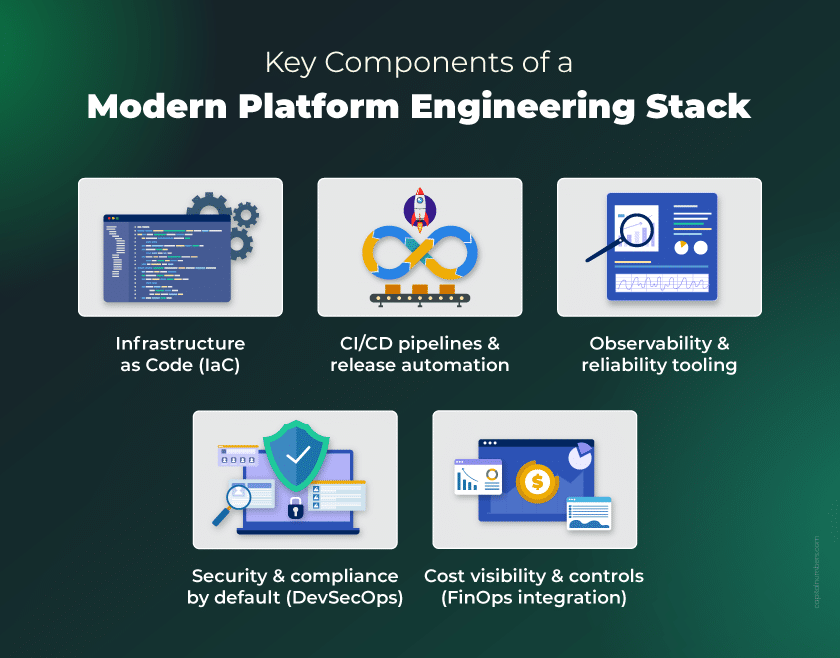
A modern platform stack in 2026 is not about collecting tools. It’s more than that. Most platform engineering tools fit into five core areas:
-
- Infrastructure as Code (IaC)
Set up and manage environments through code instead of manual steps. This speeds up provisioning and keeps environments consistent. - CI/CD pipelines and release automation
A reliable path to build, test, and deploy. Fewer handoffs. Fewer delays. More predictable releases. - Observability and reliability tooling
The basic teams need to run services well, including logging, metrics, tracing, alerts, and clear reliability targets. It helps teams detect issues early and recover faster. - Security and compliance by default (DevSecOps)
Security checks are built into the delivery process, like scanning, policy rules, and secrets handling. A strong DevSecOps platform keeps things safe without adding heavy friction. - Cost visibility and controls (FinOps integration)
Clear cost tracking and guardrails: tagging, dashboards, alerts, and spend limits. This helps prevent cloud waste and surprises.
- Infrastructure as Code (IaC)
When these pieces work together, teams spend less time on setup and firefighting, and more time shipping.
Platform Engineering and AI-Driven Development in 2026
AI is changing how software gets built. Teams can generate code, tests, and even deployment scripts in minutes. That’s great for speed, but it also increases the chance of shipping insecure patterns, messy configs, or “works on my machine” fixes. In 2026, the platform needs to keep that speed under control.
-
-
AI-generated code needs guardrails
Standard templates, approved dependencies, and automated checks (secrets, vulnerabilities, risky configs) make sure AI output remains production-ready.
-
Policy-as-code and automated compliance
Instead of chasing approvals, rules are enforced in the pipeline – what can be deployed, how it must be configured, and what must pass. This reduces compliance delays and keeps audit trails clean.
-
AIOps for fewer incidents and faster recovery
AIOps in 2026 helps teams reduce alert noise, identify root causes faster, and recover quickly through safer rollbacks and guided remediation.
-
This becomes even more important when you hire AI developers or scale AI work across multiple squads, because AI speed without shared standards quickly turns into risk and rework.
Security, Compliance, and Software Supply Chain Risk
Security delays usually happen for one reason: it shows up too late. When checks happen only at the end, teams get stuck in rework, exceptions, and long approval loops. Strong platform engineering security avoids that by making security part of the normal delivery path.
Security should be built in, not added later
- Secure defaults for new services (configs, access, secrets handling)
- Automated checks during build and release, not after deployment
- Controls that block risky deployments early
Reduce software supply chain security risk
Modern apps rely on many third-party components, so you need control over what reaches production:
-
- SBOMs (Software Bill of Materials): A clear inventory of components used
- Artifact signing: Verify what was built and prevent tampering
- Dependency governance: Approved sources, version rules, and vulnerability thresholds
These are now core expectations for software supply chain security.
Regulatory pressure and audit readiness
-
- Audits get easier when evidence is built into the process:
- Traceability of changes (who changed what, when, and why)
- Logs showing which checks passed (security, compliance, policy)
- Consistent controls across teams, not one-off exceptions
How platforms reduce security-related delays
- Fewer manual approvals for routine releases
- Fewer last-minute blockers before launch
- Faster fixes because issues are caught earlier in the pipeline
Measuring ROI: How Executives Should Evaluate Platform Engineering
Platform engineering ROI isn’t about “better tools.” It’s about real business outcomes. Track a few metrics that connect directly to speed, risk, and spend.
Delivery metrics that matter to leadership
Focus on outcomes your business can feel:
- Lead time for change: how fast a commit reaches production
- Deployment frequency: how often you can ship safely
- Change failure rate: how often releases cause incidents or rollbacks
- Time to restore service: how quickly you recover when something breaks
DORA metrics in an executive context
DORA (DevOps Research and Assessment) is useful because it stays simple. For leaders, map it to business impact:
- Shorter lead time → faster time-to-market
- Higher frequency → smaller, lower-risk releases
- Lower failure rate → fewer customer-impacting issues
- Faster recovery → less downtime and less revenue loss
Reducing the total cost of ownership (TCO)
Look at the TCO of DevOps and ongoing delivery operations:
- Less time maintaining one-off pipelines and environments
- Fewer production issues and less firefighting
- Lower security and audit overhead through standard controls
- Better cost governance to reduce waste and surprise spend
Productivity gains vs headcount growth
A strong ROI signal is a higher output without matching headcount growth:
- Faster onboarding for new teams
- More engineering time spent on product work
- Reuse compounds over time (each standard path saves effort)
When Does Platform Engineering Make Sense for Your Organization?
Not every company needs this right now. The key is when to adopt platform engineering – when “each team ships their own way” starts costing you time, speed, and control.
It usually makes sense if:
- You have many teams shipping at once, but results vary team to team
- Engineers spend too much time on setup (environments, access, pipelines)
- Security and compliance often block releases near the end
- The same incidents keep happening because standards aren’t consistent
Common Mistakes Leaders Make with Platform Engineering
Most failures here aren’t technical. They’re leadership and execution issues. These platform engineering challenges show up again and again, and they’re also the most common IDP mistakes.
-
Treating the platform like an internal tool, not a product
If it’s “built and thrown over the wall,” teams won’t adopt it. A platform needs clear users, feedback loops, documentation, and a roadmap.
-
Over-engineering too early
Trying to automate everything from day one slows progress. Start with the biggest blocks and a few golden paths, then expand.
-
Ignoring developer experience
If the platform is hard to use, teams will bypass it. Adoption depends on simple workflows, good defaults, and fast support.
-
Building without clear ownership
Without an accountable owner, platforms become nobody’s job. Define who owns outcomes (speed, reliability, cost) and who maintains the platform long term.
Platform Engineering vs Alternatives in 2026
| Aspect | Platform Engineering | SRE | Managed DevOps Services |
|---|---|---|---|
| Primary goal | Faster, consistent delivery across teams | Reliability, uptime, and incident response | Execution support for DevOps and cloud ops |
| What it improves most | Standard pipelines, self-service, onboarding speed | SLOs, monitoring, on-call, recovery speed | Delivery operations, automation help, day-to-day ops |
| Best fit when | Many teams ship in parallel and delivery is inconsistent | Incidents are frequent and stability is a top priority | You need bandwidth fast or 24/7 operational coverage |
| Where it can fall short | Low adoption if DX is poor or ownership is unclear | Doesn’t fix messy pipelines by itself | Can create dependency if standards stay external |
| What leadership should measure | Lead time, deploy frequency, and onboarding time | MTTR, incident rate, SLO/SLA health | Delivery throughput, incident load, and cost control |
| Works best with | DevOps, security, and FinOps policies built in | Strong platform standards and automation | Clear internal platform standards and governance |
Getting Started with Platform Engineering: A Practical Executive Roadmap
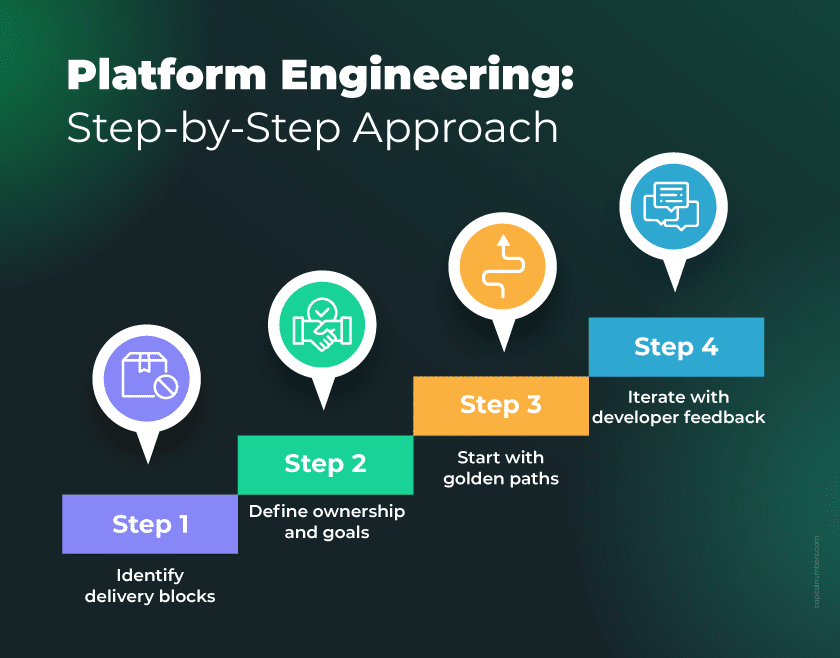
A strong platform engineering roadmap doesn’t need a big launch. Start small, fix the biggest friction first, then expand.
- Step 1: Identify delivery blocks
Look for where time is lost: ticket queues, approvals, environment setup delays, slow onboarding, repeated release issues. - Step 2: Define ownership and goals
Assign clear ownership and set 2–3 measurable goals (example: reduce lead time, cut onboarding time, lower change failure rate). - Step 3: Start with golden paths
Build the standard path for the most common services first, templates, build–test–deploy flow, default security, and observability. - Step 4: Iterate with developer feedback
Track adoption, collect feedback, improve the experience, then roll out to more teams and use cases.
You May Also Read: The Role of DevOps in Full Stack Development
Platform Engineering as a Competitive Advantage in 2026
In 2026 and beyond, delivery speed will decide who moves ahead. Teams that can ship safely, consistently, and with cost control can respond faster when priorities change. If releases still depend on too many handoffs, custom pipelines, and end-of-cycle security checks, things will only slow down as you scale.
Platform engineering helps you scale delivery without scaling chaos, so teams can deliver more without adding more complexity.
Are you trying to scale delivery in 2026 without losing control of security, cost, and reliability? Book a 30-minute discovery call with Capital Numbers. We’ll review your setup, spot bottlenecks, and suggest next steps.


 Web Development
 Cloud Engineering
 Mobile App Development
 AI/ML/GenAI
 E-commerce
 Software Development
 UI/UX
UI/UX QA
QA Dedicated Teams