
Software Development Cost: How to Forecast Your Budget Accurately (Without Guesswork)

Delivery Manager
19th February, 2026
Introduction: Why Software Budgets Keep Missing the Mark
Forecasting software costs often feels like trying to hit a moving target. You begin with a solid number, but as the first lines of code are written, the landscape shifts: new ideas surface, hidden dependencies emerge, and priorities pivot. Suddenly, the budget is stretched, timelines slip, and leadership is forced into uncomfortable trade-offs, choosing between cutting essential features, compromising on quality, or missing a critical market window. The reality? Most budget overruns aren't the result of wrong forecasting. They happen because forecasts are built on invisible assumptions, such as, unclear scope, unvetted platform integrations, or evolving market conditions. Business leaders need a practical framework to plan with confidence and communicate a realistic range to stakeholders. In this guide, we’ll move past the guesswork to break down what actually drives software development costs. You’ll learn how to define scope to minimize uncertainty, build a risk-adjusted budget that doesn't feel inflated, and keep the budget aligned with business outcomes from day one to delivery.
What You’re Really Forecasting (It’s More Than Just Dev Cost)
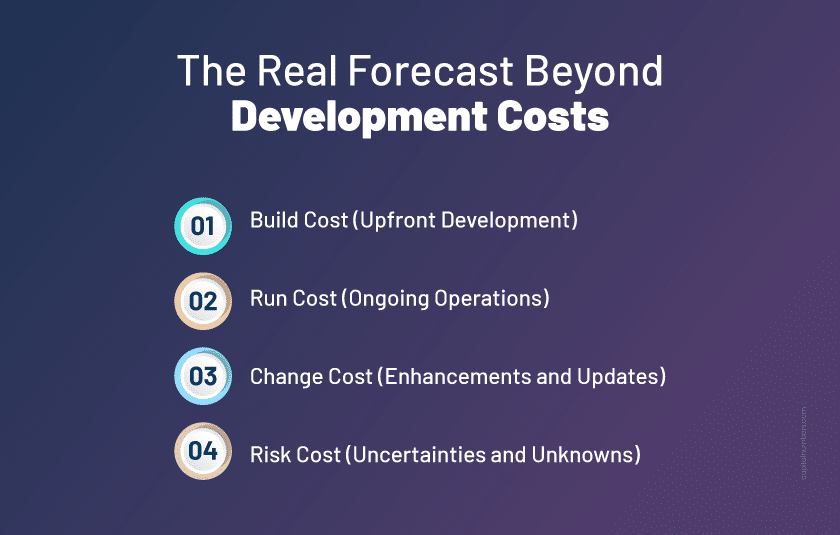
When leaders think about the costs of leveraging software development services, they often focus on one thing: how many hours they need to invest in engineers. But that’s only part of it. If you want to truly forecast how much your business needs to invest in a project, you need to break the budget into comprehensive categories that account for all the aspects of development, ongoing maintenance, and risk.
1. Build Cost (Upfront Development)
It includes everything needed to build the product. Key elements to consider:
- Engineering: Engineering costs include coding, API integrations, and backend systems.
- Design: Design costs include UI/UX design, prototyping, custom illustrations, animations, and related services. Even if you’re developing a Minimal Viable Product (MVP), a polished design can make a big difference in product success.
- Quality Assurance (QA): Includes testing cycles (unit testing, integration testing, system testing) and dedicated cycles for UAT (User Acceptance Testing) support and remediation.
- DevOps: Includes Infrastructure-as-Code (IaC), automated environment provisioning, and CI/CD (Continuous Integration and Continuous Delivery) pipelines. This architecture supports the code, ensuring scalability and product stability from the start.
2. Run Cost (Ongoing Operations)
Once the software is built and launched, the run cost covers everything needed to keep it up and running. Key elements to consider:
- Cloud Hosting: Whether using AWS, Azure, or Google Cloud, the cost of scaling infrastructure to handle users and data should be a primary consideration.
- Ongoing Maintenance: As the software evolves, you'll need to fix bugs, roll out patches, and perform regular updates to ensure it remains secure and efficient.
3. Change Cost (Enhancements and Updates)
Businesses need to budget for future updates and changes that will arise post-launch. Key elements to consider:
- New Features and Enhancements: Software evolves, and new features often get requested as users begin interacting with the product. Future-proofing your budget for this is essential.
- Regulatory Compliance: Changes in laws or industry standards may require you to update your software and budget for ongoing regulatory updates, especially in sectors such as finance, healthcare, or fintech.
- Third-Party Integrations: As your product evolves, you need to integrate it with additional platforms or APIs. The cost for these integrations can vary significantly depending on the complexity.
4. Risk Cost (Uncertainties and Unknowns)
Every project comes with risks, unpredictable factors that can delay or increase costs. Understanding where these risks are likely to emerge helps prepare you for them. Key elements to consider:
- Technical Unknowns: Whether it’s new technology, unfamiliar integrations, or innovative architectures, unknowns can slow progress and increase costs.
- Rework: As development progresses, some tasks may need to be reworked due to technical challenges, scope changes, or missed requirements.
- Security & Compliance: As software grows and scales, security becomes increasingly complex. Factors like data encryption, user access controls, and compliance audits can add significant overhead.
The Top Reasons Software Cost Estimations Go Wrong
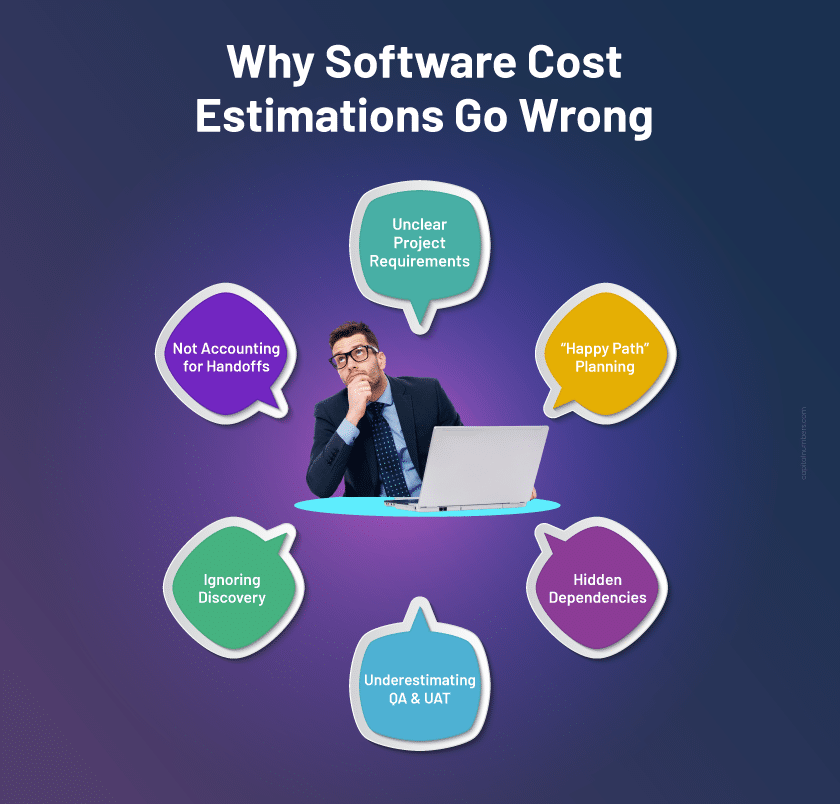
Even experienced teams often miss meeting software budget targets. Understanding the targets helps leaders anticipate issues before they turn into real problems.
1. Unclear Project Requirements and Shifting Scope
Projects that start without clear goals always take a significant toll on your budget. When the scope is undefined, every step seems to create problems for the business, creating opportunities that will cost twice as much as the business initially planned to invest. Example: A company planned a small internal tool for 3 months, but stakeholders kept requesting new reports and dashboards. The project stretched to 6 months and now cost 2x the initial estimate.
2. “Happy Path” Planning
Forecasts often assume everything will go perfectly, no bugs, no edge cases, no system crashes. But, often that is not the case. Ignoring security concerns and potential trouble spots leads to situations that may cause enterprise leaders more trouble than they intended. Example: A mobile app was budgeted for $20K, assuming that there won’t be major breakdowns or changes. However, due to inconsistent API responses, costs for fixes and stability increased by 20%.
3. Hidden Dependencies
Third-party systems, legacy architectures, or APIs often introduce areas where leaders must spend a significant portion of their budget. These dependencies add hours for debugging, workarounds, or integration with different platforms. Typically, enterprise leaders ignore these dependencies when estimating software development costs. Example: Integrating with a payment provider took ~3 additional iterations due to API quirks, adding ~$5K (≈200 extra dev hours) in engineering and QA time.
4. Underestimating QA and User Acceptance Testing
Most organizations view QA as an afterthought and often don't account for it when developing their budget. QAs, regression testing, and UATs account for a large share of a project's total expenses. The lack of adequate funding will delay completion and incur additional costs. Example: A SaaS application had 2 weeks allocated for QA with a budget of $6K. However, full regression across multiple modules took 6 weeks, and the extended cycle (QA + bug fixes + re-testing) added ~$12K in delivery effort.
5. Ignoring Discovery and Architecture Work
Several teams rush to write code without first validating the architecture, design patterns, or integration approach. This adds to the total technical debt and causes unexpected increases in the product's cost. Example: A team that developed a multi-platform mobile application did not validate the architecture prior to starting work on the project. Halfway through the project, the team had to rewrite the back-end applications for improved scalability, adding an additional $10K to their original budget.
6. Not Accounting for Handoffs and Approvals
When creating a budget, executive reviews, legal approvals, and handoffs between departments are typically not included, resulting in additional costs for each of those items. Even minor delays accumulate over time, resulting in extended timeframes and additional costs. Example: Every feature developed for the application required legal approval and review by other departments, adding an additional week to each sprint. With a 12-week project, this resulted in a 25% increase in time, which directly impacted the budget.
A Practical Forecasting Model Leaders Can Adopt
Estimating software development costs can seem daunting, but it doesn't have to be. A well-defined forecasting model will help managers feel confident in making budget decisions. The following is a practical and effective framework that will help business leaders estimate software development costs:
1. Stage-Based Estimating: Break the Project into Phases
Rather than trying to estimate all the features of a project as a single large estimate, break it down into three distinct phases of its life cycle (discovery, minimum viable product (MVP), and scaling/optimizing). Discovery → MVP → Scale/Optimize
- Discovery: In the discovery phase, you investigate what the software project will do and determine how you will accomplish it (by researching, interviewing stakeholders, prototyping, and validating your architecture). The discovery phase provides visibility into potential hidden dependencies, technical risks, and integration issues early in the project.
- MVP (Minimum Viable Product): When creating an MVP, focus on prioritizing the core value proposition. Instead of trying to "lock" a rigid feature list, focus on "time-boxing" the delivery window. This allows the team to remain agile and adjust specific features based on real-time insights while keeping the budget and launch date predictable.
- Scale/Optimize: Once the MVP has been deployed, you will likely want to continue adding enhancements and integrations to your software, as well as improving its overall performance. The estimated costs of enhancements, integrations, and performance improvements will likely be much lower than if you had estimated them before data was available (e.g., data from actual users to validate that the overall architecture has been built correctly).
Using stage-based estimating will reduce the uncertainty in estimates, eliminating the guesswork that leads to budget overruns.
2. Rolling Forecasts: Update Based on Real Delivery Data
Static budgets fail in dynamic projects. Instead, adopt rolling forecasts:
- Monthly updates: Compare completed work to planned work and adjust estimates for remaining tasks.
- Milestone reviews: After each sprint or feature delivery, revisit cost assumptions and velocity.
- Scenario planning: If a key dependency is delayed, quickly recalculate its impact on overall cost and delivery.
The Three Numbers Every Software Cost Estimation Model Should Include
When forecasting software development cost, leaders don’t need thousands of line items; they need three clear numbers that tell the story of risk, expectation, and action:
- Expected Budget – This is the most likely cost based on your current scope, assumptions, and past delivery data.
- Confidence Range – A minimum-to-maximum range that accounts for uncertainty. It shows what could happen if dependencies slip or technical challenges arise.
- Decision Triggers – Points at which a new risk or scope change forces a re-forecast. These help leaders act before the budget goes off track.
How to Keep Forecasts Accurate During Delivery
Forecasts are useless if they stay static. Accuracy comes from continuous monitoring:
- Weekly: Review blockers, scope changes, and decisions that could affect timelines.
- Sprint-by-Sprint: Compare planned vs regular activity. Adjust expectations for remaining work.
- Monthly Rolling Forecasts: Update estimates and reprioritize features based on real delivery data.
- Governance: Assign a single owner for scope and budget decisions. This person ensures updates are consistent and communicated clearly.
By monitoring frequently, you avoid surprises, maintain executive trust, and ensure that software cost estimation evolves alongside the project.
Choosing the Right Engagement Model for Budget Predictability
How you hire and structure the team directly impacts how you forecast software development costs. Choosing the right engagement model reduces risk and improves forecast accuracy, rather than leaving everything to guesswork. There’s no one-size-fits-all model, but you can check if any of these engagement models fit your business:
|
|
Pros |
Cons |
|---|---|---|
|
Fixed Cost - Best for small, well-defined projects with minimal uncertainty. |
Predictable, easy to report. |
Inflexible if scope changes. |
|
Dedicated Team - Ideal for discovery-heavy or evolving products. |
Flexible, scalable, cost aligns with actual work. |
Requires active governance to avoid scope changes. |
|
Hybrid – Combine fixed-cost for discovery, then phased delivery for development. |
Balances predictability with adaptability. |
Requires clear phase gates and milestones. |
Conclusion
Accurate software budgeting comes down to moving away from static guesses and toward a structured process. To keep your budget aligned with your business goals, focus on these four areas:
- Forecast in Phases Break the work into Discovery, MVP, and Scaling to reduce initial uncertainty.
- Use Budget Ranges Replace single-point numbers with "Expected" and "Risk-Adjusted" scenarios to account for unknowns.
- Account for All Costs Ensure your numbers include long-term maintenance, hosting, and potential rework, not just initial development.
- Track Reality Update your forecast monthly based on actual progress to catch budget drift early.
By following this framework, you can manage software costs as a predictable business metric rather than an unpredictable expense.

Subhajit DasDelivery Manager
With around two decades of experience in IT, Subhajit is an accomplished Delivery Manager specializing in web and mobile app development. Transitioning from a developer role, his profound technical expertise ensures the success of projects from inception to completion. Committed to fostering team collaboration and ongoing growth, his leadership consistently delivers innovation and excellence in the dynamic tech industry.