
Magento 2 in 2026: New Features and Enhancements

Tech Lead
27th February, 2026
Here’s a clear overview of Magento 2 in 2026 - what it offers now, where it’s going, and the main updates improving the platform.
Based on the latest developments, including the release of Magento 2.4.8 in early 2025 (April 2025) and projections for 2026, Magento 2 (now primarily Adobe Commerce) is focusing on AI-driven personalization, headless architecture (Hyvä), performance optimization, and B2B complexity management.
key Features and Enhancements for Magento 2 in 2026
1. Performance and Core Architecture
- Hyvä Themes as Standard: The industry is moving heavily toward Hyvä Themes, which replace the outdated Luma frontend to provide lightning-fast page speeds, improved Core Web Vitals, and easier customization.
- PHP 8.3/8.4 Compatibility: Magento 2.4.8 and beyond fully support PHP 8.3 and, by early 2026, 8.4, providing significant speed boosts and better security.
- Database & Search Upgrades: Mandatory migration to OpenSearch 2.x (replacing Elasticsearch) for faster, more relevant search results.
- Indexer Optimization: The default indexer mode is "Update by Schedule," which minimizes performance degradation during large product catalog updates.
2. AI-Powered Personalization and Merchandising
By 2026 AI isn’t optional - it's core to Magento offerings, especially within Adobe Commerce (enterprise). In 2026, these capabilities are increasingly baseline expectations for mid-to-large merchants.
- Intelligent Recommendations: AI-driven tools analyze customer behavior to provide real-time, highly personalized product suggestions to increase conversion rates and average order value.
- AI-Enhanced Search: Natural Language Processing (NLP) allows for more accurate search results, handling misspellings and complex queries better.
- Dynamic Pricing & Content: Websites will adapt in real-time, displaying tailored content to different customer segments driven by AI.
3. Headless and Composable Commerce (API-First)
Headless commerce - separating frontend UIs (React, Next.js, Vue) from Magento backend logic. This shift enables faster evolution of storefronts while keeping Magento as a powerful commerce engine.
- GraphQL Prioritization: GraphQL is now the standard for data exchange, offering faster performance than REST APIs, crucial for headless setups with frameworks like React or Vue.js.
- Adobe App Builder: A shift towards serverless functions, allowing developers to build micro-apps that interact with Magento via API without hacking the core code, making upgrades faster and safer.
4. Advanced B2B Functionality
- Smart Reordering & Inventory: AI predicts restocking needs based on usage history.
- Complex Catalog Handling: Enhanced support for large, complex B2B catalogs with thousands of SKUs and custom pricing tiers.
- Negotiable Quotes & Workflows: Improved B2B suite features, including better management of requisition lists and shared catalogs, largely available in Adobe Commerce.
5. Security and Compliance
- Stricter Security Protocols: Mandatory two-factor authentication (2FA) and enhanced security for admin users, including Duo Security updates.
- PCI 4.0 Compliance: Subresource Integrity (SRI) is supported to check the integrity of scripts on payment pages.
- Key Management: The encryption key rotation process has moved from the Admin UI to a more secure CLI-based command.
6. Emerging Technologies and Sustainability
- Sustainability Tools: Integration of carbon footprint calculators and sustainable product sourcing tools to meet consumer demand for eco-friendly practices.
- Voice Commerce: Optimization of product data to support voice-enabled shopping (Alexa/Google Assistant).
7. Mobile & PWA Momentum
Combined with the mobile-first trend, PWAs help merchants capture growth in mobile commerce. PWAs reduce reliance on traditional themes and improve engagement and conversion - especially in regions where mobile is the primary shopping device (e.g., India).
- PWAs as default experience: App-like speed and UX without a native app install.
- Mobile-first design norms: Optimized layouts, performance, and checkout flow for phones.
8. Emerging Tech & Longer-Term Trends
Looking deeper into 2026 and beyond:
- Blockchain & Transparency: Crypto payments and product provenance tracking for sensitive supply chains.
- AR/VR Product Experiences: Virtual try-ons, 3D product previews, and immersive shopping tools.
- IoT-Driven Commerce: Smart reordering via connected devices and real-time inventory feeds.
These are early exploration areas but signal where e-commerce could expand.
Magento 2 in 2026 - Feature Checklist
Here's a practical, implementation-focused Magento 2 (Adobe Commerce) 2026 Feature Checklist you can use for planning upgrades, audits, or new builds.
1. Core Platform & Infrastructure (Must-Have Foundation)
Version & Stack
- Running Magento 2.4.8 or 2.4.9+
- PHP 8.3/8.4 compatible
- MySQL 8.x / MariaDB 11+
- OpenSearch (not Elasticsearch legacy)
- Redis configured for cache & sessions
- Varnish enabled
- RabbitMQ for async queues
Performance
- Production mode enabled
- Static content deployment optimized
- JS bundling/minification
- Full Page Cache hit ratio > 90%
- Cron & queue consumers monitored
- CDN (Cloudflare/Fastly) configured
2. Security & Compliance (Critical in 2026)
- Latest security patches applied monthly
- Admin 2FA enabled
- Admin URL customized
- reCAPTCHA on forms
- CSP headers enabled
- API rate limiting configured
- WAF/CDN protection
- Extension vulnerability audit
- Regular backups & rollback plan
- GDPR/PCI compliance checks
3. Headless / API-First Readiness
APIs
- GraphQL enabled and optimized
- Custom APIs for integrations
- Proper caching on GraphQL
Frontend Architecture
- Decide:
- Luma (traditional)
- Hyvä
- PWA Studio
- React/Next/Vue headless
- Headless compatibility testing
- SSR for SEO
- Core Web Vitals optimized
4. AI & Personalization Capabilities
- Product recommendation engine
- Smart search (AI/semantic search)
- Personalized pricing/promotions
- Automated merchandising rules
- AI product description/content generation
- Customer segmentation automation
- Behavior-based email triggers
5. Mobile & UX Optimization
- Mobile-first design
- PWA or near-app experience
- < 2s page load time
- Optimized checkout steps
- Guest checkout enabled
- Apple Pay / Google Pay
- Lazy loading images
- Lighthouse score > 90
6. B2B Features (If Applicable)
- Company accounts
- Shared catalogs
- Custom pricing/tiers
- Quote management
- Purchase orders
- Approval workflows
- Bulk ordering/quick order
- ERP integration (SAP/NetSuite/etc.)
7. Integrations & Composable Commerce
- ERP integration
- CRM integration
- Marketing automation (Adobe/HubSpot/etc.)
- PIM for large catalogs
- OMS/WMS sync
- Payment gateway redundancy
- Tax automation
- Shipping automation
- Webhooks for events
8. Developer Experience & Maintainability
- All customizations via modules (no core hacks)
- Composer-managed dependencies
- CI/CD pipeline
- Git-based deployment
- Automated tests (unit + integration)
- Staging environment
- Extension compatibility checks
- Code quality tools (PHPStan, PHPCS)
- API documentation maintained
9. Store Operations & Marketing
- Advanced promotions engine
- Dynamic pricing rules
- Loyalty program
- Subscriptions/recurring orders
- Multi-store/multi-language ready
- Multi-currency
- SEO optimization
- Structured data/schema
- Analytics (GA4/Adobe)
- A/B testing
10. Future-Ready (Competitive Advantage)
- Headless-ready architecture
- Microservices integrations
- Cloud hosting optimized
- Edge caching
- Real-time inventory
- Omnichannel sync (POS/Marketplace)
- R/3D product previews (optional)
- Voice search readiness (optional)
Summary: Magento 2 in 2026
|
Category |
Key Trends |
|---|---|
|
Core Platform |
Stability, performance, PHP & DB upgrades |
|
Security |
Stronger MFA, patches, API protections |
|
AI & Personalization |
Native recommendations, intelligent search |
|
Headless & APIs |
Composable architectures & modern frontend freedom |
|
Mobile & PWA |
Mobile-first, app-like shopping |
|
Headless & APIs |
Composable architectures & modern frontend freedom |
|
B2B Growth |
Quoting tools, ERP sync, user management |
|
Developer Tools |
Easier customization & integration |
|
Future Tech |
AR/VR, blockchain, IoT |
Magento in 2026 isn’t a single “big release” but a mature, evolving ecosystem - one that prioritizes flexibility, performance, AI-driven commerce, and headless experiences.
2026 Release & Support Calendar for Magento 2
Here’s a 2026 Magento 2 roadmap with timelines, version expectations, and what to plan for - based on the latest official release schedule, version lifecycle policies, feature previews, and Adobe’s strategic direction, Adobe has moved to a regular and predictable update schedule starting in January 2026:
Annual & recurring pattern
- Monthly standalone security patches - released as needed (isolated fixes)
- One major feature/quality update per year in May (e.g., Magento 2.4.9)
- Aggregated security patch releases (e.g., -p versions) twice a year - in May and November
This cycle is expected to repeat in 2027 if Adobe maintains the new policy.
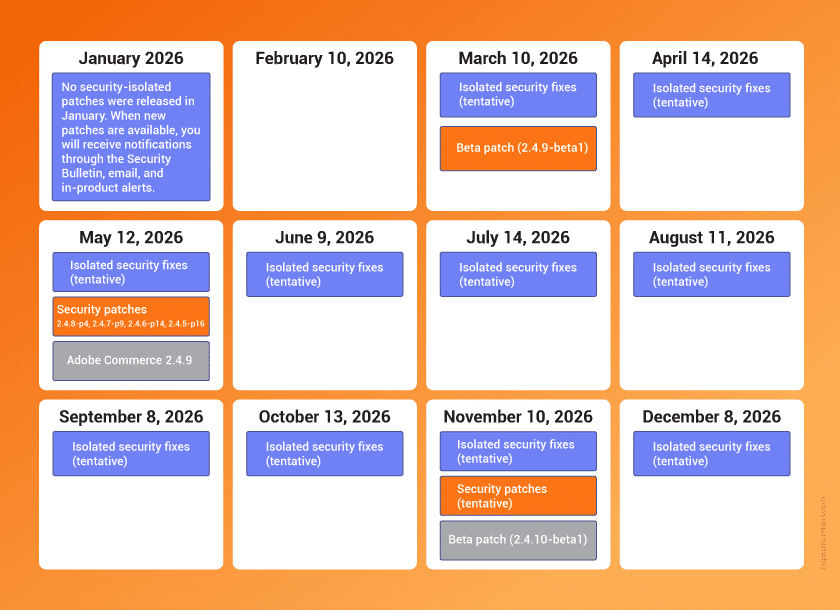
2026 Magento 2 Patch Release Schedule
Adobe Commerce follows a monthly patch release schedule with the following strategy:
- Isolated security fixes - Individual, non-cumulative security fixes may be released monthly and include security fixes for all supported release lines (includes regular and extended support).
- Security patches - At minimum, security patches are released annually (May) for all supported release lines. These patches include all previously released isolated security fixes. Adobe may release additional security patches in November if necessary, but it is not guaranteed.
- Patch - A full patch for the Adobe Commerce 2.4.x LTS release line (3-year support period) is released annually (May).
- Beta patches - Two beta patches for the Adobe Commerce 2.4.x LTS release line are released twice a year (March and November).
See the following image for details:
Best practice in 2026 (Summary of Supported Versions in 2026)
By early 2026, older versions will be unsupported.
Merchants are advised to be on 2.4.6, 2.4.7, or 2.4.8 to ensure security and compliance.
- Plan upgrades to 2.4.8 now to secure long-term support.
- Prepare for 2.4.9 in May 2026 (recommended production upgrade once stable).
- Avoid running near end-of-support versions after their sunset dates to minimize security risk.
Bottom Line
In 2026, Magento 2 is not just a platform update - it’s evolving into a full-featured commerce ecosystem powered by modern architecture, AI, mobile-first experiences, and flexible headless options. Merchants who adopt these enhancements can deliver personalized, scalable, and future-ready shopping journeys.
Ready to modernize your Magento store for 2026? Capital Numbers can help you upgrade to the latest Magento/Adobe Commerce, move to Hyvä or headless, optimize Core Web Vitals, and strengthen security - without disrupting sales. Talk to our Magento experts today.

Soumita NandyTech Lead
Dynamic Tech Lead with over 15 years of experience in web development and eCommerce solutions, Soumita specializes in Magento and Shopify. She excels at crafting innovative and scalable solutions for complex business needs. Her core strengths include thorough requirement analysis, delivering prompt and effective solutions, and mentoring team members to achieve excellence.