
How to Implement Generative AI in Production: An Enterprise Roadmap
Table of Contents
Quick Summary
Moving generative AI into production is not about picking the right model. It is about building the right system around it — clean data, sound architecture, governance from day one, and an organization ready to adopt it. This roadmap covers every decision that matters, in the order it matters.
Most Enterprises Have a GenAI Pilot. Only a Few Have a GenAI System.
That gap is where millions of dollars quietly disappear.
According to McKinsey’s 2025 State of AI survey, 88% of respondents say their organizations now use AI in at least one business function, while many are still experimenting with or piloting AI agents. [1] But using AI across the business and deploying GenAI in production are two different things. One is a controlled demo that proves interest. The other is a governed system that supports real workflows, users, data, and accountability.
Most enterprise leaders know which side of that line they are on. The pressure to cross it is real and growing.
What stands between a promising pilot and a production-grade GenAI system is not the model. It is everything built around it.
The data architecture, the governance decisions, the platform choices, the human workflows, and the organizational readiness to actually adopt the thing — that is what determines whether a Generative AI initiative compounds in value or quietly stalls. This generative AI roadmap walks through each of those elements in the order they actually matter.
What Does Generative AI in Production Actually Mean
It is important to define this clearly because “production” is often used too casually.
Generative AI in production means the system is no longer just a test or demo. It is working within a real business process, using approved company data, following security and compliance rules, being regularly monitored, and supporting real employees, customers, or operations teams.
| Area | Pilot | Production |
|---|---|---|
| Purpose | Tests whether the idea works | Proves business value at scale |
| Users | Small internal test group | Real employees, customers, or operations teams |
| Data | Sample or test data | Live, approved enterprise data |
| Governance | Limited controls | Security, compliance, and access rules built in |
| Monitoring | Occasional checks | Continuous tracking of quality, cost, adoption, and risk |
| Success metric | “It works” | Clear business outcome |
Getting a pilot to work is one thing. Building a system that runs reliably, stays secure, and that people actually use every day — that is a different problem entirely.
Why So Many GenAI Pilots Never Make It to Production
The blockers are consistent enough across industries that they are worth naming directly.
-
The wrong use case:
Teams chase impressive demos instead of workflows with a clear, measurable cost. Without a defined success metric, there is no honest path to production. -
Data that is not ready:
Enterprise data is scattered. CRMs, ERPs, PDFs, support tickets, knowledge bases, legacy databases — most of it is messy, inconsistently permissioned, and not structured for AI retrieval. This does not become obvious until you try to build something real with it. -
Hallucinations that kill trust quickly:
Even one visible error in a high-stakes workflow can damage confidence in a GenAI program. Hallucination risk cannot be handled through optimism. It needs grounding, validation, escalation paths, and human review where the business risk is high. -
Governance added too late:
Security controls and compliance requirements cannot be added cleanly to a live system. The enterprises that move fastest designed governance in from the start. -
A platform decision that never got made:
Many teams start building before deciding whether to use a managed cloud platform, third-party service, or open-source models. That ambiguity becomes expensive rework. -
People who do not adopt it:
A technically solid system that employees do not trust, understand, or find useful is a failed deployment — regardless of what the model can do.
What Is the Best Way to Implement GenAI in Production?
The best way to implement GenAI in production is to start with a measurable business use case, assess data readiness, choose the right build, buy, or partner model, design a grounded architecture such as RAG, add governance and human review from day one, roll out in stages, and monitor business impact continuously.
In simple terms, enterprises should not begin with the model. They should begin with the workflow, data, risk level, and business outcome they want to improve.
The Enterprise GenAI Implementation Roadmap: From Pilot to Production
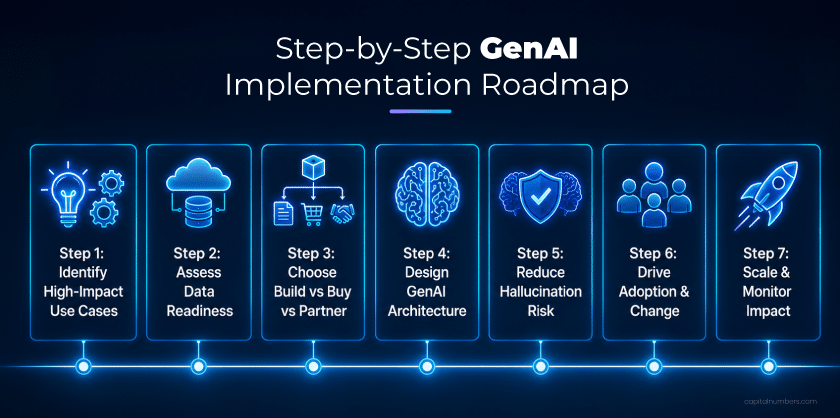
Moving GenAI into production takes more than one big technology decision. These seven steps show how enterprises can move from a promising pilot to a governed, usable, and measurable production system.
Step 1: Identify the Right Business Use Case Before Any Technology Decision
Every enterprise that has successfully deployed GenAI in production started with the same thing: a specific business problem with a measurable cost. Not “we want an AI strategy.” Something precise – this process takes too long, costs too much, and here is how we will know when it is fixed.
Strong candidates involve repetitive knowledge work, have clear inputs and outputs, carry manageable risk, and reach users who can provide early feedback. Common starting points: customer support assistants, sales proposal generators, HR policy tools, contract review assistants, engineering copilots.
Before any architecture conversation, five questions need clear answers:
- Who uses it?
- What workflow does it change?
- Which data does it need?
- What risks must be controlled?
- What metric proves success?
By the end of this step, the enterprise should have a measurable use case with clear users, data needs, risk boundaries, and business value.
If any of these answers are vague, the use case is not ready for production.
Step 2: Assess Enterprise Data Readiness Before You Build
No model can make up for poor data access. Before choosing architecture or technology, map where enterprise data actually lives, how current it is, who owns it, and what access rules govern it.
This work almost always surfaces the case for RAG – Retrieval-Augmented Generation. Instead of relying on a model’s training data, RAG retrieves relevant enterprise content before generating a response, grounding outputs in what the organization actually knows today. The industry has moved decisively here: Databricks research found that 70% of organizations now use vector databases and RAG to customize LLMs with their own proprietary data.[2]
Enterprise Data Sources
CRM | ERP | Knowledge Base | Documents | Tickets | Databases
↓
Data Cleaning + Classification
↓
Access Control + Permissions
↓
Indexing / Vector Database / Search Layer
↓
Grounded GenAI Application
For CXOs, the important point is simple: data readiness is not just a technical prerequisite. It is a business prerequisite. If enterprise data is not findable, current, permissioned, and trusted, the AI system will not be trusted either.
Skipping this step and hoping to fix it later is one of the fastest ways to spend twice the budget.
Step 3: Decide Whether to Build, Buy, or Partner Before Architecture Begins
The build, buy, or partner decision shapes the cost, speed, control, and long-term ownership of a GenAI system. Enterprises should make this call before architecture begins, as each option leads to different infrastructure, integration, governance, and support requirements.
- Managed cloud platforms — Azure OpenAI, AWS Bedrock, Google Vertex AI — are the fastest path to production for enterprises already on a major cloud, with built-in security, compliance tooling, scalability, and infrastructure integration.
- For enterprises in the US, UK, and Gulf region, Azure OpenAI and AWS Bedrock are especially relevant when compliance, data residency, and regional cloud requirements matter. Their deployment options help teams meet local market expectations without building the full GenAI infrastructure stack from scratch.
- Enterprise AI and data platforms such as Cohere, Databricks, Snowflake Cortex, or similar platforms can help teams customize, govern, and operationalize GenAI workloads with more flexibility than a narrow point solution.
- Custom open-source builds can offer greater control and potential long-term cost advantages, but only when the enterprise has the ML, DevOps, infrastructure, and governance maturity to support them.
- An experienced GenAI implementation partner becomes essential when internal teams need to move faster or lack depth in architecture, RAG, governance, LLMOps, or production rollout.
Make this decision deliberately and early. Every week it goes unmade is a week of architecture built on the wrong foundation.
By the end of this step, the enterprise should know which delivery model best balances speed, control, risk, internal capability, and long-term ownership.
Step 4: Enterprise GenAI Architecture: RAG, Agents, LLMOps, and Governance
The architecture should match the workflow, data sensitivity, risk level, and expected business outcome. A low-risk drafting assistant does not need the same architecture as a GenAI system that reviews contracts, supports customer service, or triggers actions across enterprise tools.
- Direct LLM integration suits low-risk tasks like drafting or summarization – fast to build, weak on grounding, not suitable for sensitive or consequential workflows.
- RAG-based architecture is the right starting point for most enterprise use cases. It connects the model to trusted internal data and makes outputs verifiable.
- Fine-tuned models work for domain-specific language or specialized output, a performance optimization, not a substitute for AI governance or workflow integration.
- Agentic workflows handle multi-step tasks: resolving a support ticket end-to-end, drafting and routing a contract summary, or generating a procurement recommendation. These need mature governance before going anywhere near production.
The pattern defining enterprise AI in 2026 is not “one model does everything.” Mature deployments combine RAG for grounding, rules-based automation for predictable steps, and bounded agents (agents designed to operate within defined limits rather than making open-ended autonomous decisions) for multi-step reasoning.
A production-ready GenAI architecture usually connects enterprise data, retrieval, model reasoning, workflow automation, human oversight, and monitoring into a single governed system.
Enterprise Systems
CRM | ERP | Knowledge Base | Documents | Tickets | Databases
↓
Data Cleaning + Permission Mapping
↓
Retrieval Layer / Vector Database / Search
↓
GenAI Application Layer
Direct LLM | RAG | Fine-Tuned Model | Bounded Agent
↓
Workflow + Automation Layer
Approvals | Ticket Updates | Drafts | Recommendations | System Actions
↓
Human-in-the-Loop Controls
Review | Escalation | Override | Feedback
↓
Monitoring + Governance
Logs | Audit Trails | Cost | Quality | Risk | Adoption
This structure keeps the model grounded in approved enterprise data, limits what AI can do on its own, and gives teams the visibility needed to monitor quality, cost, risk, and adoption.
AI that does too much autonomously is harder to govern, debug, and trust. The best enterprise systems are deliberate about what they automate, what they monitor, and what they route to a human.
Step 5: Reduce Hallucination Risk in Production GenAI Systems
Production GenAI needs AI governance designed in, not bolted on: data privacy, role-based access control, prompt logging, audit trails, hallucination controls, and regulatory compliance.
The exposure is real. Deloitte’s 2026 State of AI in the Enterprise report shows that agentic AI adoption is moving faster than governance: 74% of companies plan to deploy agentic AI within two years, but only 21% have a mature governance model for autonomous agents.[3]
Match automation to the risk profile of the task. Low-risk tasks, such as drafting, can be automated. Medium-risk tasks, including customer support, procurement recommendations, work best with AI drafting and a human approving. High-risk outputs, such as legal summaries and financial decisions, should always be made by an expert.
Good AI governance does not slow deployment. It removes the ambiguity that slows teams down in the first place.
Step 6: Drive Adoption — Change Management Is Not an IT Problem
A technically sound GenAI system can still fail if the people it was built for do not use it.
Adoption depends on trust, usefulness, training, and workflow fit. Employees need to understand what the system does, what it does not do, when to trust it, and when to challenge the output.
Start with lower-stakes workflows where users can build confidence. Train people to work with AI output instead of accepting it blindly. Create feedback channels and show users that their feedback improves the system.
For larger enterprises, adoption also needs internal champions. Department leaders, operations managers, and power users should help shape the rollout because they understand where work actually slows down.
The technology may be ready before the organization is. Closing that gap is a leadership responsibility, not just an IT task.
Step 7: Stage Your GenAI Rollout and Monitor Business Impact Continuously
A production rollout should be staged, not rushed.
A practical path looks like this:
Use Case Discovery → Data + Risk Assessment → Build/Buy/Partner Decision
→ Prototype → MVP with Real Users → Security + Governance Review
→ Controlled Production → Monitoring + Feedback → Scale
Scale only after the enterprise has verified business value, stable performance, governance confidence, and real adoption. Expanding weak pilots is not a strategy. It is an expensive way to multiply the problem.
After launch, monitor across three dimensions:
- Technical health: latency, uptime, error rates, token usage, infrastructure cost
- Model quality: accuracy, hallucination rate, retrieval quality, user feedback, escalation frequency
- Business value: time saved, adoption rate, cost per workflow, customer satisfaction, productivity impact
Enterprises should also monitor fallback behavior. When the AI is uncertain, lacks enough context, or reaches a risk boundary, the system should know whether to ask for clarification, retrieve more data, escalate to a human, or stop.
Model accuracy is a means. Business impact is the measure. Define the success metric before launch, not after.
GenAI Implementation Cost: What Enterprises Should Budget For
GenAI implementation cost depends on the use case, data readiness, integrations, governance, risk level, and rollout scope. A simple MVP on a managed platform may move quickly. But a production-grade enterprise system costs more because it must work with real data, real users, security controls, monitoring, and continuous improvement.
For enterprises, the real budget is rarely just model access or API usage. It usually goes into RAG architecture, data preparation, integrations, LLMOps (the operational practices for monitoring, evaluating, and maintaining AI models in production), compliance, human review, user training, and post-launch optimization.
So, when leaders ask, “How much does enterprise GenAI cost?”, the better answer is: cost rises when GenAI moves from a controlled pilot to a governed production workflow tied to real business outcomes.
Most production GenAI costs fall into four areas:
- Initial build: architecture, application development, integration, security setup
- Ongoing operations: model usage, infrastructure, support, maintenance
- LLMOps and governance: monitoring, audit trails, evaluation, compliance, human oversight
- Continuous optimization: prompt tuning, retrieval improvement, performance tuning, and user feedback loops
Model API usage is only one part of the total spend. The larger budget usually sits in the enterprise work around it: preparing data, connecting systems, managing risk, supporting users, and improving the system after launch.
| Cost Driver | Why It Matters |
|---|---|
| Data readiness | Poor data increases cleanup, mapping, and governance efforts. |
| Integrations | More systems mean more engineering, testing, and maintenance. |
| Risk level | Higher-risk workflows need stronger controls, validation, and human review. |
| LLMOps | Production systems need monitoring, evaluation, auditability, and continuous improvement. |
| Rollout scope | More users and workflows increase training, support, change management, and adoption efforts. |
The better question is not “What does the model cost?” It is “What business value does each AI-assisted workflow create?”
Common Mistakes That Stall Enterprise Generative AI Deployments
The patterns that kill enterprise GenAI programs are remarkably consistent:
- Choosing the model before choosing the use case
- Skipping the build vs. buy decision and letting it make itself
- Treating a single chatbot as an AI strategy
- Moving fast on architecture, slow on data readiness
- Deploying without clear ownership or accountability
- Assuming compliance can be added after launch
- Skipping human review on consequential outputs
- Failing to monitor hallucinations, cost, or adoption post-launch
- Scaling disconnected pilots instead of building reusable foundations
- Underestimating how long it takes for employees to genuinely adopt something new
These mistakes are avoidable. But only if production readiness is treated as part of the plan from day one.
Final Word: The Model Is Only One Part of the Production Problem
Getting generative AI into production is not a one-time technology decision. It is a discipline: choosing the right problem, building the right system, governing it responsibly, and improving it as real users interact with it.
The enterprises getting more from GenAI are not simply choosing better models. They are building better systems around those models. That is what separates a promising pilot from a production deployment that keeps improving business value over time.
Work with Capital Numbers Capital Numbers helps enterprises move GenAI from proof of concept to production with practical architecture, secure integrations, RAG-based systems, LLMOps, and human-in-the-loop workflows. With 500+ in-house tech professionals and experience across AI, cloud, data engineering, and enterprise software, we help teams build GenAI systems around real business workflows, not isolated experiments. Schedule a discovery call →
Frequently Asked Questions
1. What is the difference between a GenAI pilot and a production GenAI system?
A GenAI pilot validates the idea in a controlled setting. A production GenAI system proves it can support real workflows reliably, securely, and at scale.
2. How long does it take to move generative AI from pilot to production?
The timeline depends on the use case, data readiness, integration needs, risk level, and governance requirements. A focused GenAI MVP on a managed platform may move faster, while a larger enterprise rollout with RAG, LLMOps, security reviews, and multiple workflows usually needs a phased approach.
3. Is RAG necessary for enterprise GenAI implementation?
RAG is not required for every GenAI use case, but it is often the right starting point for enterprise systems that need accurate, current, and verifiable responses. It helps the AI retrieve approved company data before generating an answer, reducing reliance on the model’s general training data.
4. How should enterprises control hallucinations in production GenAI?
Enterprises can reduce hallucination risk through RAG-based grounding, trusted data sources, output validation, access controls, feedback loops, and human review for high-risk tasks. The goal is not to eliminate every possible error, but to make errors visible, manageable, and accountable.
5. How much does enterprise GenAI implementation cost?
Enterprise GenAI implementation cost depends on the complexity of the use case, data readiness, integrations, risk level, and rollout scope. A simple MVP may move faster, while a production-grade system usually needs deeper investment in architecture, governance, monitoring, compliance, and continuous optimization.
References
| 1. | McKinsey & Company: The State of AI in 2025: Agents, innovation, and transformation — https://www.mckinsey.com/capabilities/quantumblack/our-insights/the-state-of-ai |
| 2. | Databricks: State of AI: Enterprise Adoption & Growth Trends — databricks.com/blog/state-ai-enterprise-adoption-growth-trends |
| 3. | Deloitte: The State of AI in the Enterprise, 2026 — https://www.deloitte.com/us/en/what-we-do/capabilities/applied-artificial-intelligence/content/state-of-ai-in-the-enterprise.html |


 Web Development
 Cloud Engineering
 Mobile App Development
 AI/ML/GenAI
 E-commerce
 Software Development
 UI/UX
UI/UX QA
QA Dedicated Teams