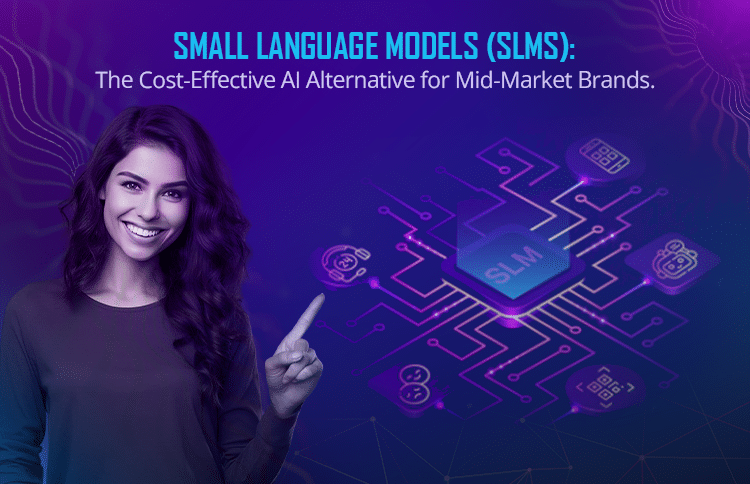

Small Language Models (SLMs): The Cost-Effective AI Alternative for Mid-Market Brands
Table of Contents
Executive Summary
- Small language models are built for focused AI tasks such as classification, summarization, search, extraction, and routing.
- For many mid-market brands, they offer a better balance of cost, speed, control, and deployment flexibility than large language models.
- They work best when the AI use case is narrow, repeated, high-volume, or sensitive from a data and governance perspective.
- Large language models still make more sense for broad reasoning, open-ended interaction, and more complex generation.
- In 2026, many strong AI systems are multi-model systems, with smaller models handling routine workflow steps and larger models used only when needed.
Small language models are AI models designed for specific business tasks, such as classification, summarization, search, extraction, and routing. In 2026, they matter more because businesses are evaluating AI based on production value rather than just model power.
For many mid-market brands, SLMs are often a better fit than LLMs when the goal is to support clear, repeatable workflows with lower cost, faster response times, and better deployment control. LLMs still make more sense when the use case requires broader reasoning, open-ended interaction, or more flexible generation.
That is why the real question is not which model is bigger. It is which model fits the workflow, the budget, the deployment needs, and the level of control required in production.
This blog explains when SLMs make sense, where LLMs still work better, and how businesses can evaluate the right fit for real AI use cases.
Why Do Small Language Models Matter More in 2026?
SLMs matter more in 2026 because AI adoption has become more operational. Businesses care less about model size alone and more about how AI performs inside real workflows.
That means buyers are paying closer attention to:
- cost at scale
- response speed inside live workflows
- retrieval of trusted internal knowledge
- deployment control and governance
- safe failure handling
- long-term operating efficiency
This shift makes SLMs more relevant to businesses looking for cost-effective AI solutions.
Imagine an internal HR and finance support assistant. Employees ask questions like:
- Where can I find the leave policy?
- How do I submit a reimbursement?
- Who approves a vendor payment?
A large language model can answer these questions. But using one for every request may be slower, more expensive, and harder to govern than necessary. A smaller model paired with retrieval from approved internal documents may handle the same job more efficiently.
How Are Small Language Models Different from Large Language Models?
The simplest way to think about it is this:
LLMs are built for range.
SLMs are built for focus.
Large models are useful when the task is broad, variable, or reasoning-heavy. Small models are more useful when the task is narrower, more predictable, and easier to define within a workflow.
This is where the LLM vs SLM for enterprises discussion becomes practical. The better choice depends less on hype and more on the workflow, the operating constraints, and the level of cost, speed, and control the business actually needs.
| Area | Small Language Models (SLMs) | Large Language Models (LLMs) |
|---|---|---|
| Main strength | Efficiency in focused tasks | Flexibility across many tasks |
| Cost to run | Usually lower | Usually higher |
| Response speed | Often faster | Often slower |
| Best fit | Repeated business workflows | Broad, open-ended interactions |
| Deployment options | Often easier in controlled environments | More infrastructure-heavy |
| Reasoning range | More limited | Broader |
When Should a Business Use a Small Language Model?
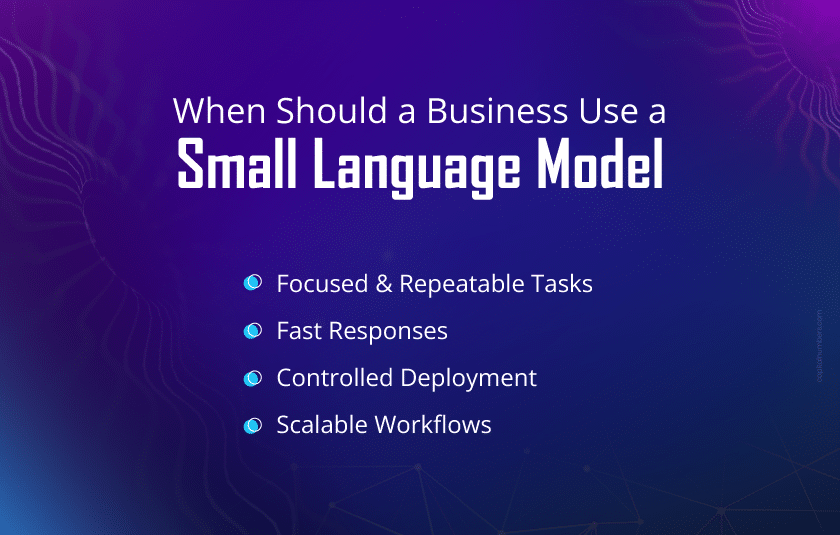
A business should consider a small language model when the AI use case is clear, repeated, and tied to a real workflow.
1. When the task is focused and repeatable
Common examples include:
- sorting requests
- extracting fields from documents
- searching internal knowledge
- routing work to the right team
These tasks matter, but they do not always need a large model. In many cases, speed, consistency, and operating cost matter more.
2. When response time affects the workflow
If AI is part of a live process, slow responses create friction.
A sales assistant in a CRM, an internal support tool, or a product feature that requires quick output all work better when the response feels immediate. In these situations, smaller models can be a better fit because they support faster interactions without unnecessary overhead.
3. When deployment control matters
Some organizations need tighter control over where AI runs and how business data is handled. This is where SLMs can be a strong fit for private AI for enterprises, especially when governance, infrastructure choice, and stricter data-handling requirements are involved.
This often matters in internal knowledge systems, policy-heavy workflows, document-based operations, and other environments handling business-sensitive information.
4. When the workflow runs at scale
A model that looks affordable in a pilot may become expensive when it runs thousands of times a day.
That is why many teams are looking for cost-effective AI for business, not just more capable models. If the AI use case is focused and high-volume, a smaller model may offer much better economics over time. This also makes SLMs useful in ROI-driven AI scaling, where every step of expansion needs to be tied back to measurable value.
When Are Large Language Models a Better Choice?
Large language models make more sense when the work needs broader reasoning, greater flexibility, or more open-ended interaction.
-
When the user input is unpredictable
If users can ask almost anything and expect a natural response, a larger model is usually the better choice.
For example, a customer-facing assistant in travel, banking, or healthcare may need to handle changing intent, vague phrasing, and a wide range of question types. That is harder to manage with a narrower model.
-
When the task requires deeper reasoning
If the work involves comparing options, analyzing long inputs, or handling ambiguity, larger models usually perform better.
For example, helping a leadership team review multiple vendor proposals requires a different level of synthesis than classifying incoming support requests.
-
When one system must do many kinds of work
If the same system is expected to support writing, summarization, coding, analysis, planning, and research, a larger model may justify the extra cost because of its wider capability.
That is why this discussion is not really about replacing LLMs. It is about understanding where each type of model adds the most value.
Why Is a Hybrid AI Strategy Often the Better Choice?
For many businesses, the best answer is not choosing one model for everything. It is building a system where each model handles the kind of work it is best suited for.
In 2026, this is one of the most practical ways to design AI systems.
A typical hybrid setup may look like this:
- a small model handles routine, high-volume tasks
- retrieval brings in trusted business data
- a larger model is used for more complex or ambiguous requests
- human review stays in place for sensitive cases
This kind of model routing helps businesses balance cost, speed, control, and capability.
For example, in an insurance workflow:
- an SLM classifies incoming claim documents
- retrieval pulls policy information from internal systems
- a larger model steps in only when the case is unusual
- a human reviewer handles the final decision for edge cases
This kind of routing keeps businesses from using a larger, more expensive model for every step when only some parts of the workflow actually need it.
It also reflects how many 2026 AI systems are being designed. SLMs can support bounded automation steps such as validating inputs, selecting the next workflow step, choosing the right tool, or routing a case for escalation. In other words, they are often useful not as standalone assistants, but as reliable components inside a larger AI system with clear rules, oversight, and handoff points.
How Should Businesses Evaluate an SLM for a Real AI Use Case?
The best way to evaluate an SLM is to start with the workflow, not the model.
Before choosing a model, ask these questions:
- Is the task narrow or broad?
If the task is predictable and clearly defined, a smaller model may be enough. - Does speed matter inside the workflow?
If employees or customers are waiting in real time, latency becomes part of the business case. - What is the cost per successful outcome?
The better question is not just what the model costs to run, but what it costs to complete a useful task correctly. - Does the system need business-specific knowledge?
If yes, retrieval may matter more than model size alone. - What happens when the model is unsure?
A production system needs a fallback path when confidence is low or the request is out of scope. - Can the workflow be measured clearly?
If success cannot be measured, it will be difficult to prove value or improve performance over time.
These questions usually lead to better decisions than starting with model names or benchmark comparisons.
How Does a Small Language Model Work in a Business Workflow?
In most business systems, a small language model handles one focused task inside a larger process rather than acting as a general-purpose chatbot.
A typical workflow looks like this:
- A document, request, form, or ticket enters the system.
- The SLM classifies, extracts, summarizes, or routes the input.
- Retrieval adds trusted business information when needed.
- Low-confidence or complex cases are escalated.
- The result is reviewed, logged, and measured over time.
That is why SLMs are often effective in production. They fit well into workflows where the task is clear and the output needs to stay reliable.
How Can Businesses Deploy SLMs Successfully?
The best way to start is not to build a large AI platform. It is to improve one useful workflow first.
Start with one high-value use case
Look for a workflow that is:
- repeated
- easy to measure
- operationally important
- still too manual today
Good examples include internal support, document handling, summarization, request routing, or knowledge search.
Add retrieval when the task depends on business knowledge
Not every use case needs retrieval. But if the system needs to answer questions based on company documents, policies, product information, or internal rules, retrieval can make the output more reliable and easier to govern.
For example, an internal HR assistant should pull from approved documents instead of relying only on general model behavior.
Build evaluation and guardrails early
A strong production setup needs more than a good-looking response.
Teams should define:
- what counts as a correct result
- when the system should escalate
- how grounded the output must be
- what kinds of failure are acceptable
- what logs and reviews are needed for oversight
This is especially important in sensitive workflows, where the system needs to fail safely and hand off to a human when needed, rather than confidently returning the wrong answer.
Measure the right things
Do not judge the system only by whether the answer sounds polished. What matters more is whether it works well in context.
| What to measure | Why it matters |
|---|---|
| Task success rate | Shows whether the workflow is being completed correctly |
| Accuracy | Helps assess output quality |
| Groundedness | Shows whether outputs stay tied to trusted business data |
| Escalation rate | Reveals how often the system cannot handle the task confidently |
| Latency | Matters for user experience |
| Cost per successful workflow | Helps judge real business value |
Keep the architecture flexible
Models will continue to change. A business does not want to rebuild its system every time that happens. A flexible setup makes it easier to swap models, improve routing, update prompts, or adjust retrieval without redesigning the whole workflow.
What Should CTOs Evaluate Beyond Model Size?
Model size matters, but it is not enough on its own.
Beyond model size, the real question is whether the system can stay fast, affordable, reliable, and manageable under production demands. That is why technical choices matter so much. They directly affect user experience, operating cost, deployment flexibility, and how well the system holds up as usage grows.
CTOs should also look at:
- context window needs to understand how much information the workflow must handle
- throughput and concurrency to see how the system performs under real demand
- hardware fit to check whether the model can run well on available infrastructure
- adaptation method to decide whether prompting, retrieval, fine-tuning, or a mix is needed
- confidence handling to define what happens when output quality drops
- monitoring and review to track latency, quality, failures, and cost over time
- portability and lock-in risk to avoid overdependence on one model or vendor setup
These are the factors that turn an AI proof of concept into a dependable production system.
What Business Outcomes Can Small Language Models Support?
When used appropriately, SLMs can support meaningful business outcomes.
| Technical advantage | Business outcome |
|---|---|
| Faster response times | Better user experience and smoother workflows |
| Lower compute needs | Lower operating cost |
| Better fit for narrow tasks | More consistent output in repeated workflows |
| Better deployment control | Stronger support for governance and internal requirements |
| Efficient scaling | Matters for user experience |
| Cost per successful workflow | Better economics as usage grows |
| Retrieval-backed responses | More reliable answers tied to approved business content |
For the right workflow, those gains can make AI easier to justify, easier to govern, and easier to scale.
How Can Businesses Choose the Right Model for the Right AI Use Case?
For most mid-market brands, the key question is not which model is bigger. It is which model can support the AI use case with the right balance of speed, cost control, and operational reliability.
In many cases, the best AI strategy in 2026 is not about choosing one model. It is about building the right workflow, using retrieval where needed, adding guardrails, and matching each task to the right level of model capability.
If you are evaluating where SLMs fit into your AI roadmap, Capital Numbers can help you assess the workflow, choose the right model strategy, and identify where a smaller model can deliver faster, more cost-effective results. Get in touch to discuss your use case.
FAQs About Small Language Models
1. What is a small language model?
A small language model is an AI model designed for focused tasks such as classification, summarization, search, extraction, and routing. It usually needs less compute and is often a better fit for narrow, repeated business workflows than a large language model.
2. When should a business use an SLM instead of an LLM?
A business should consider an SLM when the task is narrow, repeated, latency-sensitive, or cost-sensitive. If the task is broad, reasoning-heavy, or highly variable, a larger model may be the better fit.
3. Can small language models work with retrieval?
Yes. A smaller model combined with retrieval can answer business-specific questions more reliably by using approved internal content.
4. Are SLMs suitable for enterprise use?
Yes, especially for enterprise workflows such as document processing, internal support, knowledge search, summarization, classification, and routing.
5. Can small language models run on-premise?
Some can, depending on the model, hardware, and performance requirements. This is one reason they are attractive to businesses that want more deployment control.
6. Are small language models better than LLMs for business AI?
Not always. Small language models are often better suited to focused, well-resourced, high-repetition workflows where cost, speed, and deployment control matter. Large language models are usually better when the work requires broader reasoning, more flexibility, or open-ended interaction.


 Web Development
 Cloud Engineering
 Mobile App Development
 AI/ML/GenAI
 E-commerce
 Software Development
 UI/UX
UI/UX QA
QA Dedicated Teams