
How to Hire an AI Development Company: Skills, Team Structure & Red Flags
Table of Contents
Choosing the right AI development company is not just about checking technical skills. It is about finding a partner that can build AI solutions your business can actually use, scale, and trust.
For business leaders, that means looking beyond AI expertise such as Machine Learning, Natural Language Processing, or Large Language Models. You also need to review the team structure, delivery process, data security standards, and the company’s ability to take projects from pilot to production.
A suitable AI development partner should understand your needs, have proven results, follow proper ways of working, offer transparent pricing, and provide reliable post-launch support. This guide breaks down the skills, team structure, and red flags that matter most, so you can evaluate AI partners before time, budget, and momentum are lost.
Things to Do Before Partnering with an AI Development Company
Many AI projects go off track because companies start with the tool rather than the business need. “We need GenAI” or “we need a chatbot” may sound clear, but they often lead to unclear scope and weak outcomes.
Before evaluating any company for AI development services, define what you need from the project. This helps you choose the right partner, set realistic expectations, and avoid wasted time and budget. First, check whether an existing SaaS product or solution already meets your needs before committing to custom development.
-
-
Define the Problem You Want to Solve
You can start with the business problem, not the AI solution. Be clear about what needs to improve.
Examples:
- ➔ Reduce support load
- ➔ Improve sales conversion
- ➔ Automate internal workflows
- ➔ Improve forecasting
- ➔ Speed up delivery
A clear problem statement makes it easier to judge whether a vendor understands your goals.
-
Define the Type of Engagement You Need
Be clear about your stage so you can choose the right partner.
- ➔ Discovery / AI roadmap: Define the problem, check feasibility, and plan the AI roadmap.
- ➔ PoC: Test if the AI solution works for your use case and data.
- ➔ MVP: Build a basic working version with core features.
- ➔ Production rollout: Deploy the solution for real users with required integrations.
- ➔ Ongoing optimization: Improve performance, accuracy, and adoption after launch.
Not every AI company is equally strong at every stage.
-
Set Decision Boundaries Early
Define a few basics before vendor discussions:
- ➔ Budget range
- ➔ Timeline
- ➔ Data readiness
- ➔ Compliance requirements
- ➔ Internal ownership
This keeps the project focused and avoids scope drift.
-
Define Success Metrics Early
Agree on what success looks like before the build starts.
- ➔ Business outcomes: Cost, revenue, and productivity
- ➔ Operational outcomes: Speed, accuracy, and reliability
- ➔ Adoption outcomes: Usage, team adoption, and workflow impact
-
A strong AI development company will help you define these metrics early and align delivery around them.
What to Expect From an AI Development Company
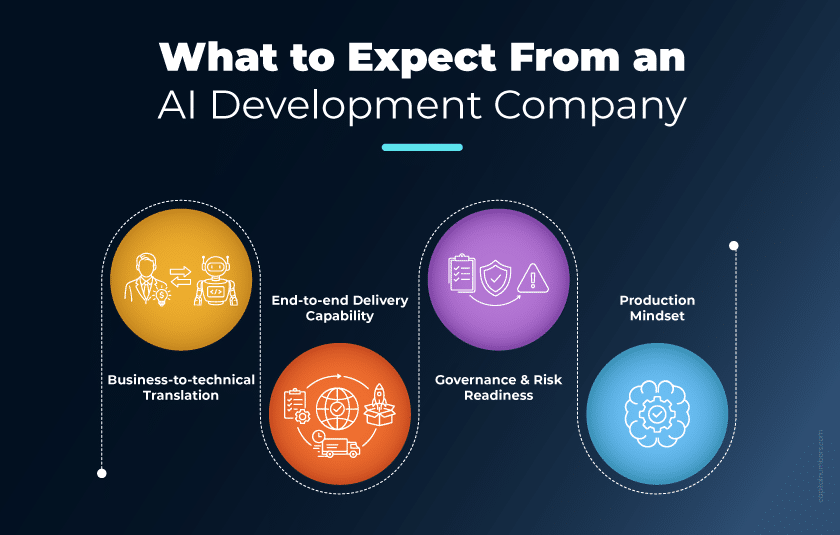
Once your business case is clear, the next step is to check whether the company can actually deliver. A reliable AI development partner should do more than build a demo. It should connect your business goals with the right solution, deliver it effectively, and support it after launch.
-
Business-to-technical Translation
A suitable partner should understand your business goals and turn them into practical AI use cases. They should explain which solution fits best and clearly discuss trade-offs such as speed vs. accuracy or custom-built vs. ready-made tools. They should also define what is realistic at each stage, what data is needed, and how the solution will support workflows, users, and business outcomes.
-
End-to-end Delivery Capability
Whether you plan to hire an AI development company or use AI staff augmentation, the team should handle the full delivery process. This includes:
- ➔ Data preparation
- ➔ Model implementation or integration
- ➔ Product or workflow integration
- ➔ Testing and evaluation
- ➔ Deployment and monitoring
A reliable partner should also explain how these stages connect, who owns each stage, and what support your team needs. Many AI projects fail not at the model level, but during integration, rollout, or adoption.
-
Governance and Risk Readiness
A strong partner should be ready to discuss data security, compliance awareness, access controls, auditability, and AI ethics from the start. These issues matter early, especially in customer-facing or business-critical AI workflows. They should also reference recognized standards such as ISO 27001 and SOC 2 to ensure robust data protection. Besides, they should explain how they handle sensitive data in practice, including PII masking, restricted access, and rules for prompts, logs, or vector databases. Vague privacy answers are a warning sign.
-
Production Mindset
Finally, look for a partner that can move beyond a pilot or demo and support a real rollout. If you want to hire dedicated AI engineers, ask how they will handle scaling, maintenance, support, and ongoing improvements. For LLM-based systems, they should also explain which LLM evaluation frameworks they use to assess hallucinations, factual accuracy, consistency, latency, and production costs. Without that, they are not ready for production AI delivery.
Core Skills to Look For When Hiring an AI Development Company
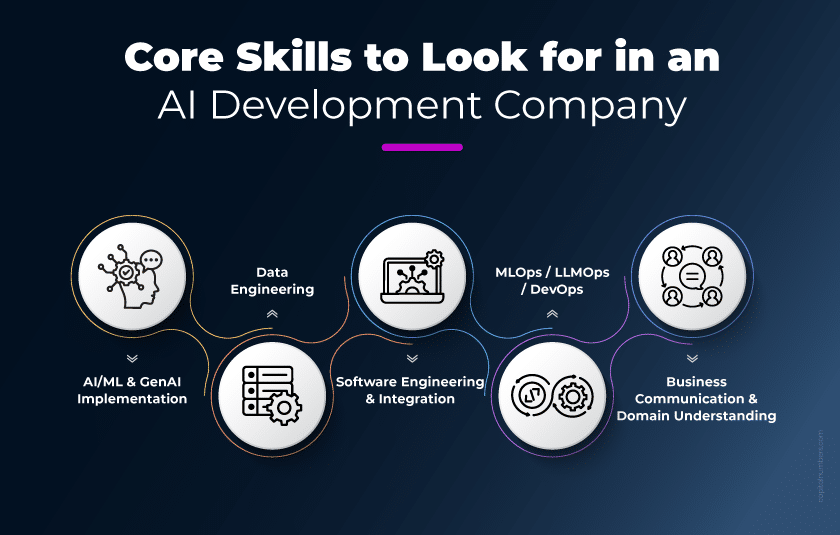
This is the most important part of your evaluation. If the core skills are weak, delivery can slow down. When partnering with an AI development company, check if they have the skills to build, launch, and improve the solution.
-
AI/ML and GenAI Implementation Skills
The team should know how to choose the right model for your use case and integrate it properly into your systems. If the project involves Generative AI or knowledge-based use cases, they should also be comfortable with prompt design, retrieval, and RAG, and improving output quality over time. They should also have a clear approach to evaluating performance for accuracy, consistency, speed, and cost. They should not treat model choice as the starting point for every discussion. If a vendor pushes a custom LLM too early, before validating the use case, data readiness, workflow fit, and ROI, that should raise concern.
-
Data Engineering Skills
AI projects depend heavily on data quality. A reliable partner should be able to connect data from different systems, clean and prepare it for use, and set the right access and permission controls. They should also implement data quality checks, especially in larger business environments with multiple teams and systems. Besides, they should know how to safely prepare business data for AI, including PII masking, retention rules, and control over which data can be used for retrieval, fine-tuning, or logging. Weak data handling often creates more risk than weak model selection.
-
Software Engineering and Integration Skills
AI features still need strong software engineering. The company should be able to handle API integration, backend and frontend development, and workflow automation. They should also have a QA approach that fits AI-based features, because testing AI is not the same as testing standard software. This is especially important in customer-facing workflows, where inconsistent outputs can affect trust and user experience. A capable partner should also be able to connect AI features cleanly into your existing systems and make them usable, traceable, and dependable across the full workflow, not just the AI layer itself.
-
MLOps / LLMOps / DevOps Skills
A good AI solution is not complete at launch. The team should have the skills to build deployment pipelines, monitor quality and uptime, manage model or version updates, handle incidents, and put rollback plans in place to prevent issues from disrupting business operations. For LLM-based systems, this should also include prompt versioning, response evaluation, dataset version control, fallback handling, cost monitoring, and traceability. These operational basics help reduce the risk of hallucinations, control spending, and improve reliability over time.
-
Business Communication and Domain Understanding
Technical skills alone are not enough. A reliable partner should be able to explain decisions in simple language, understand your industry context, and report progress in a way business leaders can act on. They should also ask the right business questions early, challenge weak assumptions, and connect technical choices to practical business impact. This matters because budget, risk, and rollout decisions depend on clear communication and domain understanding.
Team Structure: Who Should Be on the AI Delivery Team
Even a skilled AI company can struggle if the team structure is weak. AI projects often slow down when roles are unclear or ownership is split. Before signing, business leaders should understand who will be on the team and what each person is responsible for.
Key Roles in a Capable AI Team
A capable AI delivery team usually includes:
- AI/ML Engineer: Builds and improves the AI logic and output quality.
- Data Engineer: Prepares data, connects systems, and supports data quality.
- Backend Engineer: Handles APIs, integrations, and backend workflows.
- Frontend Engineer (if user-facing): Builds the user interface and interactions.
- MLOps/DevOps Engineer: Manages deployment, monitoring, and updates.
- QA/Test Engineer: Tests functionality, consistency, and edge cases.
- Product/Delivery Lead: Manages scope, priorities, timelines, and communication.
- Solution Architect (for complex work): Guides architecture and integration decisions.
Not every project needs all roles full-time, but these responsibilities should be covered.
Team Shape by Project Stage
The team should match the project stage:
- Discovery / PoC: A lean team is usually enough.
- MVP: A cross-functional team is needed to build a usable product.
- Production rollout: A fuller team is needed, with stronger governance and reliability oversight.
A good partner should explain how the team will evolve as the project moves forward.
What CXOs Should Confirm
Before you hire, confirm:
- Who is dedicated to your project, and who shared?
- Who owns delivery outcomes?
- Who makes architecture and security decisions?
- What happens if a key team member changes?
These questions help reduce delivery risk and ownership gaps later.
Commercial Model and Delivery Approach for Choosing an AI Development Company
The commercial model matters as much as the technical team. Many AI projects go off track because the engagement model does not align with how AI is done. Since AI projects involve testing, iteration, and changing requirements, the delivery approach should allow flexibility without losing control.
Common Engagement Models:
Most AI development companies offer these models:
- Fixed scope: Best for clearly defined work with limited changes.
- Time & materials: Better when the scope may change.
- Dedicated pod/team: A team that works as an extension of your internal team.
- Hybrid Model: Combines predictability and flexibility by separating early-stage validation from later iterative work.
What Works Best for AI Projects
AI projects often evolve as data, workflows, and outputs are refined. That’s why rigid contracts can create risk or slow progress. Flexible approaches, like T&M or a dedicated pod, allow teams to adapt while keeping delivery under control.
For leaders who want to balance financial certainty with flexibility, a hybrid model can work well: start with a fixed-cost Discovery or PoC phase to validate the approach and limit early risk, then transition to T&M or a dedicated pod as the project moves into MVP and production.
What to Ask before Signing
Before signing, ask:
- How do you manage scope changes?
- Which engagement model do you recommend for this project, and why?
- How do you report progress, risks, and decisions?
Proper answers to these questions usually indicate a more dependable and better-prepared delivery partner.
Data, IP Ownership, and Vendor Lock-In: What You Should Clarify
Before you sign, get clear on practical ownership and portability questions. These details often become serious issues later if they are ignored early.
Clarify:
- Who owns prompts, evaluation sets, workflows, and integration code?
- How long is data retained, and how is it deleted?
- Where is context stored (logs, embeddings, vector databases)?
- Can the solution be moved to another stack or vendor if needed?
- What third-party model terms apply, and what risks come with them?
- If a model is fine-tuned for your use case, who owns the fine-tuned model weights and any related artifacts?
A reliable AI development company should be comfortable discussing these points. In AI projects, ownership often extends beyond code. If that is unclear, vendor lock-in risk becomes much higher.
Red Flags to Watch Before You Sign With an AI Development Partner
A strong pitch or demo does not always mean strong delivery. Before you sign, check for red flags in strategy, delivery, governance, and commercials. These issues often lead to delays, weak results, or avoidable risk later.
Strategy Red Flags
- ➔ They start with tools instead of your business problem
- ➔ They overpromise outcomes
- ➔ They avoid discussing ROI, adoption, or workflow impact
- ➔ They recommend custom model training or fine-tuning before understanding your data, use case, and business constraints
- ➔ They talk more about the model than about the business process that the AI needs to improve
An effective partner should connect AI work to business value, not just technical features. Most companies do not need a custom LLM first. They need better data, stronger retrieval, and cleaner workflow design. If a vendor pushes model training too early, step back.
Delivery Red Flags
- ➔ No clear plan for data preparation
- ➔ No testing or evaluation process
- ➔ No deployment or monitoring plan
- ➔ Weak communication cadence
- ➔ No clear ownership of delivery outcomes
- ➔ No explanation of how hallucinations, response quality, or edge cases will be measured
- ➔ No clear approach to privacy controls, such as PII masking, access restrictions, or log management
These are early signs that the project may struggle during implementation or rollout.
Governance Red Flags
- ➔ Vague answers on data security
- ➔ No compliance awareness
- ➔ No audit trail or access-control thinking
Governance should be part of the project from the beginning, not added later.
Commercial Red Flags
-
- ➔ Very low pricing with unclear scope
- ➔ No milestones or acceptance criteria
- ➔ Push for long contracts before discovery or early validation
A good partner should earn trust through execution, not just pricing or contract terms.
How to Evaluate and Compare AI Development Companies
Once you have a shortlist, compare companies in a structured way. This helps you avoid choosing only based on pricing, brand name, or a polished demo.
-
-
Build a Relevance Shortlist
Start with companies that are a close fit for your needs. Look for:
- ➔ Similar use cases
- ➔ Industry experience
- ➔ Production delivery examples (not just PoCs)
-
Use a Simple Scorecard
Use a simple scorecard to compare vendors side-by-side. Score them on:
- ➔ Business understanding and technical capability
- ➔ Team strength and delivery maturity
- ➔ Governance readiness and communication quality
- ➔ Commercial fit
This keeps the evaluation practical and makes internal comparison easier.
-
Validate Through a Real Working Session
Do not rely only on proposals or sales calls. Test how the team works through:
- ➔ A discovery workshop or technical assessment
- ➔ A small paid milestone
This helps you assess how they think, communicate, and handle uncertainty.
-
Start Small, then Scale
-
Begin with a defined milestone and clear outcomes. Expand the engagement only after you see clear proof of execution. This reduces risk and gives you more confidence before scaling the partnership.
Questions Every CXO Should Ask Before Hiring an AI Development Partner
This section should help you test how the company thinks in a real discussion. Use these questions to check business fit, delivery readiness, accountability, and risk handling.
-
Business and Outcome Questions
- Which use case should we start with, and why?
- What business impact can we expect first?
- What could make this project fail?
-
Delivery and Technical Questions
- What do you need from our team to start?
- How will you test output quality?
- How will this fit into our current systems?
- What will you monitor after launch?
- How will you measure hallucinations, accuracy, and consistency in production?
- How will you handle PII, sensitive business data, and privacy controls across prompts, logs, and retrieval systems?
- Do we actually need fine-tuning or custom model work, or can this be solved through better data and workflow design?
-
Team and Governance Questions
- Who will lead the project day to day?
- How will you handle risks and blockers?
- How do you handle sensitive data?
- What happens if a key team member changes?
- If model fine-tuning is involved, who owns the model weights and related assets?
-
Commercial Questions
- What is included in the estimate, and what is not?
- How do you handle scope changes?
- What post-launch costs should we expect?
- What support do you provide after launch?
These questions help you compare AI development companies more effectively and avoid gaps later in the delivery process.
Choose an AI Partner That Can Deliver Beyond the Demo
AI expectations are rising, but business leaders still need to move carefully and get real results without taking on unnecessary risk. The right partner helps you move from idea to execution with a plan that fits your goals, systems, and way of working.
Start by defining the business outcome, checking the team and skills you need, and evaluating partners on execution, not just demos. Often, the best AI partner is not the one promising the most advanced model, but the one that can strengthen your data foundation, build the right workflow, measure quality properly, and reduce avoidable risk.
Want to choose the right AI partner for your business? Book a 30-minute discovery call with our expert developers. We will review your use case, highlight the key gaps and risks, and share clear next steps.
Frequently Asked Questions
1. What should I do before contacting an AI development company?
Before reaching out to an AI development company, you should clearly define the business problem you want to solve. You should also:
- Identify your current stage (e.g., Discovery, PoC, or MVP).
- Set initial decision boundaries regarding your budget, timeline, and data readiness.
- Establish success metrics across business, operational, and adoption outcomes.
2. What are the essential roles in a professional AI delivery team?
A capable AI team is cross-functional and typically includes:
- AI/ML Engineer: Builds the AI logic and improves output quality.
- Data Engineer: Handles data preparation and system connections.
- Backend/Frontend Engineers: Manage APIs, integrations, and user interfaces.
- MLOps/DevOps Engineer: Responsible for deployment, monitoring, and updates.
- Product/Delivery Lead: Manages scope, priorities, and communication.
3. Which engagement model is best for AI development projects?
As AI projects often involve unknowns, data issues, and iterative tuning, flexible models like Time & Materials or a Dedicated Team are often superior to fixed-scope contracts. These models allow for necessary pivots as the project evolves without losing control over delivery risk.
4. What are the “Red Flags” to watch out for when hiring an AI partner?
You should be cautious if a company shows the following signs:
- Strategy: They start with tools instead of your business problems or overpromising outcomes.
- Delivery: They lack a clear plan for data preparation, testing, or post-launch monitoring.
- Governance: They provide vague answers regarding data security and compliance.
- Commercials: They push for long-term contracts before a discovery phase or provide very low pricing with an unclear scope.
5. How do I evaluate an AI company’s technical maturity?
Look beyond the sales pitch by checking for production mindset skills. A mature partner should demonstrate:
- RAG and LLMOps expertise: Specifically, how they handle retrieval-augmented generation and deployment pipelines.
- Data Engineering: Their ability to clean data and set access controls.
- QA for AI: A specific approach to testing AI-based features, which differs from standard software testing.
- Risk Readiness: Proactive discussions on auditability, ethics, and responsible AI guardrails.
6. Who owns the IP in an AI development partnership?
It is critical to clarify ownership of specific assets before signing. Ensure you know who owns the prompts, evaluation sets, integration code, and workflows. You should also confirm if the solution is portable to another vendor or tech stack in the future.


 Web Development
 Cloud Engineering
 Mobile App Development
 AI/ML/GenAI
 E-commerce
 Software Development
 UI/UX
UI/UX QA
QA Dedicated Teams