

Offshore Web Development in 2026: A Business Leader’s Decision Guide
Table of Contents
What’s the first thing that comes to your mind when you hear offshore web development?
For most people, it’s cost savings.
That used to be the main reason. But the conversation has changed.
In 2026, many web platforms have moved beyond simple static sites to Agentic web experiences (sites that can be read and acted upon by AI agents as well as humans). They’re full-scale digital products – sometimes incorporating AI features, delivered via cloud and edge patterns (e.g., managed services, CDNs/serverless), and secured using zero-trust principles and modern application security controls. Releases are faster. Complexity is part of the job.
So offshore website development today isn’t just about spending less. It’s about building and scaling the right delivery model.
This guide breaks it down clearly: when offshore web development makes sense, how it compares with in-house and nearshore approaches, the pros and cons, and how to choose among T&M (Outcome-Based/Velocity-Aligned), Fixed Price (Scope-Locked with Outcome Guardrails), and AI-integrated pods.
Offshore vs In-House Development
Before anyone gets into “which country” or “which time zone” to choose for offshore web development, most leaders start with a simpler question: “Why don’t we just build everything in-house?”
And honestly, that’s a great point.
Why in-house feels like the safest option
- You have direct control over priorities and day-to-day work
- The team naturally fits your culture and pace
- Over time, people build deep product knowledge that’s hard to replicate
Where in-house starts to hurt
- It’s a bigger fixed cost (not just salary – benefits, tools, retention, everything)
- Hiring takes time, and good people aren’t sitting on the bench
- Scaling up or down is messy; it affects morale and continuity
- Once the team is built, you’re in a long-term commitment, even if plans change
What offshore can do better
- Help you expand faster when the roadmap can’t wait
- Let you scale flexibly based on workload
- Reduce the operational load of constant hiring and backfilling
- Open up a much wider talent pool, especially for niche skills
The decision comes down to this
Are you building a long-term internal capability as a core advantage, or do you need more execution power to ship faster without permanently expanding payroll?
Once that’s clear, the next step becomes easier: do you grow your in-house team or bring in a partner for offshore web development services?
Most companies end up using a mix. But this question usually leads you to the right model.
Offshore Website Outsourcing: Pros and Cons
Whether you want to build an AI-powered website from scratch or add new features to an existing E-commerce site, offshore website outsourcing can help you move faster and control costs. But it’s not a “hand it off and relax” setup. To make the decision confidently, here’s a clear look at what offshore outsourcing does well – and where it can go wrong.
Pros
- Better cost control: You can add delivery capacity without permanently growing payroll.
- Faster scaling: When the roadmap expands, you can scale up quicker than local hiring.
- More options for expertise: You can find teams that already know your stack and common patterns.
- Flexible ways to engage: Outcome-based, fixed price, or AI-integrated pods – you can choose based on how clear the scope is.
- More hours of progress: With some overlap, work can keep moving beyond your local workday.
Cons
- Time-zone delays: Less overlap can slow down reviews, approvals, and quick fixes.
- Miscommunication risk: If updates and documentation are weak, small gaps can lead to rework.
- Quality can slip: Without strong testing and code reviews, bugs show up later, when they’re more expensive to fix.
- Dependency on one partner: If knowledge isn’t captured, switching vendors becomes painful.
Offshore vs Nearshore vs Onshore Website Development
If you’re deciding where to build from, don’t overthink the labels. Think about what you need most — speed, cost control, time-zone overlap, or tighter collaboration. This table makes the comparison clear.
| Factor | Onshore | Nearshore | Offshore |
|---|---|---|---|
| Typical goal | Stay close and hands-on | Get overlap at a better cost | Scale delivery fast |
| Cost level | Highest | Mid–high | Lowest (usually) |
| Time-zone overlap | Full | High | Partial |
| Speed to scale | Slower | Medium | Faster |
| Best fit | Sensitive, high-touch work | Regular collaboration needs | Build, modernize, run continuous delivery |
| Main trade-off | Cost and hiring time | Smaller talent pool | Needs a stronger process |
| How to succeed | Strong internal leadership | Clear cadence and ownership | Clear ownership and quality guardrails |
In remote web development, geography matters, but strong governance, clear ownership, and a consistent delivery rhythm matter far more.
How to Choose the Right Pricing Model for Offshore Web Development?
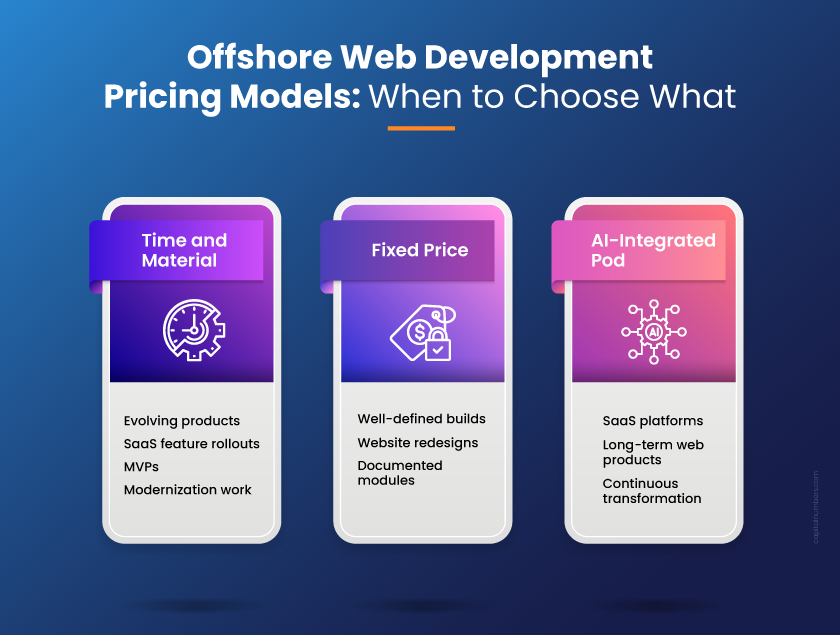
Once you’ve decided offshore is the right move, the next decision is simple but important: how do you want to work together?
The pricing model you choose will impact everything — how flexible the plan can be, how predictable the budget is, how quickly decisions happen, and what “success” looks like week to week.
1. Time and Material (Outcome-Based / Velocity-Aligned, 2026)
Time and Material is still a flexible model for evolving products. But in 2026, you should run it with clear output accountability.
You pay for dedicated capacity, but you renew based on delivery metrics: planned vs shipped work, sprint velocity, defect leakage, and cycle time.
It is best for:
- Products that are still evolving
- SaaS feature rollouts
- MVPs
- Modernization work, where you’ll discover things midway
Why leaders choose it:
You can change priorities quickly without renegotiating the contract every time.
Where it can go wrong:
If you track only hours, costs can go up without enough business value.
How to run it well:
Set a baseline velocity, define sprint outcome targets, review shipped value every sprint, and link renewals to performance trends.
Key insight:
In 2026, leaders don’t judge offshore teams by hours in a seat; they judge them by outputs shipped, quality maintained, and predictability achieved.
2. Fixed Price (Scope-Locked with Outcome Guardrails, 2026)
Fixed price still works when your scope is clear. In 2026, you should add outcome guardrails so quality and delivery remain predictable.
That means you define acceptance criteria, defect limits, milestone checkpoints, and change-control rules before delivery begins.
It is best for:
- Well-defined builds
- Website redesigns
- Clearly documented modules
Why leaders choose it:
You get budget clarity and commercial predictability from day one.
The trade-off:
If your requirements change, cost and timeline pressure can increase quickly.
How to run it well:
Lock scope after a proper discovery phase, define “done” in measurable terms, and use a clear change-request process.
Reality check:
Fixed price is safest when your scope is stable and quality guardrails are clearly documented.
3. AI-Integrated Pod (formerly “Dedicated Pods”)
An AI-Integrated Pod is the modern version of a dedicated team.
Instead of scaling only with headcount, you get a lean human pod supported by AI workflows for QA, documentation, and code optimization.
In practice, a well-run 3-person AI-enabled pod can often deliver output comparable to that of a 6-person team from 2023. Modern offshore partners now provide access to their delivery system and custom AI workflows—not just developers.
It is best for:
- SaaS platforms
- Long-term web products
- Continuous digital transformation
Why leaders choose it:
You get a predictable monthly cost, strong ownership, and higher velocity. AI support also improves efficiency by handling repetitive engineering tasks.
What it requires:
You still need planning maturity on your side – clear priorities, fast decisions, and regular review of AI-assisted outputs.
You also need explicit IP-safe AI practices and approved tool usage policies.
Key difference:
Don’t evaluate pods by timesheets. Evaluate them by shipped value, quality, and delivery rhythm.
With the right setup, AI-integrated pods scale smarter, reduce avoidable human overhead, and free teams to focus on higher-value problem-solving.
What Actually Drives Offshore Web Development Cost in 2026
When people talk about outsourced web development, the first question is usually, “What’s the hourly rate?”
That’s the wrong place to start.
In 2026, the real cost of working with an offshore development agency is shaped by the nature of the work, not just the rate on paper. If you plan to hire offshore web developers or build a longer-term offshore development team, these factors will influence your budget far more than geography.
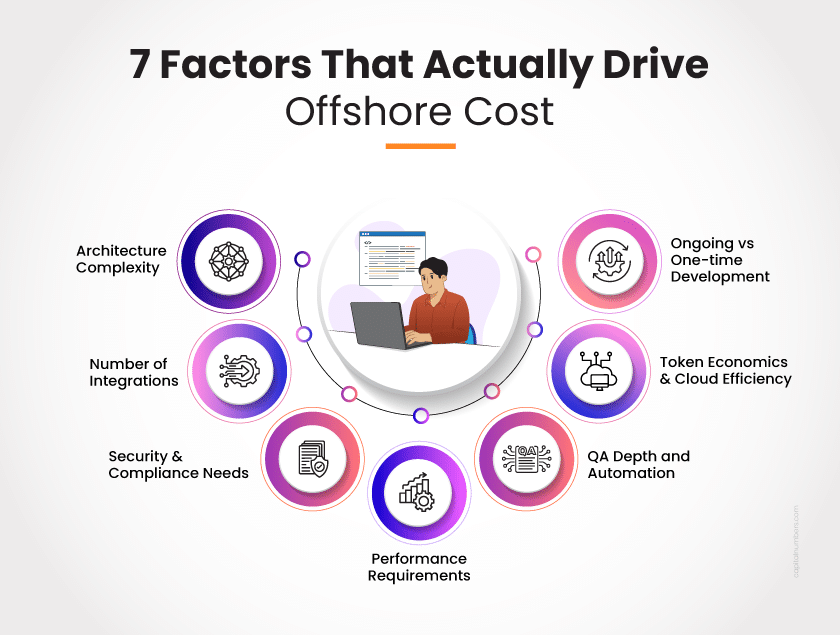
Here’s what really drives cost:
1. Architecture Complexity
A simple marketing site is different from a multi-tenant SaaS platform. The more moving parts — microservices, APIs, cloud infrastructure — the more planning and senior expertise you’ll need.
2. Number of Integrations
Every third-party integration (payment gateways, CRMs, analytics tools, ERP systems) adds effort. Integrations often take longer than expected because they depend on external systems.
3. Security and Compliance Needs
If your product handles sensitive data, you may need stronger security controls, audits, encryption standards, and compliance checks. That adds time and specialist effort.
4. Performance Requirements
High traffic, real-time features, or global user bases require more careful engineering. Performance tuning, caching, and load testing increase development scope.
5. QA Depth and Automation
Manual testing costs less upfront but more over time. Automated testing, CI/CD pipelines, and proper QA increase early investment but reduce long-term rework.
6. Token Economics & Cloud Efficiency
As AI features grow, inefficient code and prompt design increase token and cloud waste. In 2026, true cost includes inference, caching, and runtime efficiency, not just initial build effort.
7. Ongoing vs One-time Development
A one-time website build is different from continuous product development. A long-term offshore development team usually costs more per month but delivers more value over time.
Unclear direction and inefficient implementation cost more than high hourly rates. Clarity, architecture discipline, and runtime efficiency are what protect your budget.
Governance: The Make-or-Break Layer of Offshore Web Development
You can choose the right country and pricing model. But if governance is weak, outsourced web development will struggle. This is the part most companies underestimate.
Success comes down to how the work is run, week after week.
Offshore succeeds when:
-
- There’s a clear weekly delivery rhythm
Planning, execution, demo, feedback. Repeat. Offshore website development needs structure, not guesswork. - Escalations are defined
When something blocks progress, everyone knows who decides and how quickly. - Decisions don’t stall
A remote web development team moves fast when approvals and clarifications happen on time. - Code review and QA are systematic
Quality can’t depend on individual effort. It needs a defined review process, automated testing, and clear “done” criteria. - IP protection in the AI era is enforced
Use approved enterprise AI tools only; block public LLM uploads, maintain audit trails, and enforce IP clauses. - Security practices are documented
Access control, repositories, data handling — nothing should be informal. - Data sovereignty is clearly defined
There must be a clear understanding of where data resides and is processed to comply with fragmented global AI regulations (such as the EU AI Act and similar regional laws).
- There’s a clear weekly delivery rhythm
Here’s the simple thing:
Process maturity beats proximity.
A well-run outsourced web development team with strong governance will outperform a poorly managed local team every time.
How to Measure Whether Offshore Web Development Is Working
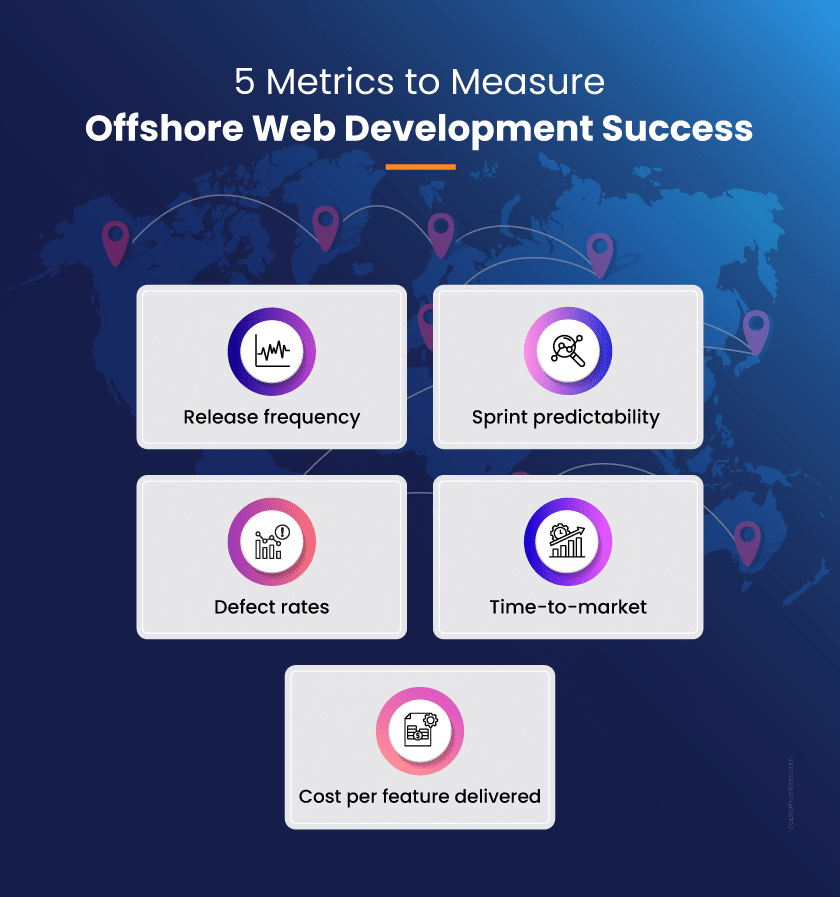
You can judge offshore work by hourly rates. But a low rate doesn’t mean you’re moving forward; it just means you’re spending less while you wait.
If you’re working with an offshore web development agency, the better question is simple: Are we shipping more, with fewer surprises?
Here are the signals that matter:
- Release frequency
Are updates going live regularly, or are releases getting stuck in review and rework? - Sprint predictability
Do sprints end with real output, or do you keep carrying the same items forward? - Defect rates
Are bugs and regressions under control, or are fixes eating up your roadmap time? - Time-to-market
How long does it take to turn a priority into something users can actually use? - Cost per feature delivered
When you look back at the month, what did it cost to deliver meaningful work — not activity, but outcomes?
If these metrics are improving, offshore is doing its job: progress is steady, quality is stable, and planning becomes easier. If they aren’t, it’s usually a sign that the working setup needs attention — not just the team.
How to Pick the Right Offshore Web Development Partner
Choosing offshore is only half the decision. The bigger question is: who you choose to work with.
Not every offshore partner for web development operates at the same level of maturity. Some provide developers. The stronger ones provide structured delivery.
Here’s what to look for before you sign:
- Proof of similar work (stack + domain): Ask for examples close to your product type and tech stack. If they’ve solved problems like yours before, you will reduce onboarding time.
- Delivery leadership: Make sure you get a dedicated Project Manager (PM) or Engineering Manager (EM) driving planning, demos, and escalation, not just developers writing code.
- QA maturity: Ask how quality is enforced. You should see structured code reviews, automated testing, and clear release gates.
- Security posture: Confirm how access control is handled, how repositories and credentials are secured, and whether they follow a defined Software Development Life Cycle (SDLC), especially if you handle sensitive data.
- Case studies and references: Ask for relevant case studies and, where possible, client references. This helps you validate real delivery experience.
- Start with a trial sprint or paid discovery: Begin with a paid discovery phase or pilot sprint so you can evaluate communication quality, delivery consistency, and technical depth before committing long-term.
Rule of thumb: If you can clearly see how the partner runs delivery week to week, you’re choosing based on structure, not just rates.
You May Also Read: Top Outsourcing Trends Set to Shape Software Development in 2026
Offshore Web Development as a Smarter Way to Scale in 2026
As products become more complex in 2026 and beyond, offshore web development can be a real advantage if it’s set up correctly. The right model helps you ship regularly, avoid last-minute surprises, and keep costs under control. It also reduces back-and-forth, so your team can stay focused on building.
To get the best results, choose the engagement model that fits your work, pick an offshore partner with strong delivery leadership and QA, and track progress by outcomes, not hours.
Want to figure out which model best fits your product? Book a 30-minute discovery call with our team. We’ll review your current setup, spot the biggest gaps, and share clear next steps.


 Web Development
 Cloud Engineering
 Mobile App Development
 AI/ML/GenAI
 E-commerce
 Software Development
 UI/UX
UI/UX QA
QA Dedicated Teams