

API-First Architecture: What We’ve Learned from Scaling Multi-Platform Products
Table of Contents
Most products do not stay single-platform for long.
A team starts with one web app. Then, mobile apps are added. Then, an admin panel. Then, partner integrations. Then, internal tools for support and operations. Suddenly, a single backend must serve multiple clients with different release cycles, performance constraints, and UX expectations.
This is exactly where teams are focusing: building APIs that remain consistent across channels and can evolve without breaking delivery.
That’s when delivery pressure changes shape.
A feature works on the web but breaks in mobile edge cases. A “small” backend response change causes partner regressions. Teams spend more time coordinating across channels than shipping new value. Velocity drops, not because engineers are weak, but because the API layer wasn’t designed for change.
This blog is a practical summary of what we’ve learned while scaling multi-platform products with API-first architecture: what failed early, what fixed it, and what consistently improved release reliability over time.
Why API Pain Shows Up Early in Multi-Platform Products
Early-stage systems often move fast with a code-first approach. One team ships to one client; backend and frontend evolve together, and changes are easy to coordinate within a small group.
That approach stops working as the product grows.
The same API starts serving:
- Web app
- iOS app
- Admin dashboard
- Partner integrations
- Internal operations tools
At that point, every API decision has a multiplied impact.
- Renaming a field is not just cleanup; it becomes a rollout event.
- Changing the error shape is not cosmetic; it can break client handling.
- Tweaking pagination can hurt performance for one client and data consistency for another.
What we learned
APIs stop being implementation details once you add a second or third serious consumer. From that point on, APIs are product interfaces and require product-level discipline. Treating APIs like products also means prioritizing API performance optimisation early – so small inefficiencies don’t turn into platform-wide slowdowns as consumers grow.
What API-First Architecture Means in Practical Delivery Terms
API-first is often misunderstood as “write docs first.” That’s too narrow. In practice, API-first means defining the contract before deep implementation. In practice, API development services often start here – by shaping the contract (schemas, validation, error model, and compatibility rules) before implementation ramps up.
- Resource boundaries (/users, /orders, etc.)
- Request/response schemas
- Validation rules
- Error envelope
- Compatibility expectations
- Deprecation and versioning behavior
- Non-functional expectations (timeouts, payload size guidance, etc.)
Once the contract is stable enough, teams can build in parallel with mocks. This works best when the API is designed with clear resources, predictable error shapes, and consistent conventions across endpoints. Backend implementation then follows that contract.
What we learned
One hour of contract alignment early can save days of downstream integration rework across web, mobile, admin, and partner teams.
API-First Architecture Advantages and Disadvantages
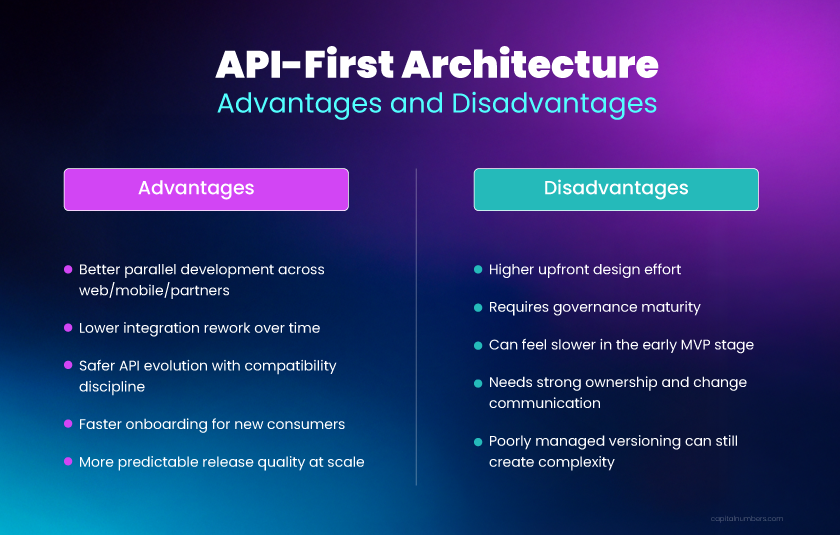
API-first has its fair share of pros and cons. Here are these:
Advantages
- Better parallel development across web/mobile/partners
- Lower integration rework over time
- Safer API evolution with compatibility discipline
- Faster onboarding for new consumers
- More predictable release quality at scale
Disadvantages
- Higher upfront design effort
- Requires governance maturity
- Can feel slower in the early MVP stage
- Needs strong ownership and change communication
- Poorly managed versioning can still create complexity
What we learned
API-first is not “free speed.” It is structured speed; slightly slower at the start, significantly faster and safer as complexity grows.
API-First vs Backend-First: What We Observed in Real Projects
Backend-first is often fast for initial shipping. The backend is built around internal logic first, and clients adapt afterward.
That works in simple setups, but in multi-client systems it often creates:
- Late integration surprises
- Frequent API reshaping
- Higher coordination load
- More client-specific exceptions
API-first shifts the sequence:
- Design contract
- Align consumers
- Build in parallel
What we learned
Backend-first can optimize short-term local speed. API-first optimizes long-term cross-team speed and release stability.
API-First vs UI-First: Where Each Approach Fits
UI-first can be useful when teams need to quickly validate user journeys, layouts, and interactions. It helps discover UX gaps early.
But UI-first often leads to API contracts being shaped late and repeatedly changed to fit already-built screens.
An API-first approach starts with shared domain contracts and allows UI teams to safely prototype with mocks.
What we learned
UI-first is good for fast experience exploration. API-first is better when the same product capabilities must remain consistent across many channels.
API-First vs Backend-First vs UI-First at a Glance
| Approach | Best Fit | Common Risk at Scale | What We Learned |
|---|---|---|---|
| API-first | Multi-client, integration-heavy products | Higher upfront design effort | Best long-term reliability, parallel delivery, and safer evolution |
| Backend-first | Single-client, early build speed | Rework when more clients are added | Fast start, weaker long-term consistency |
| UI-first | Rapid UX validation | Late API churn and unstable contracts | Great for interaction discovery, risky for integration-heavy products |
When to Use API-First Architecture
API-first is especially effective when:
- You already have (or soon expect) multiple clients
- Partner integrations are part of the roadmap
- Teams need to build in parallel
- Backward compatibility matters
- Release cadence is frequent
It is less critical for:
- Throwaway prototypes
- Short-life, single-client MVPs
- Low-risk internal tools with limited integrations
What we learned
The best adoption point is earlier than most teams think, usually when multi-client growth becomes visible on the roadmap, not after integration issues start.
What We Changed That Reduced Rework the Most in API-first Development
We removed duplicate processes and focused on a few rules that consistently performed well.
1. Keep naming boring and predictable
Use product language consistently:
- /users
- /orders
- /invoices
Avoid inconsistent conventions across domains (e.g., customer vs. client vs. account_holder for the same concept).
What we learned: Naming drift looks harmless early, but causes recurring bugs and reporting confusion.
2. Standardize list behavior early
List endpoints are where inconsistency grows fastest.
Define:
- Pagination style per domain (cursor vs offset)
- Filter parameter style
- Sort semantics
- Metadata envelope shape
A practical split:
- Cursor pagination for large/dynamic feeds
- Offset pagination for simple admin grids
What we learned: List endpoints are the fastest place for inconsistency to spread.
3. Make critical write actions idempotent
Network retries are normal. Mobile reconnects. Gateways retry. Users tap twice.
For operations like:
- Checkout
- Payment capture
- Booking
- Order creation
Support idempotency keys to prevent duplicates.
What we learned: Duplicate-write incidents are expensive; idempotency is cheaper to design than to patch later.
4. Use one error contract across APIs
Error consistency is a huge force multiplier.
Use one shared envelope with stable fields such as:
- Type
- Title
- Status
- Detail
- Trace/request identifier
What we learned: Consistent failure handling speeds up debugging and lowers support triage time.
5. Treat backward compatibility as a default
Prefer additive changes:
- Add optional fields
- Avoid renaming/removing existing fields
- Avoid semantic behavior changes without a version strategy
For breaking changes:
- Send explicit deprecation signals
- Publish transition windows
- Set removal date
- Provide migration notes with examples
What we learned: Silent breaks damage partner and client confidence quickly.
6. Keep docs useful, not decorative
One source of truth (OpenAPI or equivalent), real examples, and CI-linked updates.
Docs should answer:
- What changed
- Who is affected
- How to migrate
- When old behavior is removed
What we learned: Stale docs create hidden delivery drag across teams.
Challenges of API-First Development (and How We Handle Them)
API-first is powerful, but it is not friction-free.
Common challenges:
- Upfront design discussions feel slower
- Teams debate boundaries and schemas longer
- Governance can become heavy if done manually
- Versioning discipline is hard without ownership
How we handle this:
- Timebox contract design sessions
- Use clear ownership per API domain
- Automate linting and contract checks in CI
- Keep manual reviews for high-risk changes only
What we learned
API-first fails when treated as a documentation ceremony. It succeeds when treated as a lightweight design and strong automation.
How to Scale API-First Systems Without Slowing Delivery
As usage grows, recurring pressure points appear:
- Retry storms
- Traffic spikes on hot endpoints
- Noisy consumers affecting others
- Timeout mismatch across layers
- Weak endpoint-level visibility
Controls that mattered most:
- Gateway front door (auth, routing, validation, rate limits)
- Consumer-level quotas
- Retry discipline (retry only safe operations)
- Async workflows for heavy processing
- BFF layer for channel-specific response adaptation
- Endpoint-level observability (latency, errors, throughput)
These controls work best when paired with API security best practices, including strong authZ, input validation, abuse protection, and audit-friendly logging.
What we learned
Most scale incidents are not one big failure. There are multiple missing guardrails across retries, limits, and visibility.
A Practical Adoption Path for API-First Architecture (Without Big-Bang Rewrite)
Many teams avoid API-first architecture because they assume it requires a full reset. It does not.
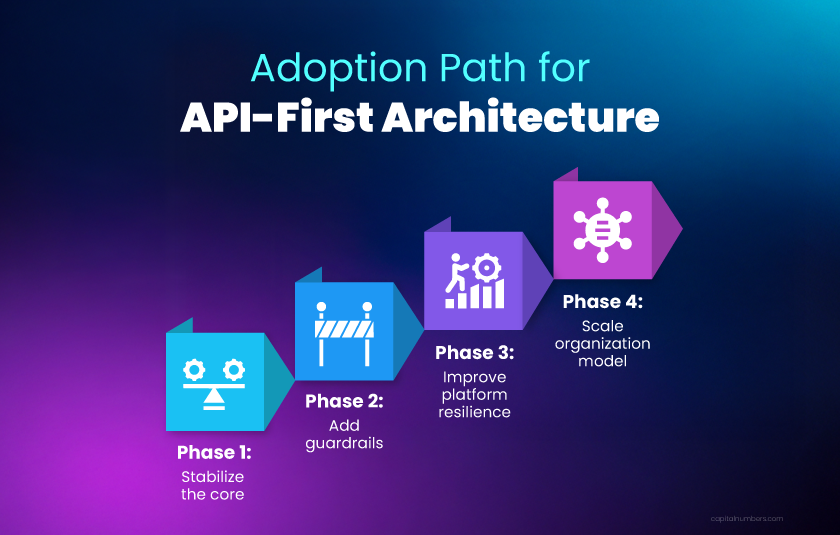
A phased transition works:
Phase 1: Stabilize the core
- Choose naming/error conventions
- Define the pagination standard
- Introduce basic OpenAPI contracts for high-traffic endpoints
Phase 2: Add guardrails
- CI linting
- Contract checks
- Deprecation headers and changelog discipline
Phase 3: Improve platform resilience
- Gateway policies
- Rate limits and quotas
- Observability dashboards and SLOs (Service Level Objectives)
Phase 4: Scale organization model
- Clear domain ownership
- Review playbooks for high-risk changes
- Consumer communication templates
What we learned
Incremental adoption delivers visible wins without freezing roadmap delivery.
Business Outcomes We Consistently Observed
When API evolution is stable:
- Release reliability improves
- Partner onboarding gets faster
- Mobile-channel delays reduce
- Cross-team coordination overhead drops
- Roadmap predictability increases
When API evolution is unstable:
- Regression and firefighting consume sprint capacity
- Cross-channel behavior drifts
- Partner confidence weakens
- The cost of scale rises non-linearly
What we learned
API-first is not only an engineering choice. It is a delivery and growth strategy.
Final Takeaway
The main lesson from scaling multi-platform products is clear:
Growth pain is usually a change-management problem before it becomes a coding problem.
Teams that scale well do not eliminate change. They design it.
API-first works best when it is treated as an operating discipline:
- Clear contracts
- Compatibility-first evolution
- Automated governance
- Reliable parallel delivery
- Guardrails for scale behavior
If a product is moving from one client to many, this is where API decisions become long-term platform strategy, not local implementation choices.
The earlier this shift happens, the lower the cost of scale.
Where to start with API-first in your current platform? Get in touch with our expert developers to start with a contract audit and proceed accordingly.
Frequently Asked Questions on API-first Architecture
1. Does API-first mean you must use microservices?
No. API-first works with monoliths, modular monoliths, or microservices. The key is the API contract, not the internal architecture. Many teams start with a monolith and still do API-first well.
2. Should REST or GraphQL be used for an API-first product?
Both REST and GraphQL can work. REST is simpler and more predictable for many teams, while GraphQL can help when clients need flexible data shapes. One choice should be standardized across teams to avoid confusion.
3. What’s the best way to handle authentication and permissions across many clients?
Use one consistent approach across all platforms (token-based auth, roles/scopes). Keep permission rules centralized so web, mobile, and partners behave the same way. This also makes audits and troubleshooting easier.
4. Is an API gateway needed, and what should it handle?
Yes, for most growing products. Gateways commonly handle auth, rate limiting, routing, request validation, and basic observability. This keeps every service from reinventing the same “front door” logic.
5. How can API changes be rolled out safely across web and mobile?
Use staged rollout: backward-compatible changes first, clear release notes, and monitoring. Add a controlled deprecation timeline for breaking changes. This reduces production surprises, especially for mobile users who update later.

 Web Development
 Cloud Engineering
 Mobile App Development
 AI/ML/GenAI
 E-commerce
 Software Development
 UI/UX
UI/UX QA
QA Dedicated Teams