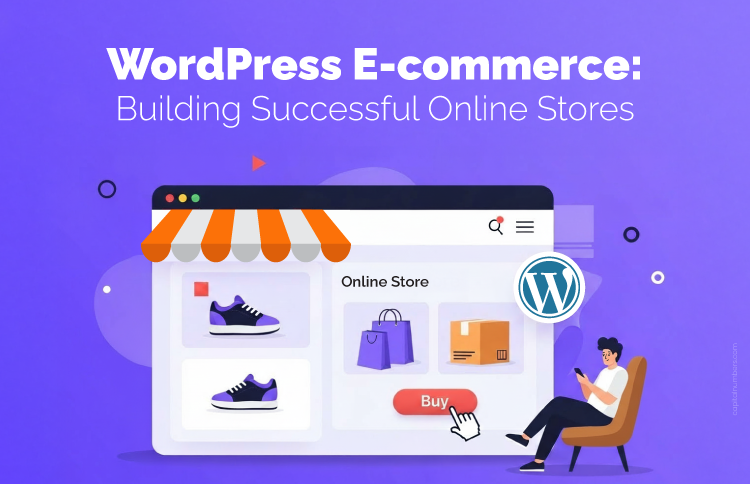

WordPress E-commerce: Building Successful Online Stores
Table of Contents
The transition to a digital-first retail environment necessitates a platform that offers unparalleled flexibility, scalability, and control. WordPress, leveraging the open-source WooCommerce extension, provides the most robust and adaptive framework for modern online commerce.
Achieving sustainable success requires moving beyond basic setup and adopting a continuous strategic focus across three integrated pillars: Optimizing Performance Infrastructure, implementing rigorous Conversion Rate Optimization (CRO) strategies, and executing Data-Driven Growth and Scaling Logistics.
This article outlines the definitive technical and business strategy to launch, optimize, and scale a profitable WordPress e-commerce operation.
1. The Strategic Advantage of the WooCommerce Ecosystem
While proprietary platforms offer simplicity, the open-source nature of WordPress grants complete data ownership and limitless customization – critical factors for long-term growth and feature differentiation. WooCommerce transforms the site into a full transactional engine, handling everything from product management to secure payment processing.
Key Platform Benefits for Business Growth:
- Total Control: Merchants maintain full ownership over their core data, code, and customer relationships, eliminating reliance on third-party platform rules or fee structures.
- Vast Extensibility: An unmatched ecosystem of plugins allows for the seamless integration of advanced functions, such as ERP syncing, sophisticated B2B pricing, and multi-warehouse inventory management.
- SEO Excellence: WordPress’s clean code structure, combined with powerful SEO plugins like Yoast or Rank Math, provides a superior foundation for organic search visibility.
2. Establishing High-Performance Infrastructure (The Tech Stack)
Performance is a fundamental business requirement. A one-second increase in load time can result in a 7% reduction in conversion rates. A successful architecture must prioritize speed, reliability, and scalability from day one.
2.1 Strategic Hosting and Database Management
For an e-commerce site, standard shared hosting is inadequate.
| Component | Strategic Requirement | Technical Implementation |
|---|---|---|
| Hosting | Choose Managed WordPress or Virtual Private Server (VPS) hosting with resources dedicated to WooCommerce’s dynamic requests. | Implement a Content Delivery Network (CDN), such as Cloudflare or Amazon CloudFront, to cache static assets globally and ensure low latency for all users. |
| Caching | Minimize database querying and server load for returning visitors. | Utilize advanced server-side caching (often provided by Managed Hosts) combined with an application-level caching plugin (like WP Rocket) to optimize minification and asset delivery. |
| Database Scaling | Essential for large product catalogs (exceeding 10,000 SKUs) and high transaction volumes. | Ensure that all WooCommerce tables (wp_postmeta, wp_posts, wp_woocommerce_order_items) are indexed correctly to support fast queries. Use dedicated extensions for managing complex inventory to prevent database bloat. |
2.2 Security and Payment Architecture
Security is paramount to customer trust and regulatory compliance (PCI DSS).
- Mandatory Security Layer: Maintain an active SSL certificate (HTTPS) site-wide. Implement strong security plugins (e.g., Wordfence) and enforce multi-factor authentication (MFA) for all administrative and user accounts.
- Diversified Payments: Offer secure and varied payment gateways, including WooPayments (for centralized management), Stripe, PayPal, and flexible Buy Now, Pay Later (BNPL) options to reduce cart abandonment caused by preferred payment method restrictions.
3. Conversion Rate Optimization (CRO) Strategies
CRO is the continuous, measurable process of maximizing the percentage of site visitors who complete a purchase.
3.1 Optimizing the Product Detail Page (PDP)
The PDP is the final stage of product consideration and requires maximum informational quality and social proof.
- Visual Trust: Use high-resolution, zoomable images and embed product demonstration videos. Showcase User-Generated Content (UGC) (customer photos/videos) as third-party validation.
- Benefit-Driven Copy: Descriptions must focus on the emotional and functional benefits to the customer, rather than just listing technical specifications. Use scannable bullet points to facilitate quick reading.
- Social Proof Integration: Visible customer ratings and reviews must be integrated near the “Add to Cart” button. Automated review solicitation tools should be deployed post-purchase to build this critical trust layer.
3.2 Streamlining the Checkout Funnel
The primary objective of the checkout process is to eliminate friction and surprise costs.
- Transparency First: Display the final, calculated cost, including shipping and taxes, as early as the mini-cart or pre-checkout page.
- Mandatory Guest Checkout: Studies confirm that forcing account registration is a top reason for abandonment. Always provide a clear guest checkout option with an easy post-purchase registration link.
- Frictionless Design: Utilize tools like the WooCommerce Checkout Field Editor to minimize required data fields. Implement express checkout options (e.g., Apple Pay, Google Pay) and utilize clear progress indicators to manage user expectation during multi-step processes.
4. Data-Driven Growth and Scaling Logistics
Scaling requires leveraging data insights and automating backend operations efficiently.
4.1 Analytics, A/B Testing, and Recovery
Success is measured by key performance indicators (KPIs) and continuous experimentation.
- Integrated Analytics: Utilize plugins like MonsterInsights to seamlessly connect the WooCommerce purchase funnel with Google Analytics, allowing monitoring of traffic sources, conversion rates, and drop-off points.
- Key Metrics: Focus on monitoring Conversion Rate (CR), Average Order Value (AOV), and Customer Acquisition Cost (CAC).
- A/B Testing: Employ scientific testing tools (e.g., Optimizely) to test variations in critical elements, such as call-to-action (CTA) text, pricing displays, and image galleries, ensuring changes are data-validated.
- Abandoned Cart Recovery: Implement an automated, personalized 3-step email sequence (immediate reminder, 24-hour follow-up with urgency, 72-hour follow-up with a small incentive) to capture lost revenue.
4.2 Scaling Logistics and Revenue Streams
For high-growth stores, specialized extensions automate complex operations.
- Advanced Inventory: For multi-channel or multi-warehouse operations, implement extensions like TradeGecko or similar Bulk Stock Management tools to maintain real-time, accurate inventory counts across all sales points.
- Shipping Automation: Integrate with industry leaders (e.g., ShipStation) to automate label printing, real-time rate calculation at checkout, and customer tracking notifications, minimizing manual fulfillment errors.
- Recurring Revenue: Leverage the WooCommerce Subscriptions extension to easily establish and manage recurring billing cycles, turning one-time customers into a predictable source of high lifetime value (LTV).
5. Mitigating Technical Risks and Common Mistakes
To maintain operational integrity and speed, developers must actively manage the ecosystem:
- Plugin Overload: Avoid installing excessive or poorly coded plugins. Regularly audit and remove inactive extensions, as they are a leading cause of security vulnerabilities and site slowdown.
- Neglecting Updates: Never defer core WordPress, WooCommerce, or plugin updates. These updates are crucial for patching security flaws and maintaining system compatibility.
- Lack of Backups: Implement automated, off-site backup solutions (e.g., UpdraftPlus) with a clear restoration protocol. Data loss is the single greatest risk to an e-commerce business.
- Mobile Neglect: Continuously test and optimize the shopping experience on smaller screens. Mobile responsiveness is not just an SEO factor but a primary driver of conversion.
Conclusion
The WordPress and WooCommerce platform offers the necessary agility and power to compete in any market. However, its full potential is only realized when technical best practices in hosting, security, and data optimization are systematically applied. By treating the platform not just as a website but as a sophisticated, constantly measured transactional system, businesses can leverage its inherent flexibility to achieve market differentiation and unlock exponential, sustainable growth.


 Web Development
 Cloud Engineering
 Mobile App Development
 AI/ML/GenAI
 E-commerce
 Software Development
 UI/UX
UI/UX QA
QA Dedicated Teams