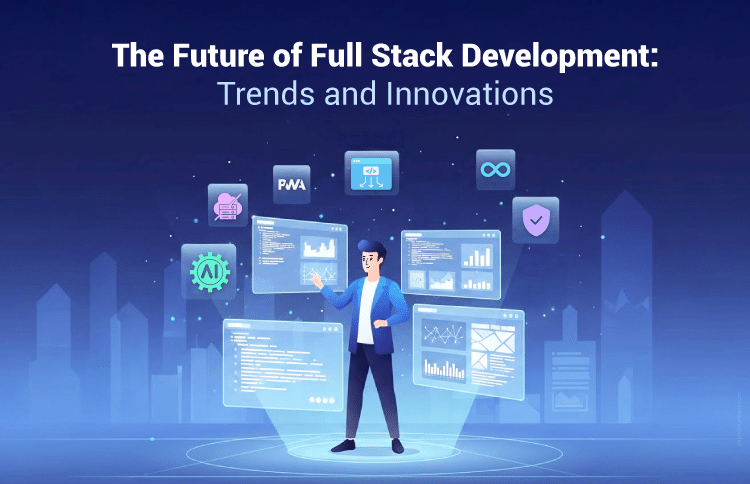

The Future of Full Stack Development: Trends and Innovations
Table of Contents
I’ve been building web applications for over a decade now, and honestly, the pace of change still catches me off guard sometimes. Just last week, I was reviewing code from a project I worked on in 2018. The patterns we used back then, the deployment strategies, even the way we structured our teams, feel almost quaint now. That project took six developers three months to build. Today? Two developers could probably ship something comparable in half that time, though they’d be working with a completely different toolkit and making entirely different architectural decisions.
This isn’t just nostalgia talking. The full-stack development landscape has genuinely transformed. We’ve moved well beyond the simple frontend-backend divide that used to define the role. These days, you’re expected to understand AI integration, think about edge computing, navigate serverless architectures, and somehow keep up with security practices that grow more complex by the quarter. It’s exhausting and exhilarating in equal measure.
AI Tools: Actually Useful Now (Mostly)
I’ll admit I was sceptical about AI coding assistants when they first appeared. The early versions felt more like autocomplete on steroids than anything genuinely helpful. But somewhere along the way, they got good. Really good. I now use GitHub Copilot daily, and it’s changed how I work in ways I didn’t anticipate.
Here’s what surprised me most: it’s not that these tools write perfect code. They don’t. What they do is handle the tedious stuff faster than I can type it. Need to write another API endpoint that follows the same pattern as the previous twelve? Copilot’s got it. Boilerplate tests? Done. This frees up mental energy for the harder problems, the architectural decisions that actually need human judgment.
But there’s a bigger story here that affects how we build applications. Machine learning capabilities have become table stakes for most products now. Users expect personalisation. They expect smart search. They expect the application to learn from their behaviour and adapt accordingly. Three years ago, implementing recommendation engines or intelligent chatbots meant hiring specialised ML engineers. Now, it’s something full-stack developers are expected to handle, at least at a basic level.
You May Also Read: Full Stack Development in the Age of AI: Building Intelligent Applications
Serverless Made Me Rethink Everything
Let me tell you about a project that changed how I think about infrastructure. We were building a document processing system that had wildly unpredictable traffic patterns. Sometimes we’d process ten documents an hour. Other times, a client would dump 10,000 documents on us at once. With traditional servers, we had to maintain capacity for those peak loads, which meant paying for idle resources 90% of the time.
Switching to AWS Lambda completely changed the economics. Each document upload triggered a function that processed it, extracted metadata, generated thumbnails, and whatever was needed. When traffic spiked, the platform automatically spun up more function instances. When things were quiet, we paid almost nothing. The cost savings were dramatic, but more importantly, we stopped thinking about servers entirely.
That’s what serverless really means. It’s not that there aren’t servers somewhere. Of course there are. But you stop caring about them. You write functions, define their triggers, and let the platform handle everything else. No more SSH-ing into boxes to debug issues at 2 AM. No more capacity planning spreadsheets.
Edge computing takes this concept further by moving computation closer to users. I worked on a real-time collaboration tool where latency mattered enormously. When users in Singapore were hitting servers in Virginia, the lag was noticeable and frustrating. Deploying functions to edge locations around the world brought those response times down to what felt instant. Users in Singapore hit servers in Singapore. Users in São Paulo hit servers in São Paulo. Simple concept, massive impact on user experience.
The challenge is that edge computing introduces complexity in other areas. State management becomes harder when your code is running in dozens of locations simultaneously. Database consistency gets tricky. You have to think carefully about what data needs to be globally consistent versus what can be eventually consistent. These aren’t simple problems, and the abstractions aren’t quite there yet to make them trivial.
The Low-Code Debate Misses the Point
There’s this anxiety in developer circles about low-code platforms. Will they replace us? Are we becoming obsolete? I’ve sat through too many conference talks that frame this as an existential threat. That framing misses what’s actually happening.
Low-code tools are genuinely good at certain things. I’ve seen product managers build internal dashboards in Retool that would have taken developers weeks to implement. Sales teams create simple automation workflows in Zapier without writing a line of code. This is great! It means developers can focus on the problems that actually require our expertise.
What low-code platforms struggle with is complexity. Try building a sophisticated financial reconciliation system in a no-code tool. Try implementing complex authorisation logic with dozens of special cases. Try optimising a query that’s hitting millions of records. You’ll quickly hit the limits of what visual programming and pre-built components can handle.
The smart move here isn’t to resist these tools but to understand where they fit. Use them for rapid prototyping. Use them for simple internal tools that don’t justify custom development. But recognise that complex systems, performance-critical applications, and anything requiring deep customisation still need traditional development skills. Both approaches can coexist, and developers who understand how to work with both will find more opportunities, not fewer.
PWAs: The Mobile Strategy Nobody Talks About Enough
Progressive Web Apps deserve more attention than they get. Building native mobile apps is expensive. You need separate iOS and Android codebases, different developers with different skill sets, separate release processes, and app store approval headaches. For many applications, this overhead doesn’t make sense.
PWAs offer a compelling alternative. They’re web applications that behave like native apps. Users can install them on their home screens. They work offline. They can send push notifications. They load quickly and feel responsive. And here’s the key part: they’re built with standard web technologies that most full-stack developers already know.
I recently converted a customer dashboard from a native app to a PWA. Development time dropped by more than half. We maintained one codebase instead of three. Updates went live immediately without waiting for app store approvals. The users honestly couldn’t tell the difference in normal usage.
The limitations are real, though. PWAs can’t access certain device features that native apps can. If you need deep integration with phone hardware or operating system features, native development might still be necessary. But for a huge range of business applications, PWAs provide 90% of the functionality with a fraction of the complexity.
DevOps: Not Optional Anymore
Remember when developers could just write code and throw it over the wall to operations? Those days are gone, and frankly, that’s probably for the best. Modern full-stack development means owning your code through its entire lifecycle.
I learned Docker somewhat reluctantly a few years ago. It seemed like extra complexity I didn’t need. Now I can’t imagine working without it. Being able to package an application with all its dependencies, run it identically on my laptop and in production, spin up complex multi-service environments with a single command… It’s transformed how I develop.
Kubernetes adds another layer of capability, though I’ll admit the learning curve is steep. Container orchestration, automatic scaling, self-healing deployments… these sound like buzzwords until you’ve dealt with a production incident where the system automatically recovered before you even got the alert. That’s when you become a believer.
The tradeoff is that the surface area of knowledge you need keeps expanding. You’re not just writing application code anymore. You’re writing infrastructure as code. You’re configuring CI/CD pipelines. You’re setting up monitoring and alerting. You’re debugging network policies and service mesh configurations. It’s a lot, and I’m not sure the industry has fully grappled with what this means for how we structure teams and divide responsibilities.
You May Also Read: The Role of DevOps in Full Stack Development
Security Can’t Be an Afterthought
I’ve seen too many projects where security was treated as something to worry about later. That approach doesn’t work anymore, if it ever did. The threat landscape is too sophisticated, and the consequences of breaches are too severe.
What changed my perspective was sitting through a security audit where penetration testers found vulnerabilities I should have caught. SQL injection issues occurred because I trusted client input. API endpoints that lacked proper authorisation checks. Secrets checked into the repository. Embarrassing stuff, honestly. But it drove home that security needs to be part of how you think about code from the beginning, not something you bolt on at the end.
Secure coding practices aren’t complicated once you internalise them. Validate all inputs. Use parameterised queries. Implement proper authentication and authorisation. Encrypt sensitive data. Keep dependencies updated. These basics prevent the most common attacks. The challenge is making them habitual rather than afterthoughts.
What Does This All Mean Going Forward
If there’s one constant in this field, it’s that the skills you need keep evolving. The JavaScript framework that’s hot today will be old news in two years. The architectural patterns we’re excited about now will seem dated surprisingly quickly. That’s both frustrating and what keeps the work interesting.
I’ve learned that the developers who thrive aren’t necessarily the ones who know the most frameworks or have memorised the most syntax. They’re the ones who understand underlying principles well enough to adapt when the landscape shifts. Strong fundamentals in computer science, software architecture, and problem-solving transfer across technology changes in ways that specific framework knowledge doesn’t.
The full-stack role continues to expand in scope, which creates both opportunities and challenges. The breadth of knowledge expected can feel overwhelming. But it also means that developers who can navigate this complexity, who can speak intelligently about frontend frameworks and database optimisation and cloud architecture and security practices, have tremendous value to organisations trying to build modern applications.
Finding Your Path Forward
My advice? Pick your battles. You can’t be an expert in everything, so focus on developing depth in areas that interest you while maintaining a broad awareness of the larger ecosystem. Stay curious, keep learning, and don’t be afraid to admit when something new is outside your current knowledge. That’s how growth happens.


 Web Development
 Cloud Engineering
 Mobile App Development
 AI/ML/GenAI
 E-commerce
 Software Development
 UI/UX
UI/UX QA
QA Dedicated Teams