Top API Trends to Watch in 2026: Security, AI & Governance

Shubendu Biswas
Technical Architect
16th December, 2025
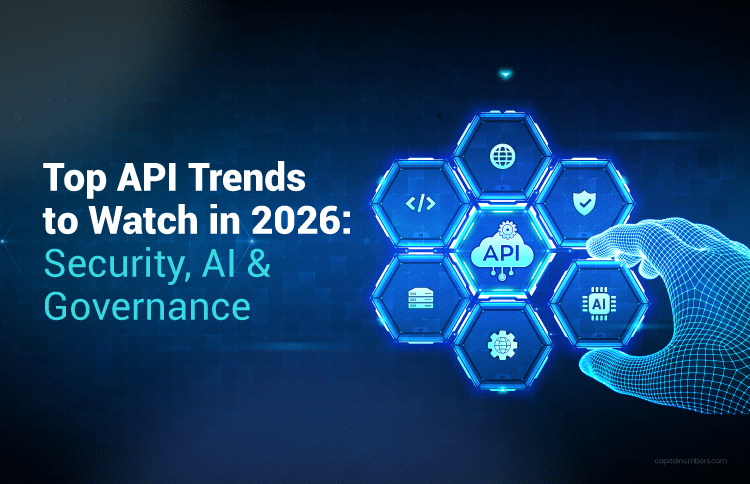
APIs sit quietly in the background of almost every digital thing you use — payments, logins, deliveries, health apps, banking, you name it. If your business builds or uses software, you’re already relying on APIs more than you realize.
But the way APIs are designed, secured, and managed is changing fast. In 2026, it’s not just about “getting the integration done.” It’s about protecting sensitive data, using AI smartly, and keeping everything under strong, predictable governance so teams don’t lose control as systems grow.
In this blog, we’ll walk through the top API trends you should watch in 2026, with a special focus on three big areas:
- Security — keeping APIs safe by design
- AI — using APIs to power and consume intelligent services
- Governance — making sure everything stays reliable, compliant, and under control
By the end, you’ll have a clearer view of where APIs are heading and what you should do next.
1. API Security as a Top Attack Surface
APIs have become a central vulnerability in your security landscape. REST APIs already power a large share of web traffic, and that makes them a natural target. Attack volumes are rising every year, from simple credential stuffing and brute force to business-logic abuse and large-scale data exfiltration. This highlights the growing importance of staying ahead of API security trends.
API security also reshapes how you think about API development trends in 2026. It’s no longer enough to “ship an endpoint and add auth later.” Security has to be built into how APIs are designed, tested, deployed, and monitored from day one. The more your APIs are exposed to partners, mobile apps, and AI agents, the larger and more complex your attack surface becomes.
What to watch:
- Adopt Zero Trust (never trusting a request without verifying it first) for APIs with mTLS (mutual Transport Layer Security), OAuth2/OIDC, JWT, and fine-grained RBAC so no request is trusted by default.
- Enforce security at the edge using gateways, WAFs (Web Application Firewalls), and API firewalls to filter, validate, and throttle traffic before it hits your services.
- Build continuous security testing into CI/CD so every new or changed API is scanned, fuzzed, and checked for common weaknesses.
- Centralize secrets management so keys, tokens, and credentials are stored safely, rotated regularly, and never hardcoded.
- Use rate limiting, quotas, and anomaly detection to spot and stop abuse patterns like scraping, credential stuffing, and bot traffic.
2. AI-Assisted API Design, Testing & Security
AI isn’t only a consumer of APIs – it’s also becoming a co-pilot for how you design, test, and secure them. By 2026, more teams will use AI tools and LLMs to generate or review OpenAPI specs, suggest security controls, and automatically create test cases. That turns security and governance from manual, checklist-driven work into something that’s built into the lifecycle from the start.
Instead of relying solely on human reviews to catch missing auth, inconsistent error codes, or undocumented fields, AI can flag these issues early in design or in pull requests. The same systems can generate negative tests, fuzz inputs, and simulate edge cases that humans might not consider. Done well, AI-assisted workflows help you ship faster and more safely, without adding more meetings or manual review gates.
What to watch:
- Use AI tools to generate and review OpenAPI/JSON Schema definitions, spotting missing fields, inconsistent types, and unclear contracts.
- Let AI propose baseline security controls for each API (auth types, scopes, rate limits) based on the data it exposes and the consumers.
- Generate test cases (including negative and security tests) from your API specs and plug them into CI/CD so every change is automatically exercised.
- Use LLM-based review bots in pull requests to flag governance issues like naming, versioning, error formats, and documentation gaps.
- Treat AI as an assistant, not a replacement: keep humans in the loop for approvals on sensitive APIs, especially those handling payments, identities, or health data.
3. APIs Consumed by AI and Agents (Not Just Humans)
A key part of the future of APIs is that your main “users” won’t just be people in front of a screen – they’ll be AI models and software agents calling your systems in the background. This shift is transforming how APIs are designed and operated.
AI-driven APIs are particularly crucial, as systems like GPT-4 and other Large Language Models (LLMs) increasingly rely on them to power everything from chatbots to advanced decision-making systems. These AI models constantly request data from APIs to process and generate responses, or to interact with other services.
How the landscape is changing:
- Gartner expects over 30% of the increase in API demand to come from AI and LLM-based tools by 2026, meaning a growing share of new traffic will be driven by machines, not frontends. Even if your web and mobile usage stays flat, background agents, workflows, and integrations will continue to add load to your APIs.
- Separately, analysts predict 80%+ of enterprises will be using generative AI APIs or AI-powered apps in production by 2026. In practice, that means most mid-to-large companies will have multiple systems calling external and internal AI services, chaining APIs together to power search, recommendations, automation, and decision support.
Whether you build everything in-house or work with an API development company offering full-stack API services, your APIs must be ready for this machine-first reality.
What to watch:
- Design APIs so they’re machine-consumable: strong schema, predictable response shapes, and consistent contracts.
- Use OpenAPI and JSON Schema as the single source of truth for how your APIs behave.
- Invest in clear, example-driven documentation that’s easy for both humans and tools to parse.
- Revisit rate limits, quotas, and pricing for AI-heavy usage, where one workflow or agent might generate thousands of calls in a short burst.
4. API Governance, Not Just Management
Another API development trend for 2026 is the shift from “just managing” APIs to API governance. Management is about traffic and keys. Governance is about the rules – how APIs are designed, secured, named, documented, deployed, and discovered across your organization. As more teams publish services, you need those rules if you want a scalable, predictable API landscape.
How the landscape is changing:
As API portfolios grow, ad-hoc standards and manual reviews don’t scale. The shift now is toward “shift-left” governance – building rules into design tools, linters, and CI/CD so standards are enforced automatically, not in slow manual reviews. Security, naming, and documentation checks happen when APIs are designed and during pipelines, which keeps the ecosystem cleaner and makes life easier for developers. At the same time, product and platform teams are taking clearer ownership of APIs, treating them as shared building blocks rather than one-off integrations.
What to watch:
- Central design guidelines for naming, versioning, security, and error handling so every API follows the same playbook.
- Linting and policy checks are built into CI/CD pipelines to automatically flag style, security, or documentation issues before merge or release.
- A proper API catalog/portal as the authoritative place to discover and manage APIs, including ownership, lifecycle stage, documentation, and access.
5. Multi-Cloud / Hybrid API Governance & Consistent Security
Most enterprises now don’t live in just one place. They run workloads across on-premises data centers, more than one cloud provider, and sometimes even at the edge. That means your APIs can’t assume a single platform anymore – your API layer has to span all of these environments and still feel consistent and safe to consumers.
Without strong governance, this quickly turns into chaos: different teams applying different auth methods, rate limits, and logging standards across environments. You end up with “shadow APIs” that behave differently depending on where they’re deployed, which makes security reviews and incident response much harder. The trend for 2026 is towards unified control planes and GitOps-style configuration, so API behavior and security posture remain consistent everywhere.
What to watch:
- Use API gateways or meshes that run across on-premises, multiple clouds, and edge environments while still being managed from a unified control plane.
- Apply consistent security, auth, rate limiting, and observability policies in every environment so an API behaves the same no matter where it’s hosted.
- Manage API definitions, policies, and configurations with GitOps/Infrastructure-as-Code so the same “contract” and security rules are deployed reliably across all regions and platforms.
- Maintain a single API catalog that shows where each API is deployed, who owns it, what data it exposes, and which policies apply.
- Regularly review multi-cloud APIs for drift in configs and policies, and use automation to bring them back in line with your global governance standards.
6. Regulatory & Domain-Specific APIs
In industries like finance and healthcare, APIs are rapidly becoming regulated infrastructure. Open banking standards, payment APIs, and healthcare frameworks such as FHIR (Fast Healthcare Interoperability Resources) and FAPI (Financial-grade API) define how sensitive data moves between systems. By 2026, these sector-specific APIs won’t just be integration tools – they will be a core part of how you prove compliance, protect customers, and pass audits.
How the landscape is changing:
Regulatory frameworks are evolving faster than many API platforms. Standards are updated more often, new guidance appears around privacy and consent, and regulators expect clearer evidence of how data is accessed and shared. That has real operational impact: teams need versioning strategies that can handle frequent changes, better control over who uses which API version, and end-to-end traceability for sensitive transactions. Audits are becoming more frequent and more detailed, so you need APIs that can answer “who did what, when, and under which rules?” without manual digging.
What to watch:
- Build on your core API security controls (encryption, strong auth, RBAC, logging) and map them explicitly to regulations like GDPR, HIPAA, and PSD2, so every regulated API can prove compliance.
- Implement robust consent and data minimization flows so you only expose what’s necessary, with a clear record of user permissions and how they were captured.
- Establish end-to-end, auditable logging and traceability for sensitive API calls so you can respond quickly to regulatory audits or incident investigations.
- Use flexible versioning and deprecation policies so you can adopt new standards or regulatory requirements without breaking existing consumers.
7. Observability, Analytics & AI-Assisted Ops
When it comes to API trends for 2026, this is one area you can’t ignore. Modern API teams don’t just want to know if an API is up or down – they want to see how each endpoint behaves in real time, which consumers are using it, where latency or errors come from, and how all of this affects user experience and downstream systems. API observability and analytics are evolving to tie together logs, traces, and metrics. The goal is an end-to-end picture instead of isolated dashboards.
At the same time, API platforms are adding AI-assisted operations as a built-in capability rather than an add-on. By 2026, more teams will rely on anomaly detection that flags unusual error or latency patterns, smart suggestions for scaling or tuning, and natural-language queries like “show me the slowest API in the last hour” or “which APIs spiked in 5xx today?” This is where observability, analytics, and AIOps converge to help teams fix issues faster and keep APIs healthy as traffic, systems, and dependencies become more complex.
How the landscape is changing:
Tools like Prometheus and Datadog have become essential for observability, allowing teams to track real-time metrics, traces, and logs across APIs and microservices. Prometheus, for example, offers powerful querying capabilities that help engineers dive deep into their API metrics, while Datadog provides a comprehensive view across the full stack, from frontend applications to backend services. These tools enable a holistic view of your infrastructure, helping you quickly pinpoint performance issues and ensure uptime.
Real-World Examples:
Companies like Netflix and LinkedIn are already utilizing AIOps in their observability stacks. Netflix, for instance, uses Mantis (their own internal AIOps tool) to monitor service health and automatically detect anomalies in their microservices architecture. This helps them identify performance issues and bottlenecks in real time, enabling quick resolution before problems affect users.
Similarly, LinkedIn uses AI-driven insights to help their DevOps teams predict infrastructure failures before they occur, ensuring continuous uptime and a better user experience. LinkedIn uses AI-powered anomaly detection to spot outliers in performance metrics that could indicate issues such as sudden traffic spikes or failing microservices.
What to watch:
- Centralize logs, traces, and metrics from gateways and services so you can see end-to-end API behavior in one place.
- Define SLOs at the API level (latency, error rate, availability) so teams know what “good” looks like and can measure against it.
- Use AIOps to flag performance regressions, unusual latency patterns, or suspicious traffic – and surface them as simple alerts or natural-language insights for your ops team.
- Make API analytics part of product and capacity decisions by tracking which endpoints are most used, most valuable, or most error-prone.
8. Policy-as-Code & Automated API Compliance
As APIs handle more sensitive data and fall under stricter regulations, manual policy reviews don’t scale. That’s where policy-as-code comes in: you define security, privacy, and data handling rules in code and evaluate them automatically in gateways, CI/CD, and runtime. Instead of hoping every team remembers the rules, you make it impossible to deploy APIs that break them.
For example, you can encode requirements like “PII must be encrypted at rest and in transit,” “no public API can expose this field,” or “EU user data must stay in EU regions.” When a new API or change is proposed, your policy engine checks it against those rules. If it fails, the pipeline blocks the change automatically. This turns compliance from a once-a-year audit activity into an everyday, low-friction guardrail.
What to watch:
- Define API policies (auth required, allowed methods, PII fields, data residency, logging requirements) in a central policy-as-code system.
- Integrate policy checks into CI/CD so non-compliant APIs, specs, or configs can’t be merged or deployed.
- Map policy rules directly to regulations like GDPR, HIPAA, or PSD2 so you can show how each API meets external requirements.
- Apply the same policy set at the gateway layer, ensuring that only compliant traffic reaches your services.
- Use policy-as-code to standardize how you handle tokens, secrets, and encryption across all APIs, regardless of which team built them.
You May Also Read: REST vs GraphQL: Which Will Power the APIs of Tomorrow?
Bottom Line
As you now have a fair idea of the top API trends for 2026, a good next step is to turn this insight into a clear action plan. The goal isn’t to adopt every new tool or buzzword – it’s to make your API landscape more secure, more consistent, easier to operate, and better aligned with where your business is heading.
Start by choosing just one or two priority areas. For example, you might decide to first strengthen API security and observability, or focus on basic API governance and preparing for AI-driven usage.
Next, define what “better” means for you over the next 6–12 months and take small, clear steps to get there. These simple changes, done consistently, will gradually give you an API platform that’s ready for AI, multi-cloud, and tighter regulations.
If you are looking for an experienced API development partner to help you modernize your API stack and get ready for these 2026 trends, get in touch with us today.