
How US SMEs Can Reduce Software Development Costs by 30–50% with Indian Teams

Aniruddh Bhattacharya
Project Manager
12th December, 2025

For most US small and mid-sized businesses, software development has quietly become one of the biggest and fastest-rising operational expenses. Developer salaries climb every year, hiring is slow and competitive, and projects that should feel simple end up requiring a dozen specialized skills. The result? Higher costs, longer timelines, and frustrated internal teams.
Yet there’s an alternative that thousands of US SMEs are already using to stay competitive: a blended delivery model where product ownership remains in the US and engineering execution is handled by experienced Indian teams – reducing total spend by 30–50%.
Still, many business leaders hesitate.
Will quality drop if costs drop? Will I lose control? How do I manage offshore work effectively?
This guide answers those questions clearly, so you can understand where the cost savings come from, how to ensure quality in software outsourcing, and how to build a model that lets your SME scale faster without overspending.
What Does Software Development Outsourcing Mean for US SMEs?
At its core, software development outsourcing means working with an external team or company to design, build, test, and maintain your software instead of hiring everyone in-house.
For a US SME, that usually looks like:
- You own the product vision, priorities, and budget.
- An external team (often offshore) does most of the actual design, coding, testing, and support.
Done right, this lets you:
- Turn fixed salary and overhead into flexible project or team costs
- Access skills you don’t have in-house (cloud, DevOps, mobile, AI, security)
- Free your internal leaders to focus on customers, sales, and growth
Why Is Software Development So Expensive for US SMEs?
Before you try to cut costs, it helps to be clear about why you’re paying so much today.
1. Local Talent Is Expensive and Hard to Find
- High salaries and extras
Mid-level and senior engineers expect strong base pay, benefits, and sometimes bonuses. That alone pushes up your total software development cost. - Recruiter and hiring overhead
Recruiter fees, job ads, and endless interviews take both expenses and leadership time. - Slow hiring delays your roadmap
It can take months to fill a key engineering role. In the meantime, features slip, deals wait, and competitors ship.
2. Modern Products Need Many Different Skills
Even a “simple” product today might need:
- React, Angular, Python, or AWS
- A secure, scalable back-end
- Integrations with third-party tools (payments, CRM, ERP, marketing)
- Analytics and reporting
- Sometimes AI or automation features
Most US SMEs can’t afford a full in-house team covering all of that. You either overpay for skills you don’t fully use or stretch a small team too thin.
3. Overheads You Don’t Always See
Beyond salaries, you’re paying for:
- Project management tools, repositories, testing platforms, design tools, and cloud services
- Healthcare, payroll, HR, training, and sometimes office costs
- Burnout and attrition, which lead to rework, re-hiring, and “lost context”.
All of this makes software a big and often unpredictable line item.
How Partnering with Indian Teams Cuts Costs by 30–50%
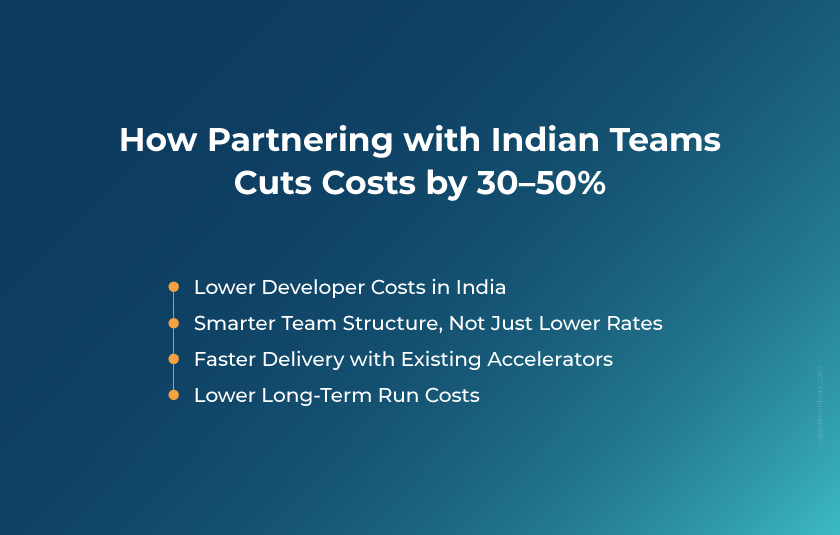
When you work with the right Indian partner for offshore software development, you’re not just getting developers at cost-effective prices. You’re changing the entire cost structure of how your software is built and maintained. Here’s where the real savings come from.
Lower Developer Costs in India
Developer salaries in India are lower than in the US because the overall cost of living is lower. That directly shows up in your budget.
- You pay lower hourly or monthly rates for experienced engineers.
- In many cases, you can work with senior talent at what would be junior or mid-level rates in the US.
This alone can significantly reduce your total development spend, especially for long-term products.
Smarter Team Structure, Not Just Lower Rates
The savings don’t stop at hourly rates. At Capital Numbers, we will help you design the right mix of skills, instead of overloading on expensive roles.
- You get blended teams with developers, QA engineers, DevOps, and a project manager, rather than a top-heavy management structure.
- You bring in specialized skills (like cloud, data, or automation) only when you need them, instead of hiring full-time for rare tasks.
This reduces waste and makes every dollar work harder.
Faster Delivery with Existing Accelerators
An experienced Indian software development company like Capital Numbers usually comes with code libraries, reusable components, and internal frameworks.
- They don’t start from scratch for common features like login, dashboards, or basic workflows.
- Reuse and proven patterns cut the total effort and shorten the timeline.
Less build time and fewer reworks mean you pay for fewer hours overall, not just cheaper hours.
Lower Long-Term Run Costs
- After launch, you can retain a small, dedicated offshore team like Capital Numbers for fixes, enhancements, and support at a lower blended rate.
- This avoids the stop-start costs of re-forming teams and lowers your total cost of ownership over 3–5 years.
What US SMEs Should Outsource to India (and What to Keep Local)?
Not every part of the SDLC should move offshore. The goal is to send the right work to Indian development teams while you keep control of the areas that are closest to your customers and strategy. When done well, this is where real software development cost optimization happens.
Good Candidates to Offshore
These are the parts of the work that fit well with outsourcing to India:
- Feature development for web and mobile apps
Turning clear requirements into working screens, workflows, and user journeys. - Back-end development and integrations
Building APIs, microservices, third-party integrations (payments, CRM, ERP, marketing tools), and data pipelines. - Testing and quality assurance
Manual testing, test automation, regression testing, and performance testing are easier to scale with offshore teams. - DevOps and environment setup
CI/CD pipelines, cloud environments, monitoring, and routine infrastructure tasks.
Work Better Kept Closer to Your Market
Some activities are more effective when handled by people who understand your local customers and business context:
- Product vision and roadmap
Deciding what to build, why it matters, and how it supports your business model. - Customer discovery and UX research
Talking to users, testing prototypes, refining messaging, and shaping pricing. - Compliance-heavy or highly sensitive work
In sectors like healthcare or finance, certain data and decisions may need to stay onshore due to regulation.
A Practical Split That Works for Many US SMEs
A common model is:
- US side: product owner or founder, key business stakeholders, maybe a UX lead or architect.
- India side: a cross-functional team from a reputable company like Capital Numbers (developers, QA, DevOps, possibly a project manager) to execute the plan.
A Simple Cost Scenario: Local-Only vs US + India
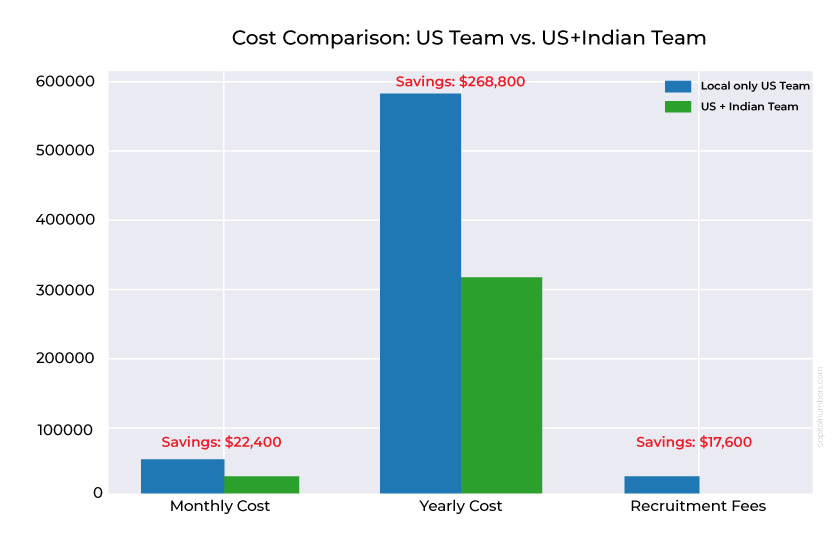
To keep things simple, let’s look at a rough, illustrative example.
These are approximate numbers to show the overall scale; actual rates may vary by city, tech stack, and seniority.
Scenario 1: Local-Only US Team
Imagine you run a small in-house team of 4 US engineers and 1 product owner:
Work hours (per month)
- 160 hours per person → 800 team hours
Hourly rates
- Product Owner (US): $85/hour
- Developer (US): $55/hour
Cost calculation
- Product Owner: 160 × $85 = $13,600
- Developers: 4 × 160 × $55 = $35,200
Total Monthly Cost (salaries only):$13,600 + $35,200 = $48,800
Recruitment fees (one-time for 4 US developers)
Assume a typical recruiter fee of 0.5 month of salary per developer:
- Monthly salary per developer: 160 × $55 = $8,800
- Recruitment fee per developer: 0.5 × $8,800 = $4,400
- 4 developers × $4,400 = $17,600 (one-time recruiter cost)
Scenario 2: US Product Owner + Indian Engineering Team
Now compare that with a blended model: you keep product ownership in the US and hire 4 Indian developers from Capital Numbers for the rest of the task (work hours are the same).
Hourly rates
- Product Owner (US): $85/hour
- Developer (India): $20/hour
Cost calculation
- Product Owner: 160 × $85 = $13,600
- Developers: 4 × 160 × $20 = $12,800
Total Monthly Cost (salaries only): $13,600 + $12,800 = $26,400
Recruitment fees
- Zero recruitment fees: you don’t pay anything to hire developers when you work with Capital Numbers.
What the Difference Looks Like
- Monthly savings: $48,800 – $26,400 = $22,400
→ ≈ 46% lower monthly team cost
- Yearly saving (salaries only): $22,400 × 12 = $268,800
→ ≈ 46% lower yearly salary cost
- First-year total saving (including avoided US recruiter fees): $268,800 + $17,600 = $286,400
→ ≈ 47% lower overall first-year cost
So, with a US Product Owner in both cases and the same total hours and capacity, moving development to an Indian engineering team from Capital Numbers gives you around 46% lower monthly team cost, plus zero recruitment fees on the developer side.
How to Structure Offshore Teams to Cut Development Costs
Even if you pick a great partner, you won’t see full savings unless the engagement is set up correctly. A clear structure turns software development outsourcing from a nice idea into a real, measurable impact on your cost of software development.
Pick the Right Engagement Model for Your Situation
The model you choose should match how clear your scope is and how long you plan to build.
- Fixed price for well-defined, short projects
It is best when you have a clear specification, a fixed set of features, and a tight timeline. You trade flexibility for predictability. - Time & materials when the scope is evolving
This is ideal for products that are still finding market fit. You pay for actual effort, adjust scope as you learn, and avoid endless change-request battles. - Dedicated/extended teams for ongoing products
When you have a roadmap, not a one-off project, a dedicated team from your offshore partner gives you stable capacity and better long-term velocity.
You May Also Read: Staff Augmentation vs Fixed Cost vs Agile Pods: Which One to Choose for Your Project
Design the Work for Cost Control
How you frame the work has a direct impact on balancing cost and quality in software development.
- Prioritize a lean feature set
Focus on the smallest set of features that solve a real business problem. Nice-to-haves can wait for later. - Break work into short phases or sprints
Plan in 4-6 week chunks with clear deliverables. This gives you frequent checkpoints to course-correct. - Tie payments to milestones, not vague timelines
Link invoices to completed phases, releases, or outcomes, so spend stays tied to progress.
Set Up Clear Governance from Day One
Good governance turns cost-effective offshore development into something predictable and low-stress.
- Assign an internal owner
One person on your side should own decisions, priorities, and approvals. - Agree on a simple communication rhythm
Weekly standups, sprint reviews, and monthly strategy calls keep everyone aligned without overloading calendars. - Use shared tools for visibility
A shared backlog, code repository, and documentation space let you and your Indian development teams work from the same source of truth and avoid misunderstandings that lead to rework and extra cost.
How to Handle Quality, Time Zones, and Security Concerns?
When you think about outsourcing to India, cost is only one part of the decision. To get the benefits from your software development, you also need a clear plan for quality, collaboration across time zones, and security.
Maintaining or Improving Quality While Paying Less
Lower rates don’t have to mean lower quality. The key is to make expectations very clear:
- Define “done” clearly
Agree on acceptance criteria, required test coverage, and performance baselines for each feature. - Build quality into the process
Ask about code reviews, QA practices, test automation, and the use of staging environments before going live. - Start with a small pilot
Run a short, paid pilot project with your Indian development teams to validate quality, communication, and speed before you scale.
Making Time Zones Work for You
The US-India time difference can be an advantage if you structure it well.
- Plan overlap hours
Set 1–3 hours each day where both sides are online for questions, decisions, and blockers. - Mix sync and async communication
Use quick calls for alignment and written updates (tickets, summaries, Loom videos) for progress and context. - Agree on a daily rhythm
For example: your late afternoon check-in becomes their next-morning plan; their end-of-day update becomes your morning brief.
Protecting IP and Data
Security and IP protection are non-negotiable.
- Get the basics in writing
NDAs, clear IP ownership clauses, and confidentiality terms in your contract. - Control access
Use role-based permissions, VPNs, and separate environments for dev, staging, and production. A simple internal software security checklist helps ensure consistency. - Check certifications
Ask whether the Indian software development company follows standards such as ISO 27001 or SOC 2 to further reduce risk.
How to Choose the Right Indian Software Development Partner?
Picking the right partner matters more than any hourly rate. A strong team like Capital Numbers will save you money and stress; the wrong one will burn time, budget, and trust.
Where to Look and What to Shortlist?
Start by casting a focused, not random, net.
- Referrals and recommendations
Ask peers, advisors, or other founders which Indian software development company they’ve had good experiences with. - Independent reviews and case studies
Check Clutch, GoodFirms, G2, and the company’s own site for detailed case studies with outcomes. - Shortlist by fit, not just price
Prioritize partners with experience in your domain (e.g., SaaS, healthcare, fintech) and your tech stack, rather than whoever is the cheapest.
Questions That Reveal How They Really Work
Once you have a shortlist, your questions should dig into “how” they deliver, not just “what” they can do.
- “How do you estimate projects?”
Look for a clear, structured approach, not just a single number thrown over email. - “Who will actually be on my team?”
Ask for roles, seniority, and whether you’ll have direct contact with engineers and a project manager. - “How do you handle change requests, delays, and production issues?”
You want concrete examples, escalation paths, and timelines. - “What does a typical week of collaboration look like?”
This should include meetings, reporting, tools, and communication channels.
Red Flags to Avoid
Walk away if you see:
- Unrealistic timelines or “we can do anything” promises.
- Very low pricing with no clear explanation of how they staff and deliver.
- Vague or evasive answers about team composition or turnover.
You May Also Read: Balancing Cost & Quality in Software Development Outsourcing
Bottom Line
For US SMEs, software will continue to play a bigger role in how you sell, serve customers, and grow. If you rely only on local hiring, your software costs will almost certainly keep rising, too. The good news is, you don’t have to.
By keeping product decisions and customer insight in the US, and partnering with the right Indian development teams for delivery, you can build more, deliver faster, and cut your software spend by 30–50% over the next few years.
The way forward is simple:
- Understand what’s really driving your costs today
- Move the right parts of the work offshore
- Set up a clear, structured, and transparent way of working
- Test everything with a small pilot before you scale
When you do this, partnering with an award-winning software development company, like Capital Numbers, isn’t just about ensuring cost-effective software development; it’s about giving your business the freedom to grow without your software budget holding you back.
Ready to lower your burn rate? Book a 30-minute consultation with our team to get a custom cost-benefit analysis.