
Bridging the Gap Between Designers and Developers in Delivery Cycles

Abhijit Sarkar
Head of Creative Services
15th January, 2026

In the world of software development, the journey from ideation to deployment is a detailed process, involving multiple stages such as research, design, development, testing, and finally, deployment. One of the crucial elements for ensuring smooth delivery is the collaboration between designers and developers throughout each phase of the project. While the roles of designers and developers are distinct, their seamless interaction can greatly influence the success of a project.
The Core Development and Delivery Cycles
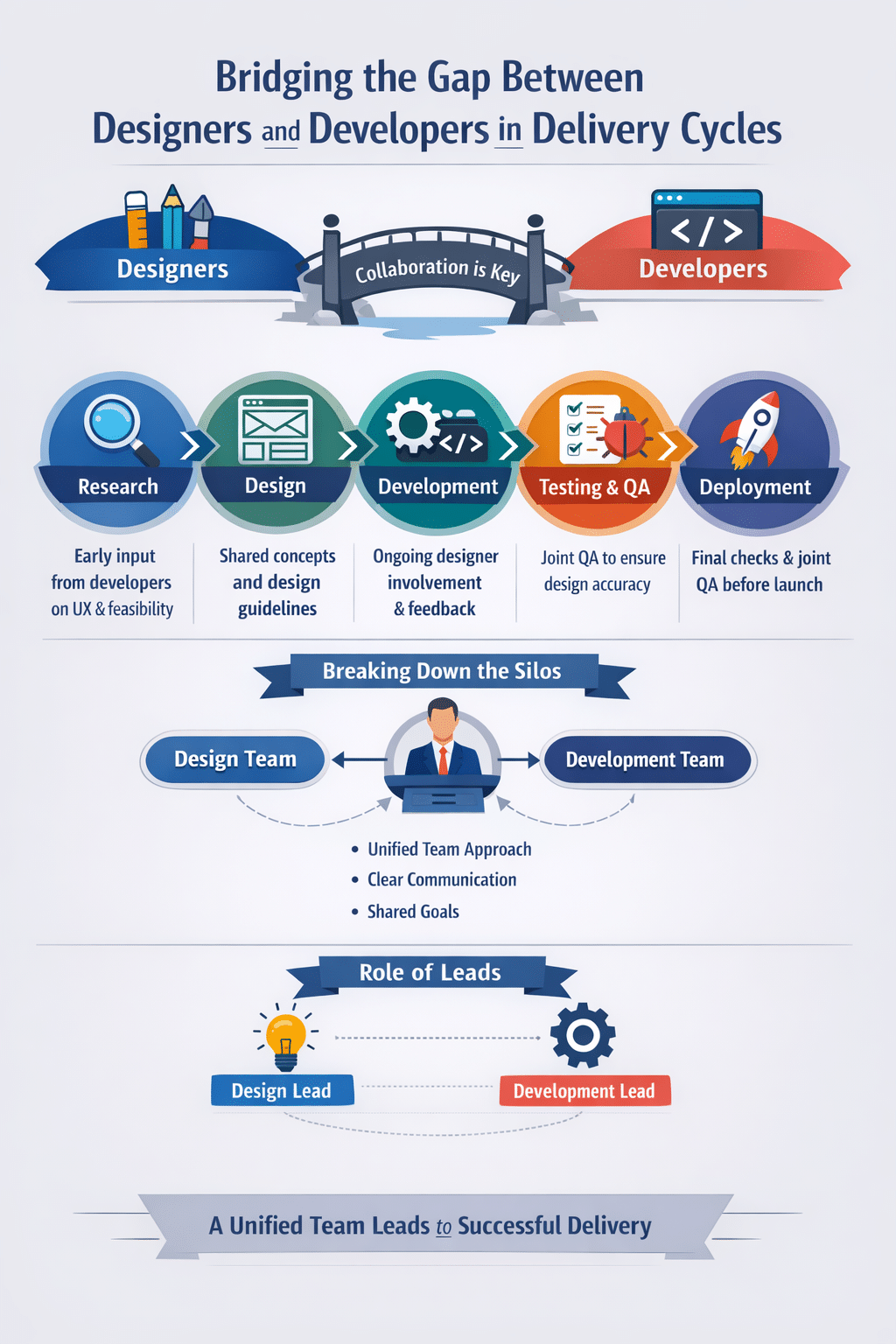
A typical project delivery cycle begins with research, followed by designing, development, testing, and deployment. Each of these stages has its importance, and it’s vital that designers and developers work together from the very start.
1. Research: Laying the Foundation
Even during the research phase, collaboration between designers and developers should be a priority. As a designer begins gathering insights and forming concepts, involving developers early on can help address technical constraints, limitations, and opportunities that the design team might not have considered. Developers can provide valuable input not just for the design’s feasibility but also in shaping the overall user experience (UX) and interactivity of the product.
2. Designing: Wireframes, Visual Design, and Collaboration
Once the research phase is complete, designers move to wireframing and visual design. At this point, the design team needs to keep developers informed of their progress. This allows developers to understand the project’s scope, design concepts, and functionality in detail. It’s crucial for developers to offer feedback, especially on interactive elements or user flows that may have development constraints. Sharing design files isn’t enough; a well-documented design system and guidelines ensure that developers can implement the design with consistency and precision.
3. Development: Bridging the Gap
Development is where the bulk of the coding happens, but this is also where designers must continue to play an active role. It’s not enough to simply hand over design files to developers and expect flawless execution. Designers must share detailed design guidelines, including color palettes, typography, spacing, and animations. It’s essential that designers educate developers about the rationale behind design choices, helping them understand the bigger picture and translating design intentions into functional code.
Furthermore, even as developers start coding, designers should stay involved in the development process. Design leads should create a system where designers continuously check in on development progress. Regular QA sessions should take place, with designers validating that the development work aligns with the original design expectations. This collaboration ensures that design integrity is maintained throughout the development cycle.
4. Testing and QA: Joint Collaboration
Once the development phase is complete, it’s time for Quality Assurance (QA). Here, collaboration between designers and developers is vital. Both teams need to come together to ensure the product meets the design specifications and user expectations. Joint testing helps identify discrepancies between the initial design and the final product. By working together during QA, the chances of missed errors are reduced, making the process smoother and more efficient.
5. Deployment: Final Touches
Before deploying the product, both designers and developers must perform a final round of QA to ensure everything functions as expected. The deployment phase is crucial, and any mistakes here can lead to major issues for users. Ensuring the collaboration continues until this stage guarantees that the final product is of the highest quality.
Breaking Down the Department Silos
Many organizations define departments separately for efficiency. However, it’s crucial to recognize that these departments should not operate in isolation. In reality, both designers and developers are integral parts of the same team, not separate functions. The project manager’s role is critical in bridging the gap between these disciplines, ensuring that both teams work toward a unified goal.
A project manager must take responsibility for facilitating communication between designers and developers, keeping them aligned on project goals, timelines, and expectations. They must also ensure that both teams are motivated to collaborate, rather than working in silos. It’s essential that designers and developers see themselves as part of the same team, focused on delivering a high-quality product for the client and end users.
The Role of Design and Development Leads
Along with project managers, design leads and development leads play an essential role in fostering collaboration. These leads must actively coordinate between the two teams, ensuring that everyone is on the same page. They should facilitate communication, manage feedback loops, and ensure that both sides are heard. This will help minimize mistakes and reduce the number of errors found in the final QA rounds, making the entire process more efficient and effective.
Dos and Don’ts to Maintain the Bridge Between Designers and Developers
Dos:
- Foster early collaboration by involving developers in the research phase.
- Create clear design systems, guidelines, and documentation.
- Maintain open communication between designers and developers.
- Involve designers in the development phase to ensure proper implementation.
- Conduct regular check-ins and joint QA sessions.
- Provide constructive feedback in a timely manner.
- Ensure proper handoff of design assets with detailed explanations.
- Encourage knowledge sharing regarding usability, performance, and constraints.
- Align both teams on the unified goal of delivering a user-centric product.
Don’ts:
- Avoid creating silos between designers and developers.
- Don’t ignore cross-team feedback; involve both sides in decision-making.
- Don’t rely only on design files for execution; provide context and explanations.
- Don’t disengage after the design phase; stay involved throughout.
- Don’t skip documentation; ensure clarity in design elements and interactions.
- Don’t overlook testing and validation during the development cycle.
- Don’t assume developers fully understand design intent; clarify expectations.
Conclusion: A Unified Team for Success
The key to successful project delivery lies in seamless collaboration between designers and developers. By keeping both teams aligned throughout the entire process – from research and design to development, testing, and deployment – we can ensure that the final product meets both the design vision and technical requirements. This level of collaboration minimizes errors, reduces development time, and enhances the quality of the final product. Ultimately, it’s the responsibility of the project manager, design leads, and development leads to create a cohesive, motivated, and synchronized team, all working toward a common goal.