
AI Transformation Services: What They Are, What’s Included, and How to Choose a Partner
Table of Contents
Executive Summary
- AI transformation services help enterprises move from AI pilots to measurable business value.
- They typically include strategy, data readiness, solution design, development, integration, governance, adoption support, and optimization.
- Unlike basic AI implementations, they focus on long-term capability rather than a single tool or use case.
- The biggest barriers are usually poor data, weak integration, limited governance, and low adoption.
- The right AI transformation partner should align AI with business goals, support production-scale delivery, and drive measurable outcomes.
AI is no longer the question. Execution is.
Most business leaders in 2026 are not asking whether AI matters. They are asking why it is not delivering more. Pilots were launched, tools were deployed, and budgets were approved. Yet when leadership looks for measurable impact on revenue, cost efficiency, or competitive advantage, the answers are often still unclear.
The gap is rarely ambition. It is usually the lack of a clear strategy, a strong data foundation, the right governance, and a capable AI development partner who can drive adoption beyond deployment. That is where AI transformation services come in. They help organizations move from fragmented AI efforts to scalable business value.
In this blog, we will look at what AI transformation services include, how they differ from basic AI implementation, and what CXOs should look for in a partner who can turn AI ambition into measurable business results.
What Are AI Transformation Services?
AI transformation services are end-to-end consulting, engineering, and integration services that help enterprises identify high-value AI opportunities, prepare data, build AI solutions, integrate them into business systems, govern risk, and scale adoption across the organization.
According to McKinsey & Company, 88% of organizations now regularly use AI in at least one business function, but only one-third are capturing meaningful enterprise value from it. That gap between AI usage and real business impact is exactly what enterprise AI consulting and implementation services are designed to address.
How Are AI Transformation Services Different from Basic AI Implementation?
AI transformation services differ from basic AI implementation in scope, integration depth, governance, and long-term business intent. Basic AI implementation usually focuses on solving a specific problem or deploying a single tool, while AI transformation is about building an enterprise-wide capability that scales across systems, teams, and workflows.
| Aspect | Basic AI Implementation | AI Transformation |
|---|---|---|
| Scope | Single-use case, tool, or pilot | Enterprise-wide and cross-functional |
| Focus | Solving a specific problem | Building long-term business capability |
| Technology approach | Often based on off-the-shelf tools or limited customization | More tailored solutions aligned to business needs, systems, and scale |
| Time horizon | Short-term deployment | Ongoing evolution and optimization |
| Integration | Often standalone | Deeply integrated with systems and workflows |
| Governance | Limited oversight | Stronger focus on compliance, risk, and control |
| Business impact | Narrow or localized gains | Broader operational and strategic impact |
What Should Businesses Realistically Expect from Enterprise AI Adoption?
Enterprise AI adoption can create real business value, but it is rarely quick or effortless. It usually takes time, strong internal alignment, clear governance, and a partner who understands your business rather than pushing a one-size-fits-all solution.
- It takes time to show meaningful returns
A focused AI use case can start delivering results in 3-6 months. But if the goal is broader transformation across teams or functions, 12-18 months is a more realistic expectation. The timeline depends on your scope, the quality of your data, and how ready your teams are to adopt new ways of working. - Your internal team still matters
An external partner can help you move faster, but they should not become a long-term crutch. If your team is not learning along the way, you may end up dependent on outside support for every change. The right partner should transfer knowledge, not create dependency. - Pre-packaged solutions should make you cautious
If the conversation starts with a product demo before anyone has understood your business problem, that is usually not a good sign. AI-led business change works best when the solution is shaped around your goals, systems, and constraints, not forced into a standard template. - Governance is not something to add later
As AI regulation becomes more serious across markets, weak governance creates real business risk. This is no longer only about ethics. It is also about compliance, accountability, and protecting the business from avoidable legal and operational issues.
What’s Included in End-to-End AI Services?
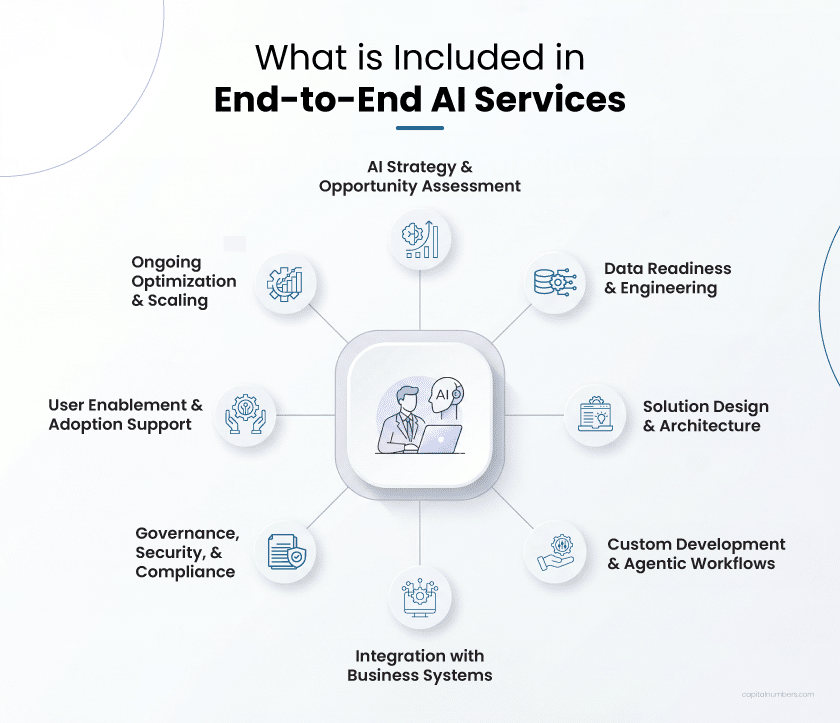
AI transformation services typically include strategy, data readiness, solution design, custom development, integration, governance, user enablement, and ongoing optimization. Together, these stages help enterprises move from isolated AI pilots to systems that can deliver measurable business value over time.
1. AI Strategy and Opportunity Assessment
- What it is:
This stage identifies where AI can create the most value and which use cases should come first. It helps shape an enterprise AI strategy by connecting business priorities with practical opportunities. - Why it matters:
It helps leaders focus on the initiatives most likely to deliver measurable results instead of spreading effort across too many ideas. - What happens if skipped or strategic implication:
Without this step, AI efforts often become reactive, fragmented, and hard to scale.
2. Data Readiness and Engineering
- What it is:
This involves assessing, cleaning, organizing, and connecting the data needed to support AI systems reliably. For many enterprise AI use cases, it also includes preparing proprietary data for retrieval-based approaches such as RAG and vector search. - Why it matters:
High-quality data improves the accuracy, relevance, and trustworthiness of AI outputs. It also helps ground AI responses in business-specific knowledge without retraining the base model. - What happens if skipped or strategic implication:
Poor data foundations lead to weak outputs, low confidence, and disappointing business outcomes. In generative AI projects, this can also increase the likelihood of hallucinations and reduce trust in the system.
3. Solution Design and Architecture
- What it is:
This stage defines the structure of the AI solution, including model selection, workflows, infrastructure, and deployment approach. It is also where teams decide between proprietary APIs and open-source models based on privacy, control, and cost. - Why it matters:
It ensures the solution fits the business context, technical environment, and budget instead of becoming unnecessarily complex. It also helps the business choose the right architecture for secure and scalable enterprise use. - What happens if skipped or strategic implication:
A weak design can create cost, scalability, and usability problems later in the project. It can also lead to the wrong model strategy and avoidable long-term constraints.
4. Custom Development and Agentic Workflows
- What it is:
This is where the AI solution is built for the business’s specific needs. It may include assistants, automation flows, recommendation engines, document intelligence, or agentic workflows. - Why it matters:
Custom development makes the solution useful in real operating conditions rather than relying on generic capabilities. A good example is our work on an AI-driven customer messaging platform, where automation, centralized communication, and real-time insights helped streamline operations and support scalable growth. - What happens if skipped or strategic implication:
The result may be a tool that looks promising in a demo but does not solve the real business problem effectively.
5. Integration with Business Systems
- What it is:
This connects the AI solution to existing platforms, including ERP, CRM, support systems, internal tools, and data environments. - Why it matters:
Integration makes AI easier to use in everyday work, rather than forcing teams to adopt disconnected tools. For example, in one of our projects, we built a data-driven energy management solution that connected diverse data sources, enabled real-time monitoring, and helped decision-makers act on predictive insights across building operations. - What happens if skipped or strategic implication:
Even a strong solution can see low usage if it sits outside normal workflows.
6. Governance, Security, and Compliance
- What it is:
This creates the rules, controls, and safeguards around how AI is used, monitored, and managed. - Why it matters:
It helps protect the business from avoidable legal, operational, and trust-related risks. - What happens if skipped or strategic implication:
Weak governance can slow adoption, increase exposure, and undermine confidence in the solution.
7. User Enablement and Adoption Support
- What it is:
This includes training, onboarding, workflow guidance, and feedback loops that help people use AI effectively. - Why it matters:
Business value only appears when teams understand how to apply the solution in their daily work. - What happens if skipped or strategic implication:
Low adoption can limit impact, even when the underlying technology is sound.
8. Ongoing Optimization and Scaling
- What it is:
This stage focuses on monitoring performance, refining the solution, and expanding successful use cases over time. It should also include tracking inference and computing costs as AI adoption grows. - Why it matters:
AI needs to evolve as business needs, data, and user expectations change. Cost control also matters because AI can become expensive to scale without proper oversight. - What happens if skipped or strategic implication:
The solution can become less useful over time and fail to deliver broader long-term value. Poor cost control can also reduce ROI and make scaling harder to justify.
Once you understand what AI transformation services include, the next step is choosing the right partner to deliver them.
How to Choose the Right AI Transformation Partner
Choosing an AI development company is one of the most consequential decisions a CXO will make in 2026. The market is crowded, the claims are loud, and the cost of getting it wrong, in time, budget, and competitive position, is high. Here’s what to actually look for:
Look for Business-First Thinking
The best AI development companies don’t lead with technology. They lead with your business.
- Do they ask about your business priorities before recommending a solution?
- Can they connect AI initiatives to measurable outcomes – revenue, cost reduction, retention, efficiency?
- Do they speak the language of the boardroom, not just the data science team?
Check for End-to-End Capability
Fragmented AI delivery creates fragmented results. Look for a partner who can own the full journey:
- Strategy: Enterprise AI strategy and roadmap development
- Data readiness: Assessment, engineering, and governance
- Design: Solution architecture and model selection
- Implementation: AI development, fine-tuning, and deployment
- Integration: Connecting AI to your existing systems and workflows
- Governance: Responsible AI frameworks, AI ethics, and compliance alignment
- Optimization: Continuous improvement post-deployment
Assess Production-Readiness
Many companies can build a proof of concept. Far fewer can deliver AI that works reliably at enterprise scale.
- Have they taken similar solutions from pilot to full production rollout?
- Do they have a clear plan for monitoring, model drift detection, and post-launch support?
- Can they handle the complexity of scaling agentic AI systems or LLM-powered workflows across business units?
Evaluate Governance and Security Maturity
As AI becomes more embedded in critical business operations, governance is no longer optional – it’s a board-level concern.
- Data privacy safeguards and compliance with regional regulations (GDPR, CCPA, and emerging AI-specific frameworks)
- Access control and role-based permissions across AI systems
- Responsible AI practices, like bias monitoring, explainability, and audit trails
- Risk management protocols for high-stakes or automated decision-making
- Human-in-the-loop mechanisms where consequential decisions are involved
- Industry-recognized certifications, including ISO 27001 (information security management) and SOC 2 Type II (security, availability, and confidentiality controls)
Review Integration Strength
AI that lives outside your business operations delivers little real value.
- Can they integrate AI seamlessly into your existing ERP, CRM, and helpdesk platforms — along with your broader support systems and data environments?
- Do they work with your current technology stack rather than forcing unnecessary replacement?
- Can they navigate legacy infrastructure, data silos, and complex enterprise architectures without derailing timelines?
Ask How They Measure Success
A serious AI transformation partner defines success before the project starts, and tracks it throughout.
Look for partners who measure against:
- Business KPIs: Revenue impact, cost savings, productivity gains
- Operational metrics: Process cycle times, error rates, throughput
- Adoption indicators: Active usage rates, user satisfaction, workflow penetration
- ROI tracking: Clear attribution of AI outcomes to business value
Check Long-Term Support Capability
Enterprise AI adoption is not a project with an end date. It’s an ongoing capability.
- Do they offer maintenance and model retraining as data and business conditions evolve?
- Can they support scaling – moving from one use case to ten, one team to the entire organization?
- Is there a dedicated support model post-launch, or does the relationship end at delivery?
Assess Cultural and Strategic Fit
This doesn’t appear on most checklists, but it shapes everything.
- Do they challenge your thinking, or just validate it?
- Do they bring a clear point of view on where AI is heading in your industry?
- Are they willing to push back when a proposed use case won’t deliver real value?
- Do their ways of working align with how your teams operate and make decisions?
The right AI development partner should not just know how to build AI. They should know how to make it work inside the business.
You May Also Read: How to Choose an AI Software Development Company: 12 Criteria That Matter
Turning AI Strategy Into Business Value
AI transformation services are not just about deploying AI tools. They help businesses build the strategy, data foundation, governance, and operating support needed to turn AI into measurable business value.
That is why understanding what these services are, what they include, and how to choose the right enterprise AI partner matters. The right company should not only understand the technology, but also know how to align it with business goals, existing systems, and the practical realities of enterprise change.
If your organization is evaluating how to move from AI interest to practical implementation, Capital Numbers can help you assess opportunities, define the right roadmap, and build solutions that deliver real business impact.
Frequently Asked Questions
1. Is AI transformation the right investment for my organization right now?
AI transformation is the right investment when your organization wants to improve efficiency, decision-making, customer experience, or operational scalability and has clear business problems AI can help address. The best starting point is not a large budget, but a focused strategy that identifies high-value use cases and readiness gaps.
2. What makes AI transformation services different from buying an AI tool?
Buying an AI tool gives you access to technology. AI transformation services help you make that technology work inside the business through strategy, data preparation, integration, governance, user adoption, and ongoing optimization. The difference is that the goal is not just deployment, but measurable business value.
3. Can AI transformation services work with legacy systems?
Yes, if the partner has a strong integration capability. In many enterprises, AI must work with existing ERP, CRM, support platforms, data systems, and internal workflows. A good partner helps introduce AI in a practical way without forcing unnecessary disruption or large-scale system replacement.
4. How long does enterprise AI adoption typically take?
Focused use cases may begin delivering results in 3–6 months, while broader enterprise transformation often takes 12–18 months or more. The timeline depends on scope, data quality, integration complexity, and team readiness.
5. How do we know which AI use cases to prioritize first?
Start with use cases where the business problem is clear, the expected value is measurable, and the data is reasonably ready. A strong partner can help evaluate each opportunity by value, feasibility, urgency, and implementation effort so you can prioritize what is most likely to deliver impact.


 Web Development
 Cloud Engineering
 Mobile App Development
 AI/ML/GenAI
 E-commerce
 Software Development
 UI/UX
UI/UX QA
QA Dedicated Teams