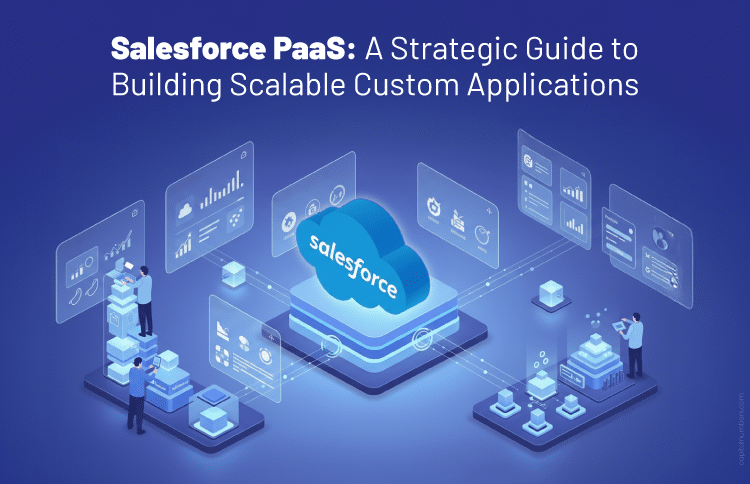

Salesforce PaaS: A Strategic Guide to Building Scalable Custom Applications
Table of Contents
In today’s fast-paced digital world, the ability to quickly create and adapt applications isn’t just a Nice-to-have – it’s a fundamental expectation. Companies are navigating landscapes where customer demands shift in the blink of an eye, regulations change frequently, and internal processes need to be agile without losing momentum. Traditional app development, with its lengthy setup times and hefty maintenance demands, often struggles to keep pace. That’s where Salesforce Platform as a Service (PaaS) really shines.
While many recognize Salesforce as a leader in customer relationship management (CRM), its real power lies in its role as a cloud application platform. At the heart of this ecosystem is the Salesforce Platform, which empowers organizations to design, build, deploy, and scale custom business applications without the hassle of managing servers, databases, or system upgrades. Salesforce PaaS shifts the focus from managing infrastructure to achieving business results – an approach that fits perfectly with today’s digital transformation objectives.
Getting to Know Salesforce as a Platform as a Service
Platform as a Service sits neatly between Infrastructure as a Service and Software as a Service. It offers developers a complete environment to create applications while taking care of the underlying infrastructure. Salesforce fully embraces this model.
Applications built on Salesforce automatically enjoy:
- Cloud-native hosting and high availability
- Automatic scalability as user demand increases
- Built-in backup, recovery, and monitoring
- Continuous platform improvements rolled out by Salesforce
This means no more massive upgrade projects or tedious manual performance tweaks. Applications remain up-to-date, secure, and resilient by default. For organizations, this means lower operational risks and predictable costs. For development teams, it translates to quicker development cycles and smoother releases.
You May Also Read: A Guide to Cloud Service Models: How IaaS, PaaS, and SaaS Benefit Your Business
Data is the backbone of every business application
At the core of Salesforce’s object-based data model is a structured yet flexible approach to representing real-world business processes.
The platform offers:
- Standard objects for common business entities
- Custom objects designed for unique workflows
- Lookup and master-detail relationships
- Validation rules to maintain data quality
What really sets this model apart is its adaptability. As business needs change, you can easily introduce new fields, objects, or relationships without the hassle of database migrations or downtime. This means applications can evolve naturally, rather than becoming rigid systems that resist change.
Bringing Processes to Life with Business Logic
While declarative tools handle a lot of scenarios, custom applications often need a bit more sophistication. Salesforce meets this need with Apex, its server-side programming language crafted specifically for a multi-tenant cloud environment.
With Apex, teams can:
- Implement complex business rules
- Coordinate logic across various objects
- Efficiently process large volumes of data
- Manage asynchronous operations and integrations
Salesforce also enforces platform limits to promote fair resource usage, which encourages designs that are both efficient and scalable. These guidelines require careful planning but ultimately lead to applications that perform reliably, even at scale.
Designing Modern User Experiences with Lightning
Creating a powerful application is only half the battle; it needs to be user-friendly too. That’s where Salesforce shines, especially with its Lightning framework and Lightning Web Components (LWC).
With Lightning, custom applications benefit from:
- Modular and reusable UI components
- Quicker load times and enhanced responsiveness
- Consistent design patterns throughout the platform
- Support for both desktop and mobile experiences
This strategy enables teams to craft modern, intuitive interfaces without the hassle of juggling separate front-end stacks. Whether the application is aimed at internal users, partners, or customers, it maintains a cohesive and familiar feel.
Low-Code and Pro-Code Working Together
One of the standout features of Salesforce PaaS is how effortlessly it merges low-code tools with traditional development. Not every business need requires custom coding, and Salesforce offers robust declarative options to meet those needs.
Some common low-code tools include:
- Flows for automating and orchestrating processes
- Approval processes to ensure governance and compliance
- Validation rules to uphold business policies
This balance not only cuts down on development time but also lowers long-term maintenance costs. Administrators can handle routine updates, while developers can concentrate on the more complex logic and integrations that provide the greatest value.
Security Embedded by Design
In Salesforce, security isn’t an afterthought; it’s woven into the very fabric of the platform. Every custom application automatically benefits from a strong, layered security model.
This includes:
- Role hierarchy and sharing rules
- Object, field, and record-level access controls
- Permission sets for detailed access management
- Built-in auditing and compliance features
By centralizing security at the platform level, organizations can avoid redundant efforts across applications. This ensures that access policies are consistently enforced while also meeting regulatory and compliance standards.
Integration-Ready from Day One
In today’s world, modern businesses thrive on a web of interconnected systems. That’s where Salesforce PaaS comes in, built with integration at its core, making it a breeze for applications to link up with outside platforms.
Salesforce offers:
- REST and SOAP APIs for seamless system-to-system communication
- Event-driven architectures powered by Platform Events
- Asynchronous processing to handle long-running tasks
These features empower Salesforce applications to share data in real time, kick off external workflows, and serve as a central hub within the larger enterprise framework.
Beyond CRM: Where Salesforce PaaS Is Used
While Salesforce is often linked to sales and service, its PaaS capabilities reach far beyond just CRM.
Organizations leverage the platform to create:
- Internal workflow and approval applications
- Partner and vendor management portals
- Customer self-service platforms
- Industry-specific operational systems
Thanks to the ability to quickly build and tweak applications, teams can swiftly adapt to regulatory shifts, operational hurdles, and market demands.
Why Salesforce PaaS Aligns So Well With Business Change
What really makes Salesforce PaaS stand out is how effortlessly it adapts to ongoing change. Business needs are rarely static – processes shift, teams expand, and customer expectations evolve. Salesforce is crafted with this reality in mind.
Its metadata-driven architecture allows for incremental adjustments to applications. You can introduce new fields, workflows, approval paths, and user experiences without having to overhaul the entire system. Instead of viewing change as a threat, Salesforce PaaS embraces it as a natural and manageable aspect of the application lifecycle. Over time, this adaptability translates into genuine business value – applications stay relevant, users remain productive, and technology fosters growth instead of hindering it.
Deployment, Scaling, and Lifecycle Management
Salesforce makes managing the entire application lifecycle a breeze, from development all the way to production and beyond.
Here are some key perks:
- Sandboxes that provide a safe space for development and testing
- Well-structured deployment processes
- Automatic updates to the platform
- Very little need for infrastructure upkeep
As more users come on board, applications automatically scale up without the need for performance tweaks or capacity planning. This means organizations can expand confidently, knowing their applications are ready to handle the extra demand.
Accelerating Delivery with App Exchange
Salesforce’s App Exchange ecosystem takes the PaaS experience to the next level. Instead of starting from scratch, organizations can tap into a wealth of pre-built applications, components, and integrations.
The benefits are clear:
- Quicker time to market
- Less development effort required
- Access to secure, certified solutions
This ecosystem allows teams to concentrate on what makes them unique while relying on tried-and-true components for their standard needs.
Important Considerations
When it comes to adopting Salesforce PaaS, there are some key points to keep in mind. First off, the platform has its limits, so you’ll want to plan your architecture carefully. Also, don’t overlook the licensing costs – it’s best to assess those early on. Plus, your teams will need to develop specific skills tailored to Salesforce. But with a solid strategy in place, these factors can lead to a well-structured design and applications that are scalable and ready for the future.
Final Thoughts
Salesforce Platform as a Service is a robust foundation for creating custom business applications that are not only secure and scalable but also adaptable. By simplifying infrastructure challenges and offering flexible data modeling, strong business logic, modern user experiences, built-in security, and smooth integrations, Salesforce allows organizations to concentrate on innovation and results instead of getting bogged down in operations. For businesses aiming to develop applications that can grow with their evolving needs – without the hassle of managing infrastructure – Salesforce PaaS remains a standout, reliable, and strategic option.
Looking to build scalable, secure custom applications on Salesforce PaaS? Capital Numbers helps organizations design, build, integrate, and scale Salesforce solutions using the right mix of low code, Apex, Lightning, and enterprise integrations. Explore how Capital Numbers’ Salesforce development services can turn your application idea into a production-ready platform built for long-term growth.


 Web Development
 Cloud Engineering
 Mobile App Development
 AI/ML/GenAI
 E-commerce
 Software Development
 UI/UX
UI/UX QA
QA Dedicated Teams