

Web Security Best Practices for 2026: A Modern Checklist for Business Owners
Table of Contents
At 10:00 AM, your campaign goes live.
By noon, traffic is strong.
By 2:00 PM, customers can’t log in, checkout fails for some users, and your support team is flooded.
There is no major hack headline. Just one weak link in a connected system.
That’s why web security is a business priority in 2026. Your website, apps, APIs, cloud services, and third-party tools now work as one connected experience. If one point fails, the impact spreads fast. It affects revenue, customer trust, and day-to-day operations.
If you want to avoid these issues, read this blog. It breaks down the web security best practices that matter most for business owners, so you can make smarter decisions and keep your growth plans protected.
Web Security Threats in 2026: What’s Changed and Why It Matters
In 2026, the threat landscape is no longer the same. We are seeing a rise in quieter, low-and-slow data theft alongside traditional ransomware. Businesses are seeing more pressure in four areas:
- APIs, because they connect products, partners, and data flows
- Identity systems, because access control is now the front line
- Software supply chains, because third-party code and tools can introduce hidden risk
If any of these is weak, attackers can move quickly across your connected systems and cause broader impact. Besides, AI-driven attacks are increasing the speed and scale of risk. Attackers can now:
- Automate reconnaissance
- Test more entry points in less time
- Scale phishing and credential-based attacks faster than before
This means threats that once took weeks can now unfold in hours, or even less.
Another major shift is that secure-by-design is becoming a standard business expectation. Companies are expected to show that security is built into products, processes, and vendor decisions from day one; not added later after an issue appears.
This is also changing how deals happen. Clients, partners, and investors now ask security questions earlier, including:
- How do you protect sensitive data?
- How do you manage uptime and resilience?
- How quickly can you detect and respond to incidents?
One thing is clear: cybersecurity in the digital age is not just a protective layer; it is a growth driver that helps you close deals faster, build trust quickly, and grow more sustainably.
Quick Exposure Check for Business Owners
Before you invest further in marketing, product, or scaling, take a moment to go through this quick check.
Why? It helps you identify security gaps early, before they turn into costly business issues. Once identified, you can fix them with your in-house team or by partnering with a trusted company that offers web development services.
So, without any further delay, go through the checklist below and answer each question with a simple
Yes or No.
- Do we know all the APIs and web pages that are open to the internet?
- Is MFA enabled for all admin accounts?
- Can our team fix critical security issues quickly, with clear ownership?
- Do we test backup recovery regularly?
- Can we quickly detect unusual login or API activity?
- Do we have a simple incident response plan if something goes wrong?
If you answer “No” to even 2–3 questions, this should be a priority right now
Web Security Checklist: Best Practices to Follow in 2026
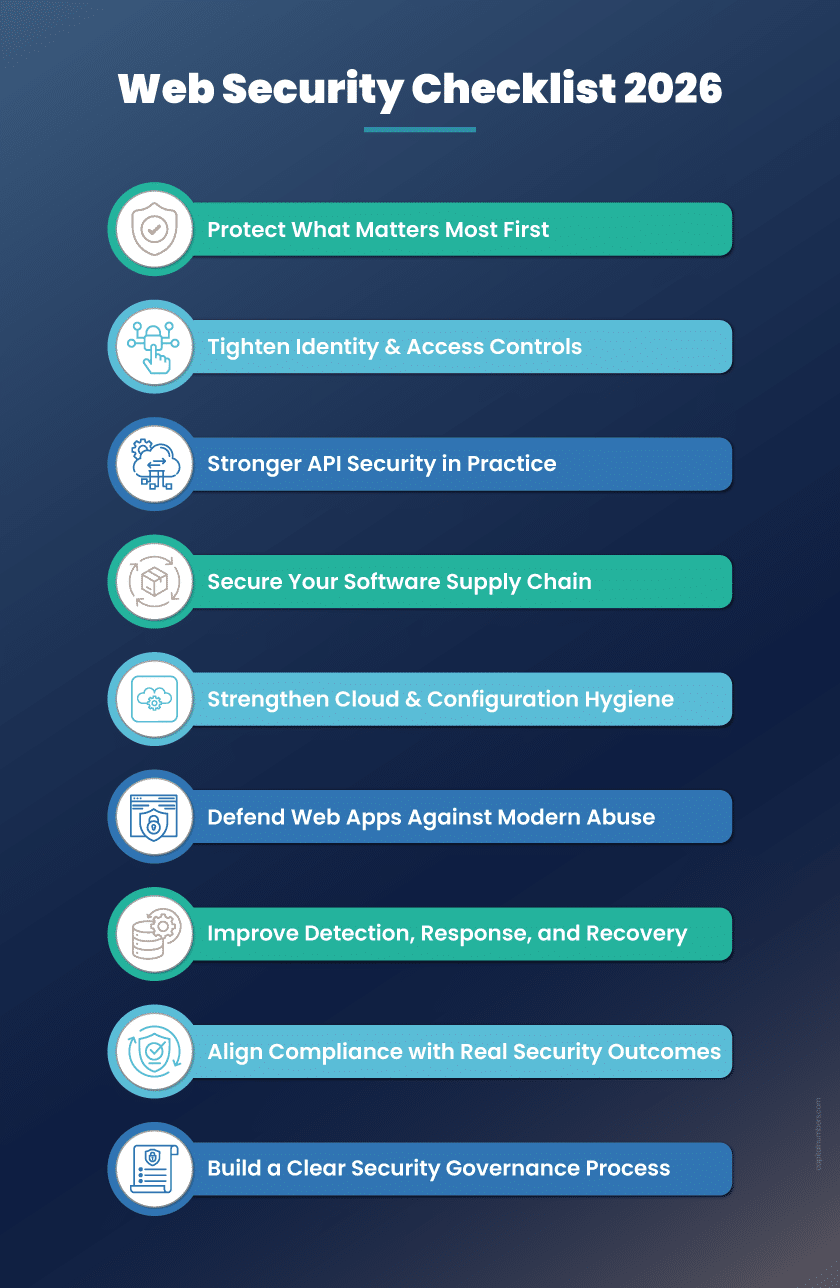
If you’re not sure what to prioritize in web security and what can wait, this checklist can guide your next steps. Consider it both a decision-making framework and a practical action plan.
1. Protect What Matters Most First
Keep this at the top of your web security checklist for 2026.
Why this matters
Many businesses spend time fixing low-impact issues while high-impact workflows remain exposed. That’s where real business damage happens – failed payments, exposed data, and lost customer trust.
What to focus on
You should start by identifying the most critical assets:
- Customer and payment data
- Checkout and transaction systems
- Admin panels and internal controls
- Core APIs that power key business journeys
Then prioritize by business impact:
- What would cause the biggest revenue loss if unavailable?
- What could create legal or compliance exposure?
- What would damage customer trust the fastest?
When priorities are clear, security decisions become faster, smarter, and easier to execute.
2. Tighten Identity and Access Controls
If you fix access control early, you reduce a large share of avoidable security risk.
Why this matters
Many incidents become bigger than they should because access is too wide and stays open too long. In simple words, too many people can access too many sensitive systems.
What to focus on
Keep access clean and controlled across teams:
- Enable MFA for admin, developer, and privileged accounts
- Follow least-privilege access (only required access, nothing extra)
- Use time-bound privileged access instead of permanent admin rights
- Review employee and vendor access regularly
- Transitioning to phishing-resistant authentication (Passkeys)
- Apply zero-trust access checks for users, devices, and internal APIs – authenticate and authorize each request and continuously evaluate access based on risk/context
Business value
When access is managed well, incidents are easier to contain, recovery is faster, and your overall web security best practices become much stronger.
3. Stronger API Security in Practice
API security needs clear ownership, clean controls, and regular testing to stay effective as systems grow.
Why this matters
In modern businesses, APIs run core experiences in the background. If API security is weak, customer journeys, integrations, and operations can all be affected at once. This becomes even more important for an AI-powered website, where model outputs, user data flows, and third-party integrations all rely on secure, well-controlled endpoints.
What to focus on
- API visibility and ownership
- Keep an up-to-date API inventory
- Assign clear owners for every API and endpoint
- Access and abuse control
- Enforce strong authentication and authorization at the endpoint level
- Use rate limiting to reduce abuse and traffic spikes
- Input and traffic safety
- Validate request input and schemas
- Return secure, minimal error messages
- Route traffic through API gateways with consistent security policies
- Lifecycle and resilience
- Manage API versions carefully
- Retire old endpoints through a planned deprecation process
- Run regular testing against common API attack patterns
Business value
Following API security best practices improves reliability, reduces partner-side friction, and strengthens API threat protection in day-to-day operations.
4. Secure Your Software Supply Chain
Your web product is only as secure as the code and packages behind it.
Why this matters
Open-source packages and third-party libraries help teams release faster. But if they are not reviewed properly, they can introduce hidden web security risks.
What to focus on
Add these checks to your delivery process:
- Scan dependencies in CI/CD
- Patch critical components within clear timelines
- Verify build artifacts before deployment
- Use only trusted package sources
- Review vendor security before onboarding
Business value
Release speed matters only when risk is controlled. These steps strengthen web security, reduce avoidable issues, and help your team ship with confidence.
5. Strengthen Cloud and Configuration Hygiene
This web security best practice helps prevent avoidable risks caused by simple setup mistakes.
Why this matters
Many real-world exposures still come from basic misconfigurations, not advanced attacks. A single wrong setting can expose sensitive systems publicly.
What to focus on
- Secure defaults
- Encrypt data by default
- Apply strict access controls
- Segment networks to limit blast radius
- Operational discipline
- Separate production and non-production environments
- Use separate credentials and secrets across environments
- Continuously monitor cloud posture, not just once per quarter
Practical reality
Default settings are rarely enough for production. A strong cloud security approach needs regular review as systems evolve.
6. Defend Web Apps Against Modern Abuse
This web security best practice helps protect your customer-facing pages from common online attacks.
Why this matters
Public-facing pages are regularly targeted by automated attacks like bot abuse, fake signups, credential stuffing, and session misuse.
What to focus on
Protect your key user flows with these steps:
- Use WAF and bot protection with AI-enhanced behavioral analysis to catch smarter bots.
- Reduce account takeover and credential abuse risk
- Strengthen session and cookie security
- Use secure headers and strict front-end validation
- Prepare for traffic spikes and denial-of-service attacks
Human reality
If login or checkout stops working, customers won’t blame attackers; they will blame your brand. That’s why web application security is also a customer experience priority.
7. Improve Detection, Response, and Recovery
A strong website security checklist is not just about prevention; it also prepares your team to respond quickly and recover with minimal business impact.
Why this matters
No system is completely risk-free. What matters most is how quickly you can detect, contain, and recover from an incident.
What to focus on
- Detection readiness
- Centralize logs across app, API, cloud, and identity systems
- Set practical alerts for unusual behavior
- Response readiness
- Define incident severity levels and clear owners
- Prepare communication playbooks for customers and stakeholders
- Recovery readiness
- Test restore success, not just backup completion
- Track response speed and recovery metrics
Business value
Strong recovery readiness protects both revenue and brand reputation during incidents.
8. Align Compliance with Real Security Outcomes
Compliance should strengthen your web application security, not just help you complete paperwork.
Why this matters
Compliance is important, but ticking boxes alone does not reduce real risk. It should support your daily security work.
What to focus on
Keep compliance simple and practical:
- Match controls to your business (payments, customer data, industry rules)
- Keep proof ready (access logs, policy updates, audit records)
- Build audit-ready workflows that don’t slow your team down
Business value
Strong compliance builds trust and can help you move larger deals forward faster.
9. Build a Clear Security Governance Process
Your web security checklist is most useful when leadership reviews it regularly, not only when something goes wrong.
Why this matters
Security can slip when reviews are inconsistent and ownership is unclear. A clear governance process helps keep things on track as your business grows.
What to focus on
Review security monthly or quarterly with a simple scorecard:
- Critical vulnerabilities are still open
- Patch SLA performance
- MFA coverage
- Backup restore test success
- Incident trends by severity
Make sure one executive owner is clearly responsible for decisions and follow-through.
Outcome
A regular governance process keeps cybersecurity aligned with business growth and reduces last-minute fire drills.
Common Web Security Mistakes Businesses Should Avoid in 2026
Even strong teams make avoidable security mistakes. The goal is to catch these early before they turn into costly issues.
- Treating web security as a one-time project
Security is not set-and-forget. As your app, APIs, and integrations change, your risks change too, so regular reviews are essential. - Treating API security as only a developer task
API issues can affect sales, customer experience, and partner integrations, so this is a business concern too. - Assuming compliance means full security
Compliance helps, but it does not cover every real-world threat. - Ignoring vendor and third-party risk
A weak plugin, partner, or service can expose your systems. - Skipping incident and recovery drills
If your team does not practice response and restore, recovery will be slower during a real incident.
You May Also Read: Top Website Development Trends in 2026 That Will Impact Growth, SEO, and Conversions
Web Security as a Growth Advantage in 2026
As digital products become more connected in 2026 and beyond, web security will directly impact business ROI. Strong security reduces revenue loss from downtime, lowers recovery costs, protects customer trust, and keeps teams focused on growth instead of firefighting.
Want to improve web security without slowing delivery? Book a 30-minute discovery call with our seasoned developers. We will review your setup, identify high-impact gaps, and recommend practical next steps.


 Web Development
 Cloud Engineering
 Mobile App Development
 AI/ML/GenAI
 E-commerce
 Software Development
 UI/UX
UI/UX QA
QA Dedicated Teams