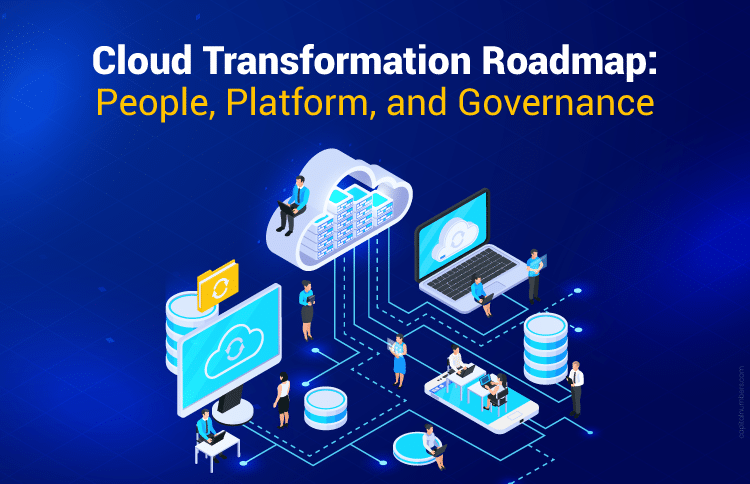

Cloud Transformation Roadmap: People, Platform, and Governance
Table of Contents
Executive Summary
For years, enterprise leaders have chased the promise cloud platforms will bring to their business. However, even after leveraging cloud platforms, many CXOs and enterprises are unable to realize the benefits of the cloud fully, the reason- an unclear cloud transformation roadmap. Without a structured strategy, organizations risk scattered projects, rising costs, and fragmented communication channels within teams.
At a Glance
- What this roadmap covers: The critical intersection of People (talent & culture), Platform (architecture & modernization), and Governance (cost, security, & compliance).
- Who it’s for: CXOs, IT Leaders, and transformation teams seeking to move beyond simple migration to becoming a truly “cloud-powered” enterprise.
- What you’ll get: Knowledge about cross-functional ownership model (CCoE), a phased migration approach, and practical guardrails for cost and security.
Introduction
For years, enterprise leaders have chased the promise cloud platforms will bring to their business. However, even after leveraging cloud platforms, many CXOs and enterprises are unable to realize the benefits of the cloud fully—the reason is an unclear cloud transformation roadmap. Without a structured strategy, organizations risk scattered projects, rising costs, and fragmented communication channels within teams.
Gartner predicts that 90% of organizations will adopt a hybrid cloud approach through 2027. As more businesses accelerate their efforts to eliminate legacy systems and move their entire business lifecycle to the cloud, a cloud transformation plan must focus on people, processes, and governance.
“While 35% of respondent organisations might be ‘leading adopters’, exploiting cloud services for IT modernisation, just 16% are considered to be truly ‘cloud-powered’.” A tailored cloud transformation roadmap for enterprises ensures that C-suite leaders know exactly what outcomes to expect, who owns what, and how risks, costs, and governance are managed, all while enabling faster innovation and business agility.
What are the key cloud transformation benefits for enterprises?
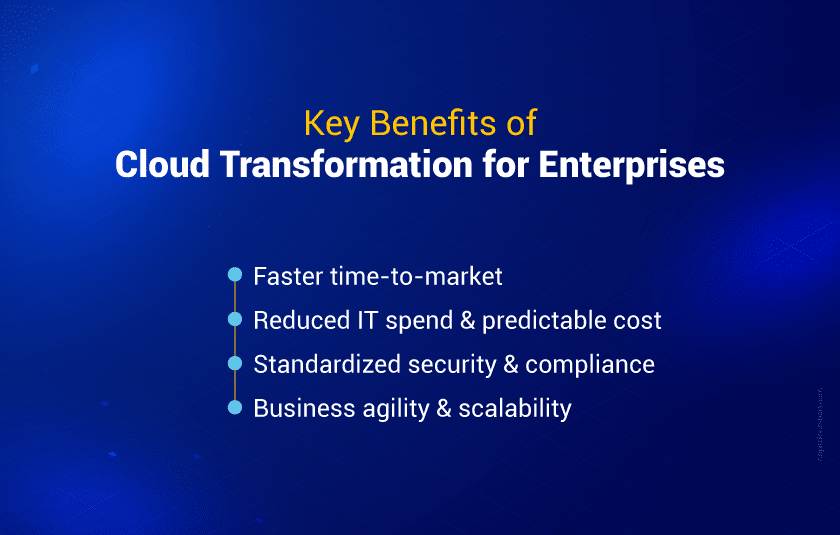
Enterprise leaders want clarity: “What benefits will we see, by when, and at what risk or cost?”
A cloud transformation strategy shows enterprise leaders what they need to do and how much they need to invest to get the full benefits of the cloud platforms. Let’s discuss the benefits of making a robust plan:
- Faster time-to-market: By standardizing processes and modernizing IT architecture, businesses can launch products more rapidly. The success of your business depends on how you align cloud adoption with your business goals and focus on building capabilities that matter most to your end customers.
- Reduced IT spend and predictable cost: Cloud adoption without a strategy can lead to uncontrolled expenses. Implementing governance, cost visibility, and financial controls helps keep cloud spend aligned with business value by improving accountability, forecasting, and cost-to-outcome tracking.
- Standardized security and compliance: Embedding security and compliance requirements in cloud architecture reduces risk exposure and ensures that audits and regulatory checks run smoothly.
- Business agility and scalability: A flexible cloud setup, including multi-cloud or hybrid strategies, allows enterprises to scale workloads without overprovisioning, supports business growth, and enables faster market responsiveness.
What does a Cloud Center of Excellence (CCoE) do, and who owns what?
Transformation fails when it is treated as just another “IT project.” Successful enterprises establish a Cloud Center of Excellence (CCoE), a cross-functional task force that can turn your plan into a reality.
What comprises this special task force?
- Executive Board: Responsible for defining risks and aligning cloud spend with allocated budget.
- Cloud Engineering Team: Hiring the best cloud engineering services ensures that your cloud transformation strategy can be fully implemented without any compromise.
- FinOps & Procurement: Manages the budget on the floor and ensures each department utilizes the cloud platform they originally intended.
- Change Management: Redefines KPIs to reward automation and manages the incentive gap to prevent talent attrition during cloud migration.
How Should Your Business Be Structured for a Successful Cloud Transformation?
Your next cloud adoption strategy is hard to execute successfully without a robust platform and architecture foundation.
- Cloud architecture shapes outcomes: How your applications can scale, how data can move from place to place, and the level of security and compliance of your applications are largely dependent on cloud architecture. A well-designed cloud architecture will enable the successful integration of workloads and support any necessary operational requirements. Poorly constructed architectures can fragment the system and, in many cases, increase costs and decrease performance.
- Platform modernization enables agility: Cloud-native platforms allow teams to update systems in small, manageable steps. This speeds up releases and encourages innovation while reducing the risk of large-scale failures – provided teams implement strong deployment practices, resilience patterns, and rollback mechanisms.
How Can You Govern Security, Compliance, and Cost Without Slowing Down Your Cloud Transformation Plan?
Enterprise leaders must find the right balance between speed, innovation, and risk. Without good governance, organizations using the cloud could expose themselves to greater risk than before, through increased security breaches, compliance issues, and unanticipated costs.
Key strategies include:
- Build Security & Compliance into the Architecture System – Security policies must be embedded in the application’s design; don’t treat them as an afterthought. Continuously monitor configurations and controls to maintain compliance of cloud workloads and environments against your chosen standards (e.g., CIS benchmarks, ISO 27001 controls, SOC 2 criteria).
- Implement Cost Controls & Transparency – Monitor and track your spending in the cloud, and create dashboards for key metrics to detect, prevent, and quickly correct uncontrolled expenditure using budgets, alerts, anomaly detection, and policy guardrails.
- Avoid Vendor Lock-in by using Universal Tools – Track each feature that you’re using that is unique to a single cloud provider (e.g., AWS or Azure) and leverage open standards where practical and design for portability, but some lock-in is almost always present (data gravity, managed services, IAM, networking, operational tooling). A better goal is to understand and manage lock-in intentionally (portability tiers, exit plans, and abstraction only where it provides net value).
- Adopt Phased Governance – Govern based on basic guardrails at first and add more complex policies as the cloud environment changes, keeping governance consistent throughout the process.
How Do You Ensure Your People and Organization are Ready for Cloud Transformation?
Cloud migration and adoption is as much about people as it is about technology.
- Assess skill gaps: Identify where teams lack cloud readiness or expertise. This is not just an IT issue; business teams also need fluency to adopt new ways of working.
- Build capabilities incrementally: Use approaches such as two-week learning sprints, where new cloud features are introduced and reinforced regularly.
- Leverage full talent ecosystems: Balance full-time hiring with contractors, consultants, or gig-economy experts to fill short-term hiring gaps so that you don’t overburden permanent staff.
- Focus on workforce enablement: Even skilled employees need time and support to adopt new processes. A successful cloud transformation plan can only be achieved by pairing capability-building with structural and process changes.
What are the step-by-step phases in an enterprise cloud migration roadmap?
Executives need a structured plan that connects outcomes, accountability, and execution. A practical roadmap includes:
- Assessing Current IT Infrastructure: Map all systems, integrations, and dependencies. Complete visibility helps you understand what you’re migrating (dependencies and constraints) and supports better decisions about why and what value you expect from migration.
- Identifying Cloud Readiness and Bridging Skill Gaps: It is important that you evaluate people, workflows, and their skills to flag areas that need support before implementing changes in your workplace.
- Aligning Strategy with Business Goals: Defining outcomes such as speed, cost efficiency, scalability, and customer experience will help you plan how you want to adopt cloud platforms for your business.
- Choosing the Right Cloud Model: Whether you are choosing public, private, hybrid, or multi-cloud platforms, selecting them based on operational fit, control requirements, and long-term scalability will help you leverage the full benefits of cloud.
- Defining Security and Compliance Requirements: Embedding controls into the architecture, establishing continuous monitoring, and maintaining compliance will help you avoid pitfalls and complete your cloud transformation journey successfully.
- Creating a Phased Migration Roadmap: Moving workloads incrementally, balancing operational risk, and measuring how these changes will impact them will help you define phases with clear ownership and defined deliverables.
This cloud transformation roadmap ensures that your strategy delivers the targeted business value while reducing risk, controlling costs, and keeping your workforce up to speed.
How Can You Track Early Wins and Continuously Improve Cloud Transformation Outcomes?
While it is the best time to achieve results early in your cloud transformation journey, it is equally important that you maintain the momentum and not lag after a single major success. Remember – the goal here is to achieve success continually, not just once for your business.
- Start with high-impact workloads: Identify projects that deliver good value quickly.
- Measure and report outcomes: Focus on metrics aligned with business goals, such as time-to-market, cost efficiency, and operational agility.
- Iterate and refine: By phasing out your cloud journey, you can learn from and improve on mistakes from the previous work cycle.
By combining clear ownership, phased execution, and early wins, enterprises can sustain alignment and maximize the ROI of their cloud migration and adoption strategy.
Conclusion
A cloud transformation roadmap is a strategic blueprint that connects people, platforms, and governance to deliver strong business outcomes. For executives, the roadmap answers key questions: What outcomes can we expect? Who is accountable? How do we manage risk, cost, and compliance without slowing delivery?
By focusing on structured planning, cloud cost optimization, incremental capability building, building robust architecture, and embedding governance at every stage of your cloud transformation journey, you can unlock the full value of cloud, improve business agility, and scale your business seamlessly.
If you’re planning a hybrid cloud strategy or need a phased cloud migration roadmap with governance and FinOps guardrails, our cloud engineering team can help define the operating model and execute in measurable waves. Book a 30-minute discovery call with our experts.
FAQ
1. What is a cloud transformation roadmap?
Ans: A strategic plan for moving IT infrastructure, applications, and data to the cloud while aligning with business goals, talent, and governance.
2. What is a Cloud Center of Excellence (CCoE)?
Ans: A cross-functional team that defines cloud best practices, governs adoption, and drives cultural change for cloud success.
3. How does FinOps help control cloud costs?
Ans: FinOps ensures financial accountability in cloud spending using data-driven monitoring, real-time reporting, and collaborative decision-making.
4. What’s the difference between cloud migration and cloud transformation?
Ans: Migration moves data/apps “as-is” to the cloud; transformation modernizes architectures, automates workflows, and evolves the workforce.
5. How long does an enterprise cloud transformation take?
Ans: Early wins appear in 3–6 months, but full-scale transformation usually takes 1–3 years depending on complexity and readiness.


 Web Development
 Cloud Engineering
 Mobile App Development
 AI/ML/GenAI
 E-commerce
 Software Development
 UI/UX
UI/UX QA
QA Dedicated Teams