
Magento 2 GraphQL vs REST API: Which One Should You Use?
Table of Contents
Today, online stores need to be fast and work smoothly on websites, mobile apps, and other platforms. As Magento 2 stores become bigger and more complex, getting data correctly and quickly becomes a challenge. Sometimes APIs return too much data, sometimes too little, or they need many requests just to load one page. This can slow down the store and affect user experience.
Magento 2 provides two main ways to handle this data: REST API and GraphQL. Both are useful, but they work in different ways and are good for different situations. Choosing the right one can help improve store speed, make development easier, and give customers a better shopping experience. In this Magento 2 GraphQL vs REST API comparison, we will explain both options in a simple way and help you understand which one is better for your project.
GraphQL Overview
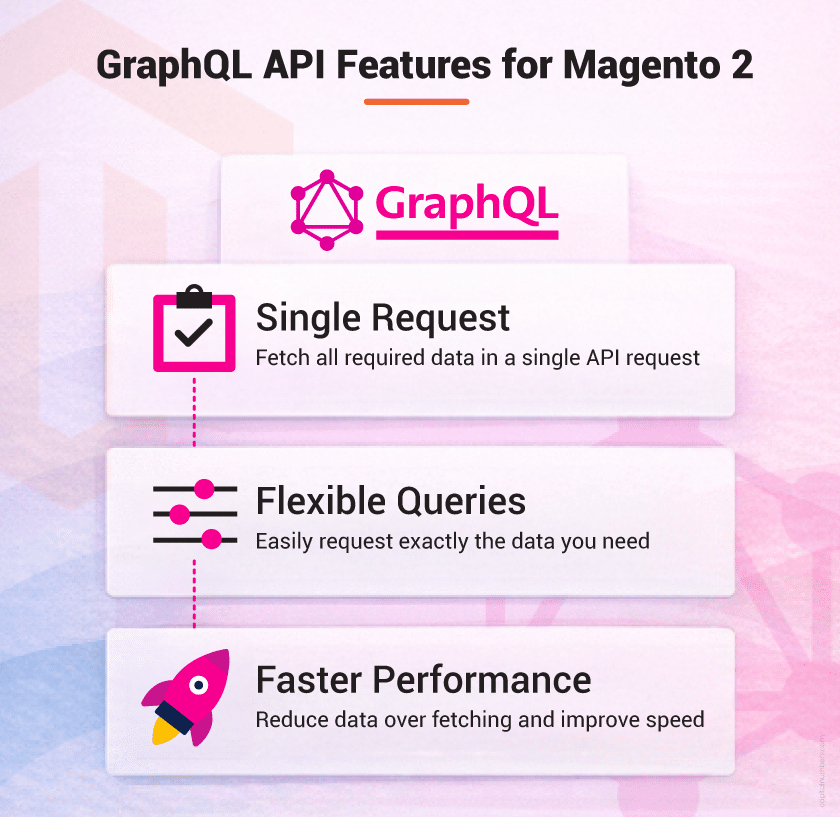
GraphQL is a data query language and runtime that revolutionizes how you build and consume APIs. Originally developed by Facebook in 2012 and open-sourced in 2015, GraphQL has become the preferred choice for modern applications that need efficient, flexible, and performant data fetching.
Why use GraphQL?
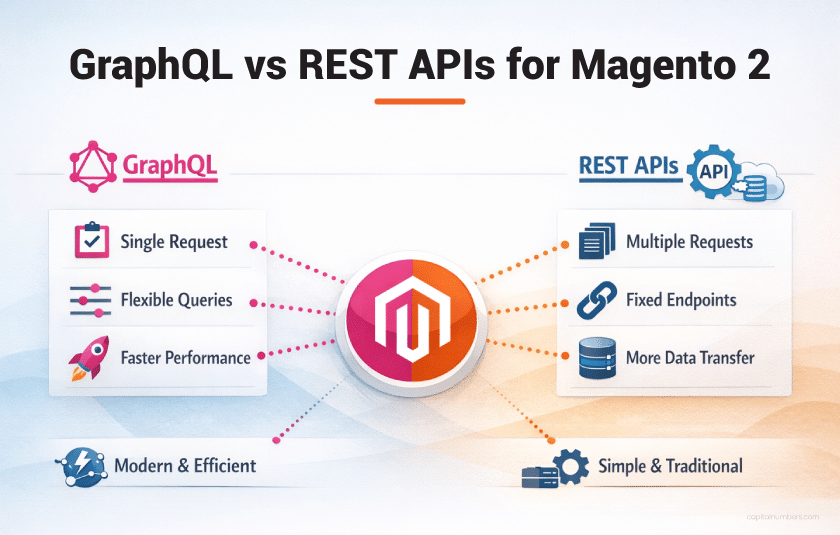
- Get exactly what you need. Unlike traditional REST APIs that return fixed data structures, GraphQL lets you request exactly the fields you need in a single query. This means faster load times, reduced bandwidth usage, and better user experiences.
- Superior performance. GraphQL minimizes over-fetching and under-fetching of data, allowing you to optimize performance by fetching only the necessary information in a single request. In addition, minimized data transfer is ideal for mobile and low-bandwidth environments.
- Enhanced developer experience. GraphQL’s strongly typed schema and introspection capabilities provide powerful tools for developers. You can explore the API, get real-time feedback, and leverage auto-completion in modern IDEs, making development faster and more efficient.
REST API Overview
The REST API documentation describes the REST APIs that are available in Adobe Commerce (PaaS) and Adobe Commerce as a Cloud Service (SaaS).
The APIs can be used to perform a wide array of tasks. For example:
- Create a shopping app. This can be a traditional app that a user downloads on a mobile device. You could also create an app that an employee uses on a showroom floor to help customers make purchases.
- Integrate with CRM (Customer Relationship Management) or ERP (Enterprise Resource Planning) backend systems, such as Salesforce or Xero.
- Integrate with a CMS (Content Management System). Currently, content tagging is not supported.
Why use REST API?
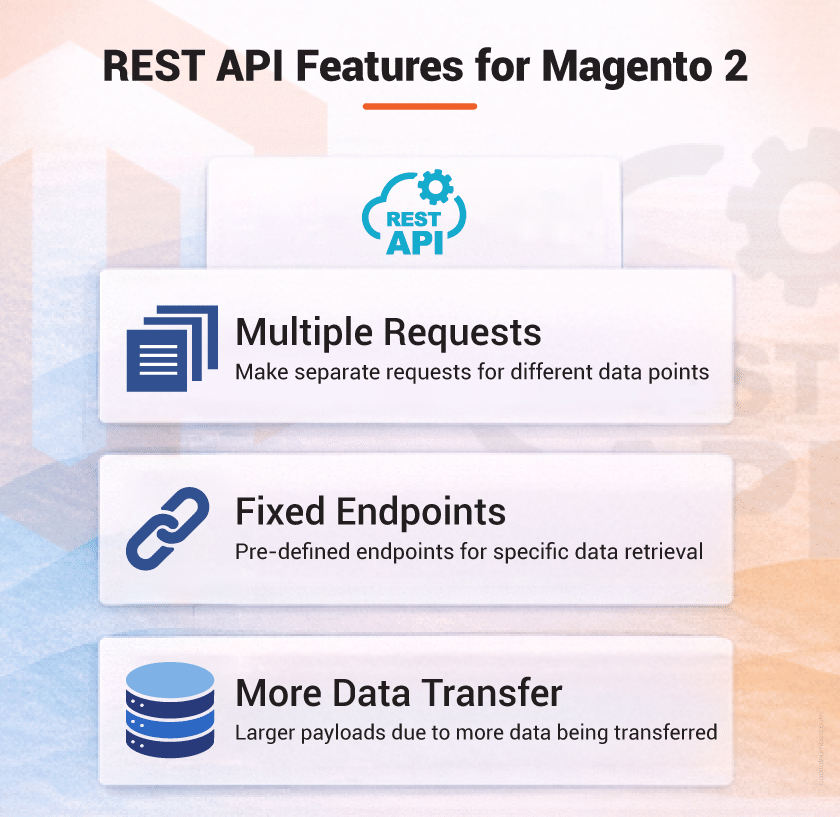
- Simplicity and familiarity: REST APIs are easy to understand and widely adopted. We can use several methods like: GET, POST, PUT, DELETE, etc., intuitive for developers and simple to integrate with almost any platform or programming language e.g. web or mobile applications.
- Scalable and cache-friendly: REST is designed with scalability in mind. Built-in HTTP caching helps reduce server load and improve performance, making REST APIs a solid choice for high-traffic applications and distributed systems.
- Flexible and reliable integration: REST APIs work seamlessly with web, mobile, and third-party systems. Their stateless nature ensures reliability, easier debugging, and smooth integration with existing tools, services, and legacy systems.
Which one should you use?
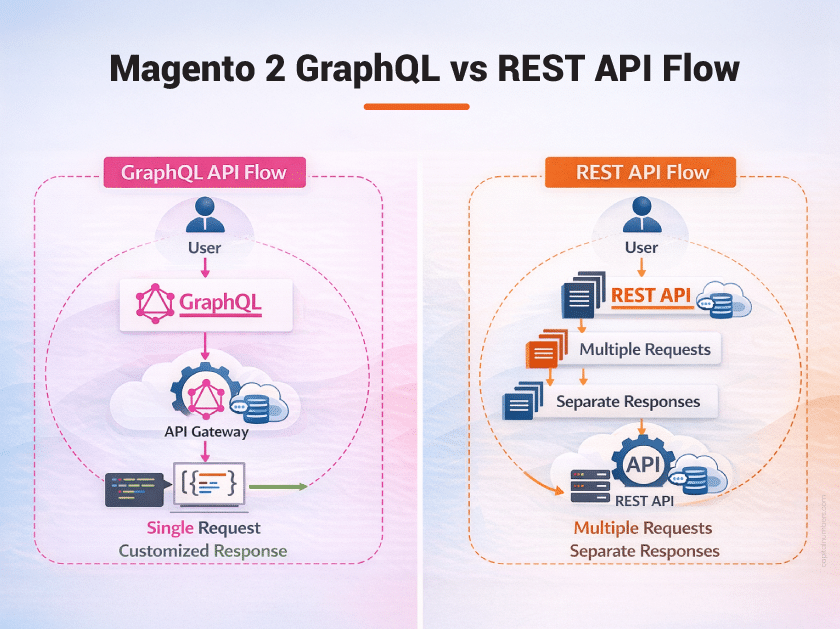
Choosing between Magento 2 GraphQL and REST API depends on what you’re building, who’s consuming the API, and how much flexibility/performance you need. Here’s a clear, practical comparison to help you decide.
Magento 2 GraphQL – Pros & Cons
| Feature | GraphQL – Pros | GraphQL – Cons |
|---|---|---|
| Data Fetching | Fetch only required fields | Query building is complex |
| Number of Requests | Single request for multiple resources | Complex queries can impact server |
| Performance | Faster storefront performance | Needs query complexity control |
| Frontend Usage | Ideal for headless & PWA | Harder to debug for FE devs |
| Backend / Admin | Limited admin coverage | Not suited for bulk ops |
| Customization | Highly flexible schemas | Resolver development is complex |
| Bulk Operations | Not suitable | Performance issues |
| Security | Field-level control | Risk of heavy queries |
| Versioning | No versioning needed | Schema changes affect clients |
Magento 2 REST API – Pros & Cons
| Feature | REST API– Pros | REST API– Cons |
|---|---|---|
| Data Fetching | Simple predefined responses | Over-fetches unnecessary data |
| Number of Requests | Simple single-purpose endpoints | Multiple calls needed for one page |
| Performance | Predictable performance | Slower frontend performance |
| Frontend Usage | Easy to consume | Not frontend-optimized |
| Backend / Admin | Excellent admin support | More API calls required |
| Customization | Simple extension points | Requires more endpoints |
| Bulk Operations | Best choice | Large payloads |
| Security | Mature & stable | Broader access per endpoint |
| Versioning | Versioned endpoints | Maintenance overhead |
Magento 2 GraphQL vs REST API: A Comparison
| Aspect | GraphQL | REST API |
|---|---|---|
| Data Fetching | Client asks for exact fields | Fixed response structure |
| Requests | Single request for multiple resources | Often multiple endpoints |
| Performance | Optimized, less over-fetching | Can over-fetch data |
| Learning curve | Steeper | Easier |
| Best for | Headless / PWA / Mobile apps | Integrations / Admin / Legacy systems |
You May Also Read: Top API Trends to Watch in 2026: Security, AI & Governance
Conclusion
Choose GraphQL if:
- You’re building a headless or PWA storefront
- Performance is critical
- You’re using React, Vue, and Next.js
- You want frontend flexibility
Choose REST API if:
- You’re integrating Magento with ERP/CRM
- You’re working on admin features
- You need bulk data operations
- You want faster development with less complexity


 Web Development
 Cloud Engineering
 Mobile App Development
 AI/ML/GenAI
 E-commerce
 Software Development
 UI/UX
UI/UX QA
QA Dedicated Teams