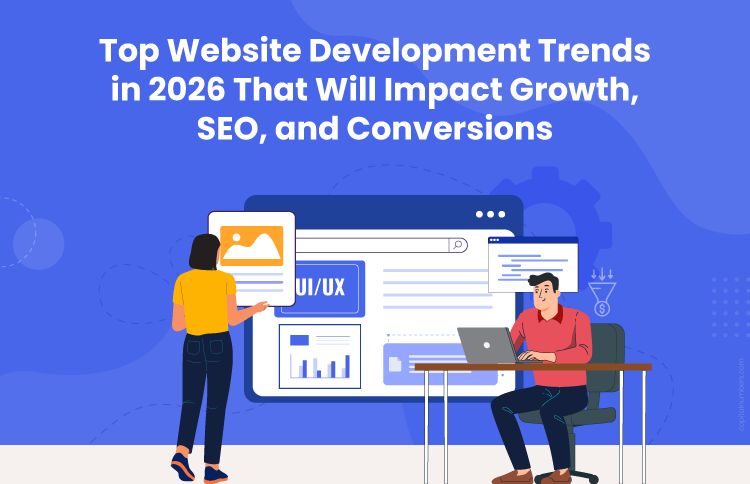

Top Website Development Trends in 2026 That Will Impact Growth, SEO, and Conversions
Table of Contents
Websites are no longer just online brochures. In 2026, they are becoming smarter, faster, and more closely tied to business growth than ever before. From AI-driven personalization to performance-focused design, the way websites are built is changing how companies attract, engage, and convert customers.
For business owners, keeping up with these changes is no longer optional; it directly impacts visibility, trust, and revenue. In this blog, we cover the key website development trends in 2026 – what’s changing, why it matters, and how to stay ahead without diving into technical jargon. If you’re evaluating website development services for 2026, these trends will help you prioritize what actually drives performance, SEO, and conversions.
Top Website Development Trends in 2026
In 2026, the strongest business sites will be built around performance, trust, and experiences that adapt to customer expectations in real time. The trends below highlight the key shifts that will shape how teams plan, build, and scale modern websites this year.
1. AI-Powered Website Personalization
What Is It?
AI-driven hyper-personalization means AI-powered websites adapt in real time, rather than showing the same experience to every visitor. Based on user behavior, the website dynamically adjusts:
- Page layouts
- Headlines and messaging
- Calls-to-action
- Content priority
This goes beyond product recommendations; the entire website responds to user intent. To do this well, personalization should be privacy-first – use consent-based data, be transparent, and avoid “creepy” targeting that makes users uncomfortable.
Why Will It Be a Trend in 2026?
- Users now expect relevant, personalized experiences instantly
- AI tools are now mature enough for many real-time personalization use cases
- Rising ad costs are forcing better conversion from existing traffic
Why Business Owners Should Consider It?
- Higher engagement and conversion rates without higher ad spend
- Better ROI from the same website traffic
- A more relevant, modern experience that builds trust faster
2. Data-Driven Websites as Growth Platforms (CRM + Analytics + Automation)
What Is It?
One of the key website development trends in 2026 is turning websites into data-driven growth platforms. Instead of working in isolation, modern websites integrate with CRM, analytics, marketing automation, and sales systems, capturing every user interaction as actionable data. The core focus here is measurement – tracking what users do, where leads come from, and what actually drives conversions and revenue.
Why Will It Be a Trend in 2026?
- Businesses need clearer attribution and faster insights
- Latest web development trends focus on connected, data-first systems
- The future of website development depends on real-time data and automation
- Website development companies are building websites beyond static experiences
Why Business Owners Should Consider It?
- Better visibility into funnels and revenue impact
- Faster, evidence-based decisions
- A website that supports growth, not just branding
- Increased ROI by turning the website into an active growth asset
3. Headless CMS + Modular Architectures for Faster Website Updates
What Is It?
Headless and modular architectures are modern website development approaches that focus on flexibility. A headless architecture separates content and data from the user interface, while a modular design breaks the website into independent components. In simple terms, it lets you change parts of the site without rebuilding everything. Together, they allow teams to update features, content, or layouts independently and launch new channels without rebuilding the entire website.
Why Will It Be a Trend in 2026?
- Traditional all-in-one platforms struggle to adapt to change
- Faster releases and flexibility define website trends in 2026
- Modular systems integrate easily with new tools and platforms
- Headless is becoming a preferred foundation for brands that need speed, flexibility, and multi-channel growth
Why Business Owners Should Consider It?
- Faster updates with minimal disruption
- Lower long-term maintenance and reduced technical debt
- Better performance and smoother future integrations
- A scalable foundation aligned with the future of website development
4. API-First Website Development for Scalable Digital Ecosystems
What Is It?
It is one of the latest web development trends in 2026. API-first development means building the website’s data and core functions before designing the pages. This makes it easy for the website to connect with mobile apps, AI tools, third-party platforms, and internal business systems. Here, the core focus is connectivity – making your website work smoothly with other tools and channels so you can scale without rebuilding later.
Why Will It Be a Trend in 2026?
- Businesses use more digital tools than ever
- Websites need to connect smoothly with other systems
- API-first setups are easier to change as needs grow
- Flexibility is a key part of website trends in 2026
Why Business Owners Should Consider It?
- Easier and faster integration with new tools
- Fewer technical issues as the business scales
- Better support for automation and analytics
- A website foundation that’s ready for future growth
5. Performance-First Development and Progressive Web Apps (PWAs)
What Is It?
It is another important web development trend to consider in 2026. Performance-first development means building websites that load fast and feel smooth, especially on mobile. Progressive Web Apps (PWAs) support this by giving users an app-like experience in the browser, without needing a full native app. The real value is not “offline mode” for most business sites. It’s instant loading, smoother interactions, and reliable performance even when the network is weak. PWAs are best when mobile experience is a core part of your funnel (leads, bookings, repeat visits, or frequent customer actions).
Why Will It Be a Trend in 2026?
- Mobile users expect pages to load quickly and respond instantly
- Google and users both reward fast, stable experiences
- More traffic comes from slower or unstable networks (travel, events, commuting, and emerging markets)
- Businesses want app-like UX without the cost of building and maintaining separate apps
Why Business Owners Should Consider It?
- Better SEO and ad performance because faster sites convert more
- Higher conversions from smoother mobile experiences and fewer drop-offs
- More reliable browsing on poor networks, which protects lead and sales flow
- Optional push notifications (when relevant) to bring users back for offers, updates, or reminders
6. Adaptive & Context-Aware Website Design
What Is It?
Adaptive, context-aware design goes beyond basic responsive layouts. Instead of resizing for different screens, the website adapts to the device and how people interact with it, including foldables, ultra-wide displays, wearables, and voice-assisted browsing. It adapts to factors like screen orientation, input method, and device capabilities.
Why Will It Be a Trend in 2026?
- People access websites from more device types than ever
- Screen formats and interaction methods keep evolving
- Users expect consistent experiences across devices
- Consistency across platforms is a key part of website trends in 2026
Why Business Owners Should Consider It?
- Faster, smoother experiences on all devices through web performance optimization
- Fewer usability and performance-related drop-offs
- Better engagement and conversions across channels
- A future-ready website that adapts as new devices emerge
7. Web Accessibility as a Standard (WCAG-Ready UX)
What Is It?
Accessibility means designing websites so everyone can use them, including people with disabilities. Instead of adding accessibility later, it’s planned from the start – using WCAG-ready UX practices like keyboard navigation, readable contrast and typography, clear focus/hover states, and screen reader-friendly structure.
Why Will It Be a Trend in 2026?
- Accessibility expectations are rising across industries
- Legal and compliance pressure is increasing in many regions
- Better accessibility usually means better usability for all users
- Trust and inclusivity are becoming central to website trends in 2026
Why Business Owners Should Consider It?
- Lower risk of complaints and legal issues
- More customers can access and complete actions on your site
- Cleaner UX that reduces drop-offs and support queries
- A stronger brand impression: modern, inclusive, and professional
8. Security-First and Privacy-Aware Website Development
What Is It?
Security-first development means the website is built to be safe from the start, not “secured later.” It includes secure-by-design architecture, zero-trust access, and data minimization (collect only what you truly need). Privacy-aware development adds clear consent choices and transparency so users know what data is collected and how it’s used. In practice, this often includes MFA for admin logins, regular dependency/security updates, WAF or rate limiting to block attacks, and secure cookie/consent handling. Together, this strengthens your overall web security and customer trust.
Why Will It Be a Trend in 2026?
- Cyber threats targeting websites continue to rise
- Users are more cautious about sharing personal data
- Privacy expectations and regulations are getting stricter
- Even a single security incident can damage brand credibility
Why Business Owners Should Consider It?
- Higher trust, which directly supports conversions
- Lower risk of costly breaches, downtime, and reputation damage
- Fewer complaints and smoother compliance efforts
- A safer foundation as your traffic, tools, and data grow
9. Sustainable & Green Website Development (GreenOps)
What Is It?
Green website development means building websites that use less energy and fewer resources, without sacrificing speed. It focuses on lightweight code, efficient hosting, reduced data transfer, and smarter asset usage (like optimized images and scripts). The result is a faster site with a smaller footprint.
Why Will It Be a Trend in 2026?
- Sustainability is shifting from a message to a measurable expectation
- Enterprises and partners increasingly factor ESG (Environmental, Social, and Governance) into vendor decisions
- Efficient websites are cost-effective to run at scale
- Many “green” practices also improve performance and reliability
Why Business Owners Should Consider It?
- Lower operating costs over time (hosting, bandwidth, infrastructure)
- Better speed and user experience with fewer heavy assets
- Stronger brand credibility with modern buyers
- Higher chances of qualifying for enterprise projects where sustainability matters
10. Human-Centric UX Design (Clarity, Motion, and Trust Signals)
What Is It?
Human-centric design is a shift from stiff, grid-heavy pages to experiences that feel natural, clear, and easy to use. Instead of forcing users to “figure out” your site, the design guides them smoothly with better spacing, readable content, friendlier visuals, and subtle motion that supports the journey. The goal is not to look fancy. It is to make people feel confident, understood, and ready to take action.
Why Will It Be a Trend in 2026?
- Buyers have less patience for cluttered, confusing layouts
- Brands are competing on trust and experience, not just features
- Modern design systems make it easier to build clean, consistent UX at scale
- Motion and micro-interactions are being used more strategically to guide behavior
Why Business Owners Should Consider It?
- Higher conversions because users find what they need faster
- Lower bounce rates and better engagement across mobile and desktop
- Stronger brand recall and trust through a more “human” experience
- Fewer UX-related drop-offs in key moments (forms, checkout, booking, contact)
How to Choose the Right Website Development Trends for Your Business?
Not every website development trend of 2026 is worth your budget. Prioritize what improves speed, conversions, trust, or efficiency.
Use this quick filter:
- Goal first: leads, sales, bookings, or fewer support requests
- Traffic source: SEO → speed and content; Ads → landing pages, CRO, and personalization
- Buying journey: B2B/high-ticket → trust and tracking; fast purchase → mobile speed and frictionless UX
- Current stack: if CRM/automation is in place, data-driven upgrades deliver faster ROI
- Team capacity: choose what you can maintain (don’t overbuild)
- Risk/compliance: if you collect customer data, make security and privacy a baseline
Rule: Do quick wins first (performance, UX, tracking). Then invest in bigger foundations (headless, API-first, advanced personalization).
ROI Metrics to Track (SEO, Conversions, Speed, Trust)
Track only what ties to business outcomes.
Revenue and conversion
- Conversion rate (lead/sale/booking)
- Cost per lead / CAC (if you run ads)
- Lead quality (qualified inquiries, MQL→SQL)
- Form completion rate
Speed and experience
- Core Web Vitals
- Page load time (mobile)
- Bounce/engagement rate
- Mobile conversion rate
Trust and operations
- Support tickets reduced
- Uptime/downtime incidents
- Security issues fixed
- Accessibility issues resolved
Tip: Pick 3–5 KPIs per trend and review monthly.
Conclusion: Building a Future-Ready Website in 2026
In 2026 and beyond, your website will behave less like a set of pages and more like a connected growth engine. Buyers will expect faster experiences, smarter journeys, and stronger trust signals by default. The businesses that stay ahead will not chase every website development trend in 2026. They will invest in the right foundations – performance, clean UX, reliable tracking, and secure, scalable architecture – so their website can adapt as tools, devices, and customer expectations evolve. The goal is future-ready digital growth, not another redesign cycle.
If you are planning to upgrade your website for 2026, book a 30-minute discovery call with our expert professionals. We’ll review your current site, spot high-impact improvements, and outline a practical roadmap aligned with your goals.
FAQs on Website Development Trends in 2026
1. Which 2026 trends should I prioritize first if my budget is limited?
Start with performance (Core Web Vitals, faster mobile load), conversion-focused UX (clear CTAs, shorter forms), and clean tracking (GA4 + conversion events) because these give the fastest ROI. Then add security/privacy basics (MFA, updates, consent) before investing in bigger rebuilds like headless or advanced AI personalization.
2. How do AI-driven personalization and data privacy work together without crossing the line?
Use consent-based, first-party data and keep personalization helpful (segments, intent, content order) rather than overly specific. Minimize what you collect, be transparent, and avoid sensitive or “creepy” targeting that surprises users.
3. Do I need a headless website, or is my current CMS enough?
Your current CMS is enough if you mostly publish content, don’t need multiple channels, and can fix speed/UX without a rebuild. Go headless when you need frequent releases, multi-channel experiences, heavy integrations, or your CMS is blocking performance and scalability.
4. What does “API-first” mean in simple terms, and how does it help my business scale?
API-first means building your site so it can easily connect with tools like CRM, automation, payments, analytics, and apps. It helps you scale by making integrations faster, reducing rebuilds, and keeping data consistent across systems.
5. How fast should my website load in 2026 to avoid losing leads and sales?
Aim for key pages to feel instant on mobile – around ~2 seconds or better, especially for landing and service pages. A solid benchmark is Core Web Vitals targets: LCP ≤ 2.5s, INP ≤ 200ms, CLS ≤ 0.1.


 Web Development
 Cloud Engineering
 Mobile App Development
 AI/ML/GenAI
 E-commerce
 Software Development
 UI/UX
UI/UX QA
QA Dedicated Teams