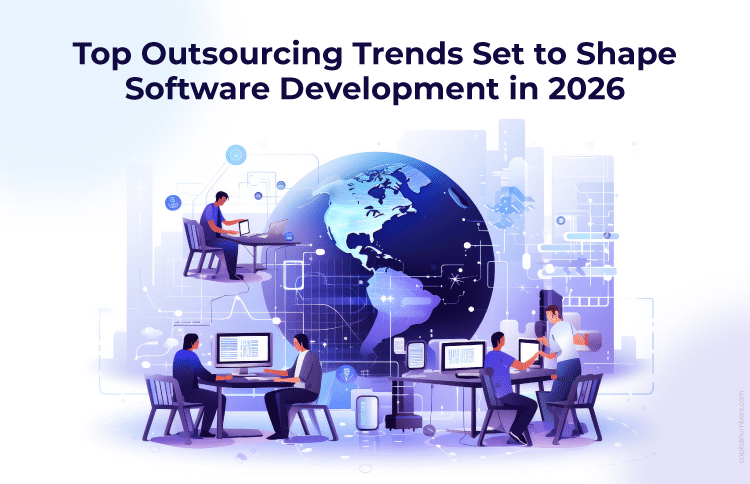
Top Outsourcing Trends Set to Shape Software Development in 2026
Table of Contents
Software development outsourcing has changed a lot over the past decade. What started mainly as a way to reduce costs is now becoming a core growth strategy for businesses around the world.
As we move toward 2026, companies are facing new pressures for software development. They need to deliver faster, adopt AI, stay secure, manage costs, and scale teams without slowing down their core business. Hiring locally for every role is expensive and slow. Managing large in-house teams is risky when priorities shift.
This is why software development outsourcing is entering a new phase.
In this blog, you’ll see the outsourcing trends shaping software development in 2026 – what’s changing, why it matters, and what to look for if you want business outcomes.
Key Software Development Outsourcing Trends for 2026
Rising expectations from outsourcing partners are reshaping the outsourcing of software development. The trends below show what modern outsourcing looks like, and how to prepare before small gaps turn into big delivery problems.
1. Outsourcing as a Growth Engine
For years, outsourcing was treated as a short-term fix to save money. Businesses looked for the lowest hourly rates and assigned isolated tasks to external vendors.
However, that approach is fading fast.
In 2026 and the coming years, outsourcing will increasingly be viewed as a growth strategy. Companies want partners who can:
- Move products faster
- Scale engineering capacity without delays
- Support long-term product roadmaps
- Align with digital transformation goals
Instead of transactional vendors, businesses want long-term partnerships for custom software development that focus on real business outcomes. These partners understand the product vision, not just the task list. They also bring stronger delivery discipline – better planning, clearer estimates, and fewer last-minute surprises.
Outsourcing now plays a role in:
- Faster launches and iterations
- Modernization and platform rebuilds
- Expansion into new markets or product lines
- Helping in-house teams stay focused on strategy, not constant execution pressure
Cost still matters, but it is no longer the only driver in software development outsourcing.
2. Long-Term Value Streams Over Short-Term Projects
Traditional project outsourcing often looks like this: define scope, set deadlines, deliver, and move on. It can work for one-off builds, but it breaks down when you’re running a product roadmap.
In 2026 and the coming years, more companies will structure outsourcing around long-term value streams – stable, cross-functional teams that own outcomes over time (a module, a workflow, or a full product area), instead of “project teams” that disappear after delivery.
Value-stream teams help because they:
- Stay accountable for a product area over multiple quarters
- Retain system + domain knowledge (so progress compounds)
- Keep sprint velocity steady without repeated onboarding
- Maintain consistent engineering standards, testing discipline, and release routines
- Reduce rework and “context loss” when priorities shift
With short-term project outsourcing, knowledge resets happen again and again. That increases risk, slows delivery, and weakens quality standards over time.
Value-stream outsourcing supports:
- Continuous feature delivery and optimization
- Faster decisions because the team understands context
- Better ownership across the software development lifecycle
- Predictable execution even when roadmaps evolve
This model reduces the “start–stop” cycle and builds long-term delivery momentum.
3. Building and Shipping with AI
AI is no longer just a feature add-on. By 2026, businesses expect outsourcing partners to deliver on two fronts:
AI for the Product (what you ship to users)
This includes:
- Generative AI features (assistants, summarization, copilots)
- AI-powered automation (routing, classification, recommendations)
- Agent-based workflows with guardrails (tool/API calling, step planning, approvals)
- Data pipelines and analytics foundations that keep models useful
But companies don’t want demos. They want production-grade AI with security, evaluation, monitoring, and rollback plans.
AI-Augmented Delivery (how the team builds faster)
Clients will also expect partners to use AI tools to improve delivery speed and consistency, such as:
- Reducing boilerplate coding and accelerating implementation
- Faster test creation and bug triage support
- Better documentation and code understanding during handovers
- Higher throughput without cutting corners on quality
When evaluating outsourcing partners, businesses now ask:
- Do you have shipped AI work (not just prototypes)?
- Can you run AI reliably in production with monitoring and governance?
- Do your teams use AI to improve velocity and reduce wasted effort?
AI capability is now a roadmap accelerator. If a partner can’t build AI or deliver faster with it, the product roadmap slows down.
4. DevSecOps, Supply Chain Security, and Data Governance as Baseline
Security risks are growing, regulations are stricter, and customers expect stronger safeguards by default. In 2026, businesses will expect outsourcing partners to treat security as part of the delivery system.
This includes:
- DevSecOps practices embedded into build and release workflows
- Supply chain security (dependency checks, SBOM-style visibility, secure packages)
- Strong access controls and auditability
- Clear data governance and handling standards
- Regular vulnerability scanning and patch discipline
Security is no longer just infrastructure hardening. It must cover:
- Design decisions (threat-aware architecture)
- Code (secure coding + reviews)
- Dependencies (third-party libraries, plugins, packages)
- Releases (gates, approvals, traceability)
- Production access (least privilege, stronger controls)
Companies want partners who:
- Build security into engineering workflows
- Follow documented, repeatable processes
- Take shared responsibility for risk and response
Outsourcing without mature security practices is becoming too risky. One incident can cost more than months of savings.
5. Hybrid Engagement Models Gain Momentum
No two businesses operate the same way. A single outsourcing model rarely fits all needs.
That’s why hybrid engagement models are gaining popularity. Companies are mixing formats rather than forcing everything into a single contract style.
Many teams now combine:
- Staff augmentation for short-term skill gaps (e.g., a React dev, QA engineer, platform engineer)
- Dedicated teams for core product work that need continuity and ownership
- Fixed-scope delivery for clearly defined initiatives (like a migration, integration, or a new module)
This flexibility allows businesses to:
- Scale teams up or down as priorities change
- Control costs without locking into rigid contracts
- Balance speed with predictability
Hybrid models support real-world business needs, where priorities shift and roadmaps evolve. One-size-fits-all outsourcing models are slowly disappearing.
6. Nearshore and Offshore Balance for Risk and Time Zone Coverage
Global delivery is becoming more thoughtful. Instead of choosing between nearshore and offshore, companies are blending the two to reduce risk and improve collaboration.
Common reasons include:
- Overlapping work hours for faster decisions and fewer blockers
- Offshore scalability for cost efficiency and access to larger talent pools
- Nearshore support for stakeholder alignment, workshops, and quicker feedback loops
This balanced approach helps companies:
- Maintain speed
- Improve communication
- Reduce dependency on a single location
It also supports a smarter operating flow. For example, nearshore teams can handle discovery, sprint planning, reviews, and urgent production issues during business hours, while offshore teams drive build work, testing, and overnight progress, so you wake up to updates instead of delays.
To make this model work, businesses typically set clear rules:
- Who owns the architecture and technical decisions
- How handoffs happen (daily notes, shared tickets, clear “definition of done”)
- How quality is enforced (code reviews, automated tests, release gates)
Modern global outsourcing models focus on resilience – delivery footprints are designed to support long-term growth rather than short-term convenience.
7. Value-Transparent Reporting and ROI Visibility
Hourly billing and dedicated teams aren’t going away. But businesses are asking for something more important than “hours”: clear visibility into progress, impact, and delivery health. This isn’t about changing contract models. It’s about making delivery and ROI visible week by week.
The hidden costs of a weak partner show up fast:
- Rework
- Missed timelines
- Weak documentation
- Unstable releases
- Unclear ownership
That’s why outsourcing is shifting toward value-transparent reporting, including:
- Clear scope boundaries and assumptions
- Regular delivery updates tied to measurable progress
- Visibility into quality and release health (not just time spent)
- Forecasting that helps stakeholders plan decisions earlier
Clients want transparency on:
- What’s being built and why
- What “done” means (acceptance criteria)
- How changes affect the timeline and cost
- Whether delivery is stable (quality, defects, performance)
This builds trust, reduces surprises, and supports long-term partnerships, without changing the engagement model.
8. Platform Engineering and Reliable Delivery Systems
Speed alone isn’t enough. By 2026, businesses want outsourcing partners who can deliver through a reliable engineering system, not just “write code and hand it over.”
This is where platform engineering comes into play. It’s the evolution beyond basic DevOps – creating standard, repeatable delivery paths that improve speed and release safety.
This typically includes:
- Consistent environments (dev/stage/prod parity)
- Standardized delivery paths (pipelines, environments, and quality gates that teams don’t reinvent each time)
- Built-in test automation and quality gates
- Observability by default (logs, metrics, tracing)
- Release safety practices (feature flags, staged rollouts, rollback readiness)
- Runbooks and incident readiness as part of the system
When outsourcing partners bring a mature platform mindset, businesses get:
- Faster, safer releases
- Fewer “surprise failures” in production
- Lower long-term maintenance cost
- Better scalability and delivery confidence
Outsourcing in 2026 is not just development. It’s delivery reliability end-to-end.
9. Domain Specialists Pull Ahead of Generalist Vendors
Generalist vendors can build features, but they often miss the “industry rules” that decide whether software actually works in the real world. That gap becomes expensive – rework, compliance issues, incorrect workflows, and slow onboarding. In 2026, generalist agencies and freelance marketplaces are losing ground to domain specialists who already understand the workflows, risk patterns, and technical standards of specific verticals.
Examples include:
- Fintech: KYC/AML flows, audit trails, PCI considerations, ledger-style data, fraud signals
- Healthcare: privacy-by-design, consent flows, role-based access, interoperability (HL7/FHIR), strong logs
- E-commerce: catalog rules, promotions, inventory sync, OMS/WMS, payment flows, peak traffic performance
- SaaS: multi-tenancy, feature flags, metering/billing, SSO (SAML/OIDC), SLAs, upgrade-safe releases
Domain knowledge helps partners:
- Onboard faster and ask better questions early
- Avoid common compliance and workflow mistakes
- Deliver relevant solutions sooner
- Reduce risk and shorten time-to-value
When timelines are tight, domain knowledge becomes a competitive advantage.
10. Collaboration, Communication, and Cultural Alignment as Differentiators
Strong technical skills are essential, but they’re not enough on their own. Many outsourcing failures stem from poor communication and slow decision-making.
Successful software development outsourcing relationships depend on:
- Clear, consistent communication
- Overlapping work hours for quick decisions
- Proactive problem-solving (raising risks early, not at the deadline)
- Cultural compatibility in how teams plan, estimate, and deliver
This is also a delivery systems issue. High-performing teams align on the basics: a shared backlog, clear acceptance criteria, fast feedback loops, and predictable release rituals (standups, sprint reviews, demos). Without that, small misunderstandings turn into rework, missed milestones, and unstable releases.
Businesses want partners who:
- Speak up early when the scope or timelines drift
- Ask the right questions before building
- Share ownership of outcomes, not just tasks
- Understand business context (users, risk, priorities)
If communication isn’t tight in the first few sprints, it usually gets worse. Strong collaboration reduces friction, speeds up delivery, and builds trust over time.
You May Also Read: How to Secure Your Intellectual Property When Outsourcing?
Bottom Line
Software development outsourcing is not slowing down; it’s getting smarter. Teams are using it to move faster, build safer, adopt AI, and keep delivery steady even when priorities change. But the gap between “good outsourcing” and “painful outsourcing” is getting bigger, too.
If you stick to the old way, you’ll likely feel it in missed timelines, rework, security risk, and slow releases. The right setup, with the right outsourcing partners, delivers predictably and drives real business outcomes rather than constant firefighting.
Now is the time to tighten your outsourcing, before small gaps turn into bigger delivery problems.
Why Choose Capital Numbers for Software Development Outsourcing?
Capital Numbers is an award-winning software development company offering future-focused solutions to start-ups and mid-level brands to Fortune 500 companies worldwide. Here are the core reasons to partner with us:
- Wide Range of Services: From custom software development to AI, cloud, platform engineering, data, web/mobile apps, QA, and UI/UX- everything in one place.
- Flexible Engagement Models: Hire talent through staff augmentation, build a dedicated team for long-term value streams, or use a hybrid model that scales up or down as priorities shift.
- 500+ Skilled Experts: Access experienced developers, QA, DevOps, and designers who can join your project quickly.
- ISO and SOC 2 Type II Certified: Strong security and compliance practices built into how we work.
- Post-Development Support: We support you after launch too – updates, fixes, improvements, and ongoing maintenance.
Eager to discuss your project requirements? Get in touch with us today!


 Web Development
 Cloud Engineering
 Mobile App Development
 AI/ML/GenAI
 E-commerce
 Software Development
 UI/UX
UI/UX QA
QA Dedicated Teams