Django for E-commerce: When to Choose It Over Shopify or Magento
Table of Contents
Choosing the right technology for your online store is a big decision. It affects how fast you can launch, how easily you can grow, and how much control you have over your business. Many brands start with popular platforms like Shopify or Magento. They are well-known and trusted, making it easy to go live quickly.
But as your business grows, you may start to feel the limits. You want custom pricing rules, special workflows, unique checkout steps, or deeper integrations with your internal systems. At that point, you might begin exploring Django for E-commerce as a more flexible, long-term option.
This blog will walk you through a simple, business-focused comparison of E-commerce platforms. You’ll see where Shopify and Magento shine, and when to use Django over them. By the end, you’ll have a clearer view of when it makes sense to build E-commerce with Django as part of your growth strategy.
Why Django is a Good Fit for E-commerce Development?
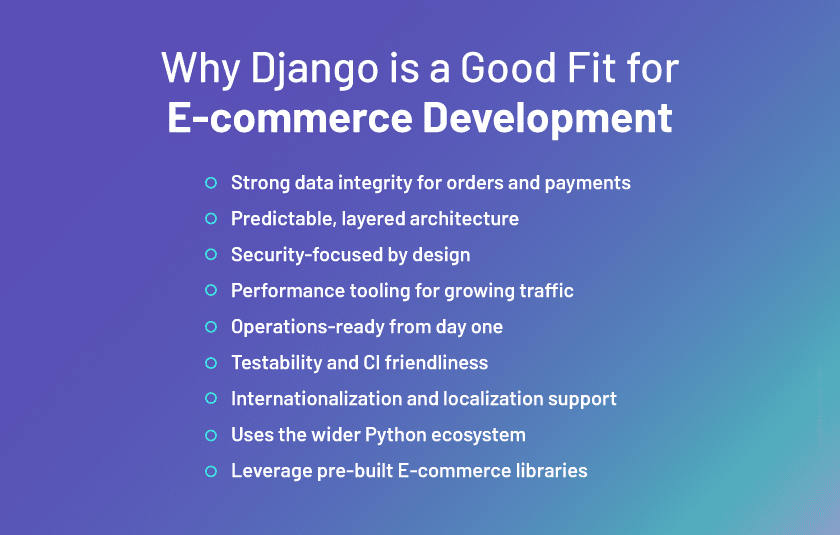
Django provides a mature, Python-based foundation designed for data-heavy, transactional web applications. Here are the reasons to choose it for E-commerce development:
Strong data integrity for orders and payments
- Django’s ORM maps cleanly to relational databases like PostgreSQL and MySQL, so orders, line items, refunds, and stock updates stay consistent.
- Transactions, constraints, and migrations help avoid “orphan” records or half-written orders when something fails mid-request.
Predictable, layered architecture
- Clear separation of concerns (models, views, templates, forms) keeps business logic, presentation, and persistence decoupled.
- The “app” structure lets you isolate modules such as catalog, cart, promotions, and fulfillment into reusable, testable units.
Security-focused by design
- Django ships with protections against common web attacks (SQL injection, XSS, CSRF, clickjacking) enabled by default.
- Password hashing, session management, and permission hooks provide a solid baseline for account and session security.
Performance tooling for growing traffic
- Built-in caching hooks (per-view, template fragment, low-level cache API) help keep catalog pages and listing views fast.
- Connection pooling, query optimization helpers (select_related, prefetch_related), and async support make it easier to tune performance around busy sales periods.
Operations-ready from day one
- Django Admin provides a ready interface to inspect and manage data structures like products, orders, returns, and logs during development.
- Management commands and signals make it easier to implement recurring jobs (cleanups, reconciliations, data fixes) needed in real-world stores.
Testability and CI friendliness
- The built-in test framework supports unit, integration, and functional tests for critical paths like cart calculations and payment callbacks.
- Fixtures, factories, and transactional tests help you simulate real-world order flows before deployment.
Internationalization and localization support
- Translation, timezone, and formatting tools are part of the framework, helping you prepare your store for multiple regions and currencies.
- Template filters and utilities make it easier to format prices, dates, and messages consistently across the site.
Uses the wider Python ecosystem
- You can plug in Python packages for search, analytics, recommendation logic, or background processing without fighting the framework.
- This makes it easier to evolve your E-commerce platform as your technical requirements become more advanced.
Leverage pre-built E-commerce libraries
- Django E-commerce libraries like Oscar and Saleor offer pre-built solutions for handling complex features like product catalogs, shopping carts, and checkout processes.
- These libraries provide a solid foundation, reducing the need to build everything from scratch and accelerating your development timeline.
If you’re looking to build a secure, scalable, and customizable E-commerce site, hire Django developers to use these benefits and create a platform that’s built to last.
5 Business Scenarios Where Django Wins Over Shopify or Magento
Now, let’s look at specific situations where Django can be a better choice than Shopify or Magento for E-commerce development.
1. You Have a Non-Standard Business Model
If your business doesn’t look like a typical online store, Shopify or Magento can start to feel restrictive. You might:
- Mix rentals, subscriptions, and one-time purchases
- Use complex B2B pricing by segment, region, or volume
- Need special approval steps before an order is confirmed
On Shopify or Magento, this often needs multiple apps, scripts, and manual work. With Django, your development team can build these rules directly into the system, so the buying flow actually matches your real business model.
2. You Need a Custom Checkout or Ordering Experience
In some businesses, checkout is more than “add to cart and pay.” For example:
- Customers build custom bundles step by step
- B2B buyers request quotes or upload documents
- Orders need multiple shipping addresses or split invoices
Shopify and Magento can address some of this, but complex flows can feel patchy. With custom E-commerce development on Django, you control every step of the journey and design it exactly around how your customers buy.
3. You’re Building a Marketplace or Multi-Vendor Platform
Marketplaces are more complex than single-brand stores. You may need:
- Vendor signup and verification
- Flexible commission rules and payouts
- Vendor dashboards, disputes, and ratings
There are marketplace apps for Shopify and Magento, but they can struggle as your rules become more complex. When you build E-commerce with Django, your team can create a marketplace engine that matches your exact vendor and commission logic.
4. You Plan to Go Headless or Omnichannel From Day One
Many growing brands want to sell across multiple touchpoints:
- Website
- Mobile app
- In-store kiosks
- Partner portals
- Other digital endpoints
This is where Headless E-commerce comes in. Your backend manages products, orders, and customers through APIs, while different frontends handle the experience for each channel.
Shopify and Magento can support headless setups, but you’re still working within their structure and limits. Django, on the other hand, works well as an API-first backend. If omnichannel is part of your plan from day one, Django gives you the freedom to design a central engine that serves every channel consistently.
5. You Need Deep Integration With Internal Systems
If your E-commerce is just one part of a larger system, this section is critical.
You may need to integrate with:
- ERP for inventory, procurement, and accounting.
- CRM for customer data and sales pipelines.
- Warehouse management systems and logistics tools.
- Custom pricing or recommendation engines.
Shopify and Magento can integrate with many tools, but often through apps, connectors, and workaround logic. When the integration logic gets complex, Django shines. It can act as the main hub that coordinates data and workflows between all your systems. In these cases, a Django-based architecture can support robust integrations that reduce manual work and errors.
When Is Django Not the Right Choice for E-commerce Development?
While Django offers immense flexibility and customization, it may not be the best fit for every business. There are certain situations where alternative platforms like Shopify or Magento might be more suitable. Here are a few scenarios where Django may not be the ideal solution:
-
Early-stage or Small Businesses Needing a Fast, Low-Cost Launch
If you’re just starting out or working with a tight budget, the upfront cost and time required for a custom Django build can be hard to justify. Platforms like Shopify let you launch a functional store in days or weeks with minimal technical setup. You pay a predictable monthly fee, pick a theme, add a few apps, and you’re live. When your priority is getting something reliable online quickly, instead of designing a tailored system from day one, a hosted platform is usually the better fit.
-
Lack of Technical Resources
Django requires a capable technical team for development, implementation, and ongoing maintenance. If you don’t have in-house developers or don’t plan to work with an experienced Django partner, maintaining a custom platform can become a strain. In that case, using a platform with built-in support, a large app ecosystem, and less custom code to manage is often the safer and more sustainable option.
Cost, Timelines, and ROI Expectations: Django vs Shopify vs Magento
As a business owner, you likely have three main questions: How much will it cost? How long will it take? Will it be worth it?
Upfront Costs
- Shopify: Lowest upfront cost. You pay a monthly fee, choose a theme, and add apps. Most of the investment is in setup and configuration, not custom development.
- Magento: Higher initial cost than Shopify, especially for complex catalogs and custom features. You’ll need expert developers and strong hosting.
- Django: Usually the highest upfront investment because you’re funding custom E-commerce development tailored to your workflows, pricing rules, and integrations.
Ongoing Costs
- Shopify: Ongoing subscription fees, app charges, and transaction fees (depending on your plan and payment gateway).
- Magento: Hosting, maintenance, updates, and extension costs can add up, especially at scale.
- Django: You’ll pay for hosting, maintenance, and enhancements. However, these costs can reduce manual work, errors, and third-party app fees over time, as the system is built to your exact needs.
Timelines
- Shopify: Often live in a few weeks, depending on design choices and app setup. Ideal when speed-to-market is critical.
- Magento: Typically longer than Shopify due to configuration, performance tuning, and complex catalog setup.
- Django: Usually takes a few months to build a solid MVP. It’s slower to start, but when you build E-commerce with Django, you gain a flexible foundation that can evolve with your business.
ROI and Total Cost of Ownership (TCO)
The return from your platform comes from:
- Automating manual tasks and reducing operational effort
- Lowering errors and improving efficiency across teams
- Enabling new revenue models (marketplaces, B2B portals, subscription flows)
- Improving customer experiences, which boosts loyalty and lifetime value
When comparing Shopify, Magento, and Django for E-commerce, don’t just look at launch costs. Consider the total cost of ownership and growth potential over 3–5 years: Shopify works best for quick, standard setups, Magento is strong for larger, feature-rich stores, and Django is ideal when you need a highly flexible, deeply integrated E-commerce engine.
You May Also Read: Is Django Cost-Effective? A Deep Dive into Its TCO
How to Decide: A Simple Framework for Business Owners
You may ask, “So, what should I choose?” Let’s make the decision easier.
Ask yourself:
- Is our business model straightforward or unique?
- Do we rely on internal systems that need deep integrations?
- Are we planning a marketplace or a complex B2B portal?
- Are we under pressure to launch something basic quickly, or can we invest a bit more time in a platform that supports future complexity?
- Do we have, or can we find, a capable technical partner to work with Django?
If your answers are more about a simple, standard, and fast launch, Shopify or Magento is likely a good choice. But if you’re leaning toward complex, integrated, unique, and long-term control, then it’s time to consider Django seriously.
In that case, the next step is to hire Django developers or partner with a team experienced in building advanced E-commerce solutions using Django.
Bottom Line
The right E-commerce platform is about more than just meeting today’s needs; it’s about how well it supports the way you actually sell, fulfill, and grow. Shopify and Magento are excellent when you want proven features and a fast, predictable path to launch.
Django becomes worth the investment when your store has to handle non-standard pricing, multi-party flows (like marketplaces or B2B portals), or tight connections to ERP, CRM, and logistics. In those cases, you’re not just launching a storefront; you’re building a core business system. A Django-based stack lets you design that system around your operations instead of constantly working around platform limits, so you can keep extending it as new products, channels, and markets come into the picture.
Looking for a scalable and customizable e-commerce solution with Django? Get in touch with us today to build a platform that grows with your business!


 Web Development
 Cloud Engineering
 Mobile App Development
 AI/ML/GenAI
 E-commerce
 Software Development
 UI/UX
UI/UX QA
QA Dedicated Teams