Loading page…

The client offers a cutting-edge medical test management app - an all-in-one solution for effortlessly managing medical tests and patient records in healthcare. From simplifying blood sugar tracking to alerting critical results, the app empowers healthcare teams to act quickly. With seamless automation, the app keeps every test trackable, mitigating risks and ensuring no patient is overlooked.
Industry
Healthcare
Tech Stack
Country
UK
Managing medical test records manually can be a nightmare for healthcare teams. Endless reminders and scattered patient data can weigh heavily on patient safety. Our client faced these exact challenges, struggling to juggle manual processes that left too much room for error and little time for patient care.
They needed a smarter way to handle everything:
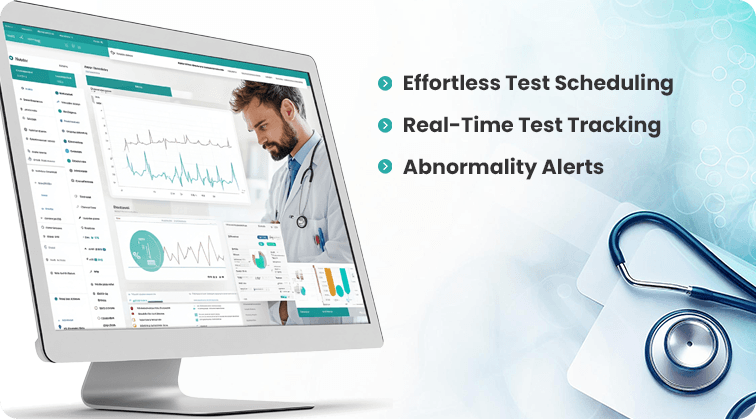
They envisioned an app that could revolutionize test scheduling and slot patients without the hassle of manual logs. The app also needed to track medical tests in real-time - whether in progress, completed, or overdue. As a lifesaving must-have, the app had to flag borderline results for patient safety instantly.

But, the actual technical challenge lay in creating multiple forms that could evolve based on a patient’s input. For example, if a patient entered "blood pressure medication" as part of their medical history, the forms needed to display follow-up fields asking for dosage details, frequency of intake, and any recent test results related to kidney or heart health. If the patient then indicated "high dosage," additional fields had to appear, prompting for monitoring schedules or any side effects experienced.
The app's backend had to handle a maze of conditional logic in real-time to make this interaction happen. Each user input had to trigger specific changes, with the system cross-checking against predefined parameters and instantly updating the forms to reflect the next logical step.
Capital Numbers approached the project by piecing together tailored solutions to every challenge. First, we replaced chaotic manual logs with a sleek, automated test scheduling mechanism that made patient slotting a breeze. Next, we delivered a real-time tracking feature that showed test statuses at a glance: in progress, completed, or overdue. We then added a result-flagging system that spotted and escalated abnormalities to prevent patient risks.
Additionally, we built interactive charts to show real-time analytics of patient history and pending tests. To put healthcare teams in the driver’s seat, we built customizable filters - letting them slice and dice patient data by date, test type, or urgency.
However, the most complex part was developing dynamic patient intake forms. We handled the UI/UX to create these forms using radio buttons, drop-downs, and text boxes. But, the work wasn’t just about throwing some digital forms; it required meticulous attention to data validation and input processing. So, behind the scenes, we built a sophisticated backend engine.
The engine ensured each input field’s visibility was linked to specific conditions. For example, if a patient selected "Diabetes" under medical history, the form would instantly adapt to display additional fields like "Type of Diabetes" (Type 1 or Type 2) and "Current Medication" (with a drop-down for Insulin or Oral Medications).
If the patient then selected "Insulin" as their medication, follow-up fields would appear, prompting for "Last Blood Sugar Test Results," "Dosage Frequency," and "Recent HbA1c Test Results" (with text boxes for numerical inputs).
Creating these backend interactions required us to develop a network of conditional logic and real-time APIs that interpret inputs in real-time, cross-check them against a web of predefined dependencies, and update the form fields instantly.
The logic had to understand these dependencies and manage complex hierarchies of nested conditions, ensuring that the correct fields appeared at the right time. Each layer of this hierarchy required the system to evaluate multiple variables simultaneously, ensuring that only the most contextually relevant fields were dynamically displayed at any moment. It demanded advanced decision trees, priority-based processing algorithms, and failproof algorithms to handle edge cases gracefully.
The magic behind it all? Capital Numbers’ precision engineering skills using a rock-solid tech stack featuring .NET, Angular, and SQL Server seamlessly orchestrated to manage forms, patient data, and test cycles.


The outcome is a game-changing software that takes the chaos out of medical test data and patient record management. Here’s a quick lowdown on the benefits the app brings:
Automated test scheduling cuts manual effort by 80%, saving clinics up to 10 hours weekly.
Test tracking time is reduced by 70% with auto-updates: in progress, completed, or overdue.
Around 95% of abnormalities get flagged instantly, improving patient safety outcomes.
Real-time form field adjustments speed up patient data collection by 60%.
Forms handle up to 100 nested conditions, capturing context-aware patient data.
Backend validation in forms improves data accuracy by 90%, eliminating discrepancies.
Dynamic forms adjusting instantly to individual workflows cut manual intervention by 90%.
A robust backend handles a 200% load increase even during high patient inflow.
Interactive charts cut analysis time, with clinical teams identifying key trends 3x faster.
Custom filters reduce search times, allowing clinical teams to sort patient data in seconds.
Automated alerts reduce human error by 70%, ensuring timely intervention in critical cases.
Automation reduces hospital admin tasks by 80%, allowing clinical staff to focus on quality care.

Industry: Healthcare

Industry: Healthcare

Industry: Healthcare
Industry: Healthcare

Industry: Healthcare

Industry: Healthcare

Industry: Healthcare

Industry: Healthcare

Industry: Healthcare