Loading page…

As the global pandemic puts stress on the healthcare system, the need for telehealth chatbots, catering to a growing number of patients, has gone high. Keeping this in mind, the US-based IT company wanted to develop a telehealth bot that would help inpatient care during these trying times.
Industry
Healthcare
Tech Stack
The US-based company is our existing client, and they have immense faith in our high-quality service. Therefore, when they planned to build this AI bot, they contacted us without any second-guessing. While discussing the project with the client, Capital Numbers found out that they already have a bot in place; however, it was not programmed correctly, plus, the bot was outdated. Our biggest challenge was to enhance this existing bot platform with a cutting-edge AI solution without changing the existing codebase.
Besides, with the rising COVID-19 cases and piling pressure on healthcare systems, we had to come up with an evolved telehealth bot within a very short time. Our challenge was to conduct in-depth research within a few weeks to develop a bot that transforms patient diagnoses.
Our tech team discussed ways to simplify the flow of billing information for customers. We also had to add a solution to process all bill payments without data loss. We noted down each point and started developing the app using the following techs:
We made the most of the Android SDK because of its pre-built libraries that speed up development and boost the UX. To link bank accounts to the app, we used the Plaid API. Plaid-powered apps are end-to-end encrypted. They store sensitive data like login credentials and OTPs via HTTPS connection that prevents fraud.
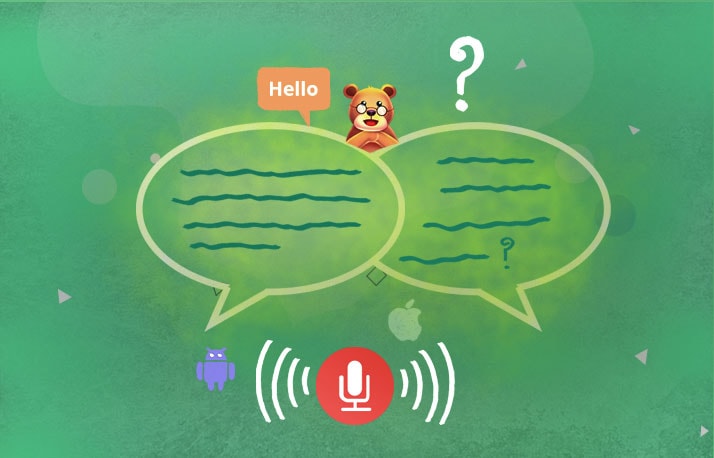
We chose Google Dialogflow to develop this conversational bot. Dialogflow is a platform that makes it easy to integrate conversational UI into a mobile app. It analyzes text and audio inputs from users. Accordingly, it responds to users, either through speeches or texts. As a result, Dialogflow was our obvious choice for this interactive voice response system.
Next, our experts used Swift because of its clean code and simplified syntax. Moreover, Swift comes with dynamic libraries that get updated independently, speed up load time, and enhance overall app functionality. Also, Swift offers code reusability, removes classes of unsafe code, makes apps secure, and comes with UTF-8 based encoding that supports multiple languages and emojis. Therefore, this programming language was a top choice for the iOS platform.
We used REST API because this architectural style comes with various layers that assure security and flexibility to iOS apps. REST can also easily integrate with existing platform architecture without the need to refactor the codebase from scratch. Plus, REST APIs are stateless that makes iOS apps scalable and cacheable.
To add versatility to the app, we chose the schema-less data structure - MongoDB. This database comes with auto-sharding that helps in horizontal scaling. Moreover, MongoDB adds flexibility and high-speed to apps. It is developer-friendly and one of the most cost-effective options. Clearly, MongoDB was the perfect fit for our iOS app.



We successfully created the iOS platform that signals hospital staff if patients require medical or clinical assistance.
Patients need to download the app in their iPads, log in with username and password, and interact with the nurses within the chat interface.
When a patient fills in his login credentials in the app, a unique patient ID gets generated along with his room number at the hospital.
Once the unique ID gets generated, patients can start accessing the app by keeping their iPads beside their hospital beds to call nurses for various kinds of assistance such as anxiety, stress, drugs, or other personal care.
The emotionally intelligent bot keeps track of a patient's condition by efficiently asking the patient about his health at regular intervals. When a patient specifies some sickness or discomfort, the voice assistant in the iOS app immediately sends real-time alerts to the caregivers. The nurses or caregivers receive this alert in their own iPads and extend help immediately without delay.
Our experts used the best conversational datasets to train the bot with relevant questions to improve the quality of patient care. Through Natural Language Processing, we triggered a blot flow that sounds human-like while asking patients questions like:
Our pool of talents delivered a bug-free iOS version of the AI bot that assists patients with medical guidance, symptom checks, medical queries, nutrition, and other tailored services.
The client acknowledged the efficacy with which Capital Numbers could deliver this Machine Learning project that ensures 100% accuracy. They added:
“The pool of resources is amazing. They can find you any skill set if needed.”
The ability to build an AI-powered virtual assistant within two months and port the same to Google based iOS app solution was something we excelled at.
We carefully engineered advanced search algorithms that would create unique searches, trigger quick results, and cater to all user queries with perfection.
Our dedicated team members were quick, prompt, and proficient at optimizing the bot performance with built-in technologies like Swift 5 and MongoDB that leave ample room for future scalability. Moreover, our developers' readiness to research on Google Dialogflow and implement it to enable natural language conversations was highly commendable.
By deploying this virtual assistant app on-time, Capital Numbers not only triggered a conversational bot flow, but it also triggered innovation in healthcare.
This instilled greater client trust.
We couldn’t be more proud of our skilled developers who created this patient-care app that offers trusted healthcare services and enables efficient crisis management in these uncertain times.
Industry: Healthcare

Industry: Healthcare
Industry: Healthcare
Industry: Healthcare

Industry: Healthcare

Industry: Healthcare

Industry: Healthcare

Industry: Healthcare
Industry: Healthcare