
AI Proof of Concept vs MVP vs Production: What Each Stage Delivers

Project Manager
16th November, 2026
|
Key Takeaways
|
A successful AI demo does not guarantee business value or production readiness. Before committing more budget, decision-makers need to know what has been validated, what risks remain, and whether the solution is ready for the next stage.
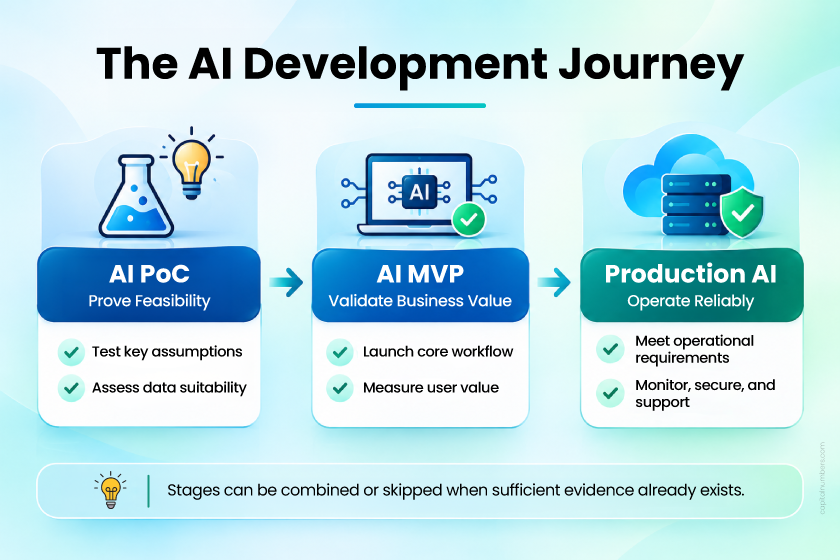
An AI proof of concept (PoC), minimum viable product (MVP), and production deployment are connected stages of AI development, and each delivers a different kind of evidence. A PoC tests technical feasibility, and its findings help shape the MVP. The MVP validates business value with real users, while production engineering prepares the solution for reliable, ongoing operations.
This guide explains what each stage delivers, how to assess production readiness, and when to move forward. Businesses can also combine or skip separate stages when sufficient evidence already exists.
AI PoC vs MVP vs Production: At a Glance
The table below compares the goals, deliverables, success criteria, and remaining uncertainties at each stage of the AI development lifecycle.
|
Factor |
AI PoC |
AI MVP (including pilot testing) |
Production AI |
|
Primary goal |
Validate technical feasibility and critical assumptions |
Validate usability and business value |
Support reliable business operations |
|
Main deliverables |
Working demo, evaluation report, feasibility findings |
Usable application, user feedback, improvement backlog |
Deployed system, monitoring, security controls, support documentation |
|
Scope |
One use case with selected data |
Core features for a defined workflow |
Defined users, workloads, and service requirements |
|
Primary users |
Engineers and project stakeholders |
Selected business users |
Authorized employees or customers |
|
Success criteria |
Technical and feasibility targets are met |
Users achieve measurable business outcomes |
Quality and operational requirements are satisfied |
|
What remains unproven |
User adoption, full workflow value, operational reliability |
Wider adoption, scalability, and any untested production controls |
Future behavior under changing data, workloads, models, and requirements |
|
Next decision |
Develop, revise, or stop |
Improve, expand, or prepare for wider deployment |
Maintain, optimize, and scale |
What Is an AI Proof of Concept (PoC)?
An AI proof of concept (PoC) is a small-scale experiment that tests whether a proposed AI solution can work with the available business data and meet agreed technical targets before larger development begins.
AI proof of concept deliverables typically include a technical demonstration or experiment results, performance findings, and documented limitations. Depending on the project scope, the handover may also include source code, evaluation datasets, and reusable components.
The evaluation report should document what was tested, the agreed success criteria, results, remaining risks, and a recommendation to proceed, refine, or stop development. This gives decision-makers the evidence needed to approve the next investment.
When Do You Need an AI PoC?
Consider an AI PoC when:
- The proposed model has not demonstrated acceptable performance on company data.
- The project involves unfamiliar technology or a specialized use case.
- Data quality, availability, or access permissions remain uncertain.
- Accuracy, latency, or infrastructure feasibility needs validation before development.
AWS’s generative AI maturity model recommends setting success metrics and measuring ROI against the agreed success criteria for each PoC.
A PoC is ready for review when the team has tested its critical assumptions and documented the results. Proceed to MVP development only when the evidence supports technical feasibility and the remaining risks justify further investment. Otherwise, refine the approach or stop development.
What Is an AI Minimum Viable Product (MVP)?
An AI minimum viable product (MVP) is a functional application with the essential AI capabilities needed to test a business workflow. It can be released through a limited pilot, allowing selected users to evaluate its usability and business value.
AI MVP development typically delivers a usable application or integration, performance results, user feedback, and a prioritized backlog of improvements. Depending on the use case, the application may also require safeguards such as role-based access controls and human approval workflows.
These findings help businesses decide whether to refine the solution or invest in broader deployment.
When Do You Need an AI MVP?
Consider an AI MVP when:
- You've validated technical feasibility, but business value remains unproven.
- You need real users to test essential AI features within existing workflows.
- You need to measure user adoption, efficiency gains, or operating costs.
- You want to identify improvements before expanding the solution to more users.
An MVP can run in a controlled production environment. Its primary goal is to validate business value, while a production-ready AI system must support reliable ongoing operations.
What Is Production-Ready AI?
Production-ready AI is a system designed to operate securely and reliably in its intended business environment. It integrates with existing applications and includes the performance, monitoring, and support capabilities required for ongoing operations.
Typical deliverables include a deployed AI application, security and access controls, performance monitoring, test results, and operational documentation covering incident response, recovery procedures, and support ownership.
For example, an AI-powered insurance platform might flag uncertain document-extraction results for human review while monitoring errors across different document types.
When Is an AI Solution Ready for Production?
An AI solution is ready for production when:
- It meets agreed output-quality, performance, reliability, and applicable safety requirements.
- Security controls, access permissions, and required integrations have been tested.
- Monitoring, error handling, and recovery procedures are in place.
- Business and technical owners have reviewed outstanding risks and approved deployment.
Production-readiness requirements should reflect the use case, data sensitivity, and potential impact of errors. An internal drafting assistant may need different safeguards from an AI system supporting financial or insurance decisions.
The NIST AI Risk Management Framework provides voluntary guidance for identifying, assessing, and managing AI risks.
How Does an AI Project Progress From PoC to MVP to Production?
Moving from AI PoC to production involves decisions about feasibility, business value, and operational readiness. The four checkpoints below help teams determine whether to proceed, refine, or stop development.
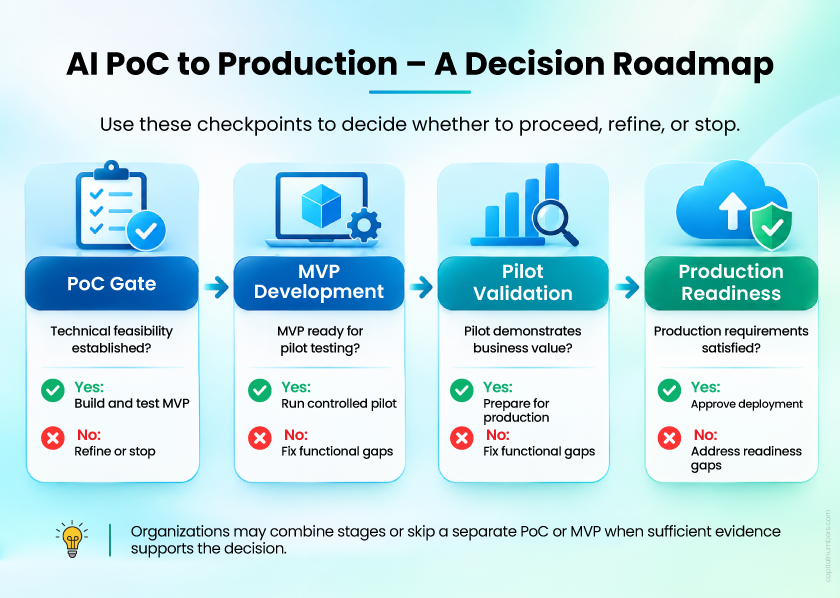
Step 1: Validate Technical Feasibility (PoC Gate)
Evaluate the AI approach using representative data, including difficult and previously unseen cases. Set measurable targets for output quality, response time, and cost before testing. Document failures and limitations alongside successful results.
Even during experimentation, teams should use approved datasets and appropriate access controls when handling company or customer information.
The development partner should document evaluation results, system limitations, and technical risks before recommending further investment.
Decision Checkpoint: Is there sufficient evidence of technical feasibility to justify MVP development?
Step 2: Build and Test Essential Features (MVP Development)
Turn validated AI capabilities into a usable application that supports essential business workflows. Focus on core features, user interfaces, baseline security, and necessary integrations. The development team may need to redesign experimental PoC components or build new application infrastructure to support real users.
Test the complete workflow, including data handling, integrations, AI output quality, and error handling. Define acceptance criteria for functionality, output accuracy, response time, user access, and human review where required before pilot testing. Document unresolved issues and confirm that the MVP is ready for controlled user testing.
Decision Checkpoint: Has the MVP passed the functional, integration, and security checks needed for controlled pilot testing?
Step 3: Measure Real-World Impact (Pilot and Business Value Validation)
Test the MVP with a controlled group of users to evaluate its performance in real business workflows. A pilot can expose unexpected inputs, adoption challenges, and accuracy problems that earlier testing missed.
An MVP defines what is built, while a pilot tests it with a limited group of users. A successful pilot does not automatically mean the system is ready for wider production deployment.
Measure processing time, manual corrections, user adoption, and cost per completed workflow. Compare these results with the existing process to determine whether the MVP delivers enough business value to justify broader deployment.
Decision Checkpoint: Does the pilot demonstrate enough business value to justify broader deployment?
Step 4: Operationalize and Scale (Production Readiness)
Prepare the application for broader deployment with reliable integrations, access controls, monitoring, and incident response procedures. Monitor AI output quality for performance changes, test updates before release, maintain model and prompt versions where relevant, and establish fallback procedures. Assign clear ownership for ongoing support.
The Azure Well-Architected Framework cautions against treating experimental PoC code as production-ready. Production implementation requires appropriate engineering, security, logging, and error handling.
Before broader deployment, estimate ongoing costs for infrastructure, model usage, monitoring, and maintenance alongside the initial development investment.
Decision Checkpoint: Can the organization securely operate, monitor, and support the AI system?
For instance, Capital Numbers delivered an AI PoC within four weeks for a European insurer’s multilingual AI insurance platform, supporting the rollout of production AI modules. Across the overall engagement, the solution delivered 95%+ multilingual retrieval accuracy, improved p95 latency by 40–55%, and reduced manual data handling by over 65%.
For a closer look at deployment requirements and operational safeguards, see our guide to implementing generative AI in production.
Red Flags to Watch for at Each AI Development Stage
An AI project may appear successful while important risks remain unresolved. Before approving further investment, decision-makers should watch for these warning signs:
- PoC: Strong results on limited data. A model may perform well on carefully selected samples but struggle with real-world variations. Check its performance on representative, previously unseen data, including difficult cases.
- MVP: High adoption but limited business value. Employees may use the application regularly, yet manual corrections and operating costs can outweigh the benefits. Compare task completion time, accuracy, and costs against the existing process.
- Production: Reliable uptime but declining output quality. An AI system may remain available while its accuracy deteriorates or operating costs increase. Monitor output quality, errors, costs, and corrective actions alongside system availability.
Before moving forward, confirm that the results reflect actual operating conditions and justify the next investment.
What Should You Ask an AI Development Partner Before Approving the Next Stage?
When comparing AI development partners, look beyond technical capabilities. Assess how they validate feasibility, measure business value, manage risks, and support production deployment. Before selecting a partner, ask:
- Which technical assumptions will the PoC test, and how will you measure success?
- What source code, evaluation datasets, documentation, and other assets will we receive?
- Which PoC components can be reused, which need rebuilding, and what engineering review is required before production?
- How will the MVP measure user adoption, output quality, and business value?
- Which security, integration, monitoring, and support requirements remain before production?
- Who owns the code, infrastructure access, documentation, and maintenance responsibilities after handover?
Vendors may deliver similar PoC demonstrations but provide different handover assets. Reusable code, documented evaluations, and clear technical recommendations can reduce the effort required for subsequent MVP development. Our guide to choosing the right AI development company covers ownership, handover, and red flags in more depth.
Which AI Stage Comes Next?
For businesses weighing AI proof of concept vs MVP, the next stage depends on what remains uncertain. Start with a PoC when technical feasibility or data suitability needs validation. Move to an MVP when the approach works, but its business value remains unproven. Prepare for production when the solution meets the required quality, security, integration, and operational standards.
Not sure which stage you are at? Get a Free AI Readiness Audit to see what your use case still needs to validate before you commit to the next stage.
Frequently Asked Questions
Should my company start with an AI PoC or an MVP?
Start with an AI PoC when important questions about technical feasibility, data suitability, or model performance remain unanswered. Begin with an MVP when existing evidence supports feasibility and the main goal is to validate user value. The decision should account for technical risks, available data, and business requirements.
What is the difference between an AI PoC, a prototype, and an MVP?
An AI PoC tests whether the approach can work technically with your data. A prototype shows how the solution could look and behave, such as screens or workflows, so stakeholders can react to the design. It may not run a working AI model. An MVP is a functional application with essential AI capabilities that selected users can test in a real workflow. Teams often use a prototype to shape the MVP, or skip it when the workflow is already clear.
How do I know whether an AI proof of concept is ready to become an MVP?
Review the PoC results against predefined success criteria. Confirm that the approach works with representative data, technical limitations are documented, and remaining risks are manageable. Next, define an MVP scope that lets selected users test the intended business workflow.
Can an AI proof of concept go directly into production without an MVP?
Yes. A business can skip a separate MVP when the use case is narrow, requirements are clear, and further user validation would add limited value. However, the team must still complete the necessary engineering, security, testing, integration, and operational readiness work before deployment. PoC findings, evaluation data, and reusable components can support later development. Any code carried forward must undergo appropriate engineering review and meet production security, testing, and reliability standards.
Why do successful AI proofs of concept sometimes fail in production?
PoCs often use limited datasets, controlled conditions, and simplified integrations. Production introduces variable inputs, higher workloads, security requirements, and ongoing operational responsibilities. For example, an assistant that extracts data from documents may perform well on a clean sample, then struggle once live files include scanned pages, unusual layouts, or several languages. Broader evaluation helps identify these risks before deployment.
How long does an AI PoC take, and what affects its cost?
A focused AI PoC can take a few weeks, while more complex projects may require longer. For example, Capital Numbers delivered an AI PoC for a European insurance client within four weeks. Costs depend on data preparation, technical complexity, integrations, and testing requirements. Defining the scope and success criteria early helps estimate the required time and investment.

Srijeeb ChakrabortyProject Manager
An IT Project Manager at Capital Numbers Infotech Ltd., Srijeeb manages multiple simultaneous client engagements spanning web, mobile, AI/ML, Salesforce, and Power BI projects. He serves as the primary bridge between internal development teams and external clients, driving smooth delivery, clear communication, and strong client relationships across diverse technology initiatives.