
Human Accountability in AI-Assisted Software Development: What Buyers Should Expect

Project Manager
6th November, 2026
|
Quick Summary Human accountability in AI-assisted software development means identifiable people remain responsible for important engineering decisions and outcomes, even when AI assists with the work.
|
Consider a hypothetical Friday-night production change in an AI-assisted software development project.
An AI coding agent identifies a fix in a payment service, updates the code, runs the available tests, and prepares the change for release. The checks pass, and a reviewer approves the update.
By the next morning, an edge case that neither the agent nor the review process caught is affecting transactions.
The immediate question is: who understood the change, assessed the risk, and approved its release?
That question matters as AI in software development moves beyond code suggestions to agents that can plan tasks, modify files, run tests, and use other development tools. Faster implementation does not remove the need for secure, testable, maintainable software, or clear responsibility when something fails.
To assess that responsibility, ask where people make decisions, what agents can do independently, and what evidence supports a release.
What Does Human Accountability Mean in AI-Assisted Software Development?
Human accountability means identifiable people remain responsible for important engineering decisions and outcomes. It does not mean engineers manually write or inspect every line of code
People remain accountable for:
- Architecture and technical direction
- Security and data access
- Acceptance criteria
- Handling uncertainty and exceptions
- Production approval
- Incident response
- Long-term maintainability
AI can assist with these activities, but the people responsible for its use, oversight, and outcomes should be clearly identified.
This becomes especially important with agentic AI in software development. A conventional coding assistant generally responds to a specific request. An agentic workflow may break a task into steps, inspect a repository, modify several files, invoke tools, react to failures, and continue working toward an objective.
Human-in-the-loop means a person approves before a defined action proceeds. Simply using the phrase tells a buyer little unless the team explains who approves what.
The useful questions are: Where is human judgment required? What can the agent do independently? And what makes it stop and escalate?
Those questions also expose a weakness in one of the most common approaches to AI oversight.
Why “A Human Reviews Everything” Is Not Enough
Human review sounds reassuring. But as automation grows, review can become a bottleneck, or simply a formality.
Thoughtworks notes that coding agents can now generate, test, and refactor code faster than traditional line-by-line review can keep up. The answer is not to remove human oversight, but to focus it on boundaries, outcomes, and decisions that require judgment.
When Review Becomes Routine
An agent writes the code, runs checks, summarizes the change, and presents a polished pull request.
After enough successful runs, reviewers may start trusting the summary instead of questioning the decisions behind it. That is where review can become routine rather than critical.
GitHub documents limitations of Copilot code review: it can miss problems, flag issues that do not exist, and suggest changes that need further checks. Its feedback should support human review and testing, with engineers checking whether suggested fixes address the underlying problem.
Reviewers need enough context to challenge the implementation, assess its risks, and confirm that the evidence supports approval.
Focus Human Oversight Where It Matters
As agents handle more work independently, reviewing every small decision becomes less practical.
A better approach is to match human oversight to the level of risk. Atlassian describes three models. Here is how they can apply to software development:
|
Risk |
Oversight model |
Example |
|
Low |
Human-out-of-the-loop: The agent works within clear limits, with review afterward |
Formatting internal documentation |
|
Medium |
Human-on-the-loop: The agent works while a person monitors and can intervene |
A bounded refactor in a development branch |
|
High |
Human-in-the-loop: A person approves before the sensitive action proceeds |
Changing production access or payment rules |
The right model depends on what could go wrong and how easily it could be reversed. Permission to edit code does not mean permission to release it.
Three Foundations of Accountable AI-Assisted Development
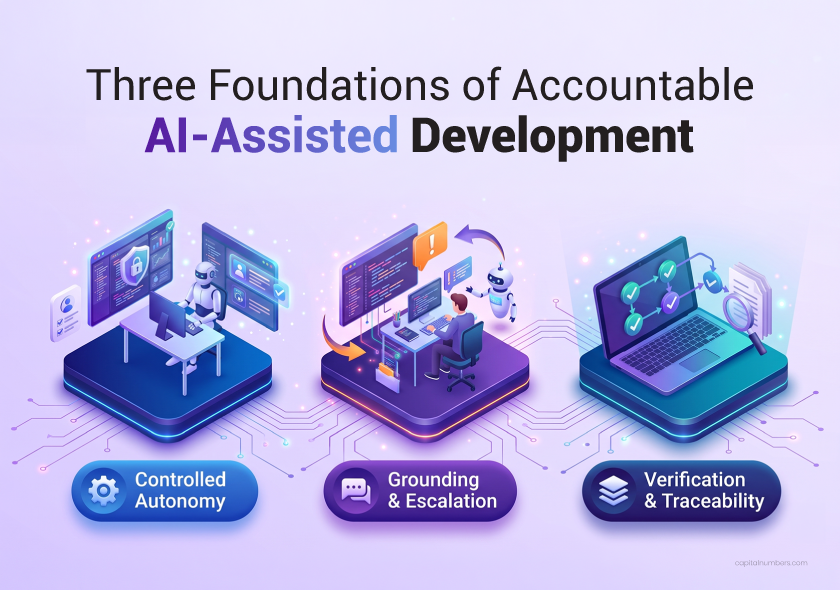
Buyers can assess accountability through three practical areas.
1. Controlled Autonomy
Autonomy is safe only when its limits are set before an agent starts work. Without those limits, an agent’s access can grow beyond what anyone approved.
Using the tiers above, define practical boundaries for AI-assisted software development:
- Which repositories and environments an agent can access
- Which actions it can perform independently
- Which changes require approval
- Which actions are prohibited
- How autonomy changes as risk increases
Boundaries on paper are not enough. When choosing custom software development services, ask how your partner enforces these limits in practice, for example through access permissions and approval rules, not just team guidelines.
Even well-set boundaries will be reached. What the agent does at that point is the next foundation.
2. Grounding and Escalation
Autonomy works better when an agent has relevant context.
That may include architecture decisions, API contracts, coding conventions, security requirements, acceptance criteria, repository documentation, and business rules.
But context does not eliminate uncertainty.
An accountable workflow should define conditions that make an agent stop and escalate, such as:
- Incomplete or conflicting requirements
- Security-sensitive changes
- Unfamiliar legacy dependencies
- Unexplained test failures
- Requests for broader permissions
- Changes involving production data or infrastructure
- Conflicts with approved architecture
This is where AI code governance becomes practical. An AI system should not quietly turn uncertainty into implementation.
For example, an agent fixing a report should stop if it needs broader database access. An authorized engineer should decide whether that access is appropriate.
For higher-impact work, escalation shows that the controls are working.
3. Verification and Traceability
The third foundation is evidence.
A buyer should be able to follow an important change through the engineering process:
|
Work item → relevant context → AI involvement → code change → automated checks → reviewer → approval → commit → build → deployment |
Record which AI tool or agent helped and flag AI-assisted changes. There is no need to save every prompt forever, but keep enough context to answer practical questions later:
- Why was this change made?
- What was tested?
- Who reviewed it?
- Who approved it?
- When did it reach production?
- What should happen if it fails?
- Where did AI contribute?
Traceability is important when an incident occurs months after the original change.
At that point, the engineering team needs evidence, not someone’s memory.
What Buyers Should Expect From AI-Assisted Coding Security
AI-assisted coding security covers more than the code itself. Buyers also need to know what AI tools and agents can access and where their information goes.
Veracode’s 2025 GenAI Code Security Report found that 45% of AI-generated code samples failed security tests. The study evaluated more than 100 large language models across four programming languages. The results show why working code still needs security checks.
Check that your development partner has clear controls for:
- Secrets and client data: Keep credentials and sensitive information out of unapproved tools and prompts.
- Prompt injection: Treat instructions hidden in files or external content as untrusted, and restrict what agents can access or change.
- Dependencies: Verify that suggested packages are genuine and come from trusted sources, then scan them for known security issues.
- License and ownership: Review AI-generated and third-party code for license obligations and ownership concerns before using it.
- Agent access: Give agents only the permissions needed for the task.
- Model training: Confirm whether providers can retain client code or use it to train their models.
Ask your partner to show how these safeguards work in practice and who takes responsibility when a security issue arises.
Where Should Humans Remain Accountable Across the Software Development Lifecycle (SDLC)?
Accountable delivery does not divide the lifecycle neatly into “AI work” and “human work.”
Responsibility changes according to risk and the judgment required.
|
SDLC Stage |
Where AI Can Assist |
Human Accountability |
|
Requirements & Architecture |
Organize requirements, identify gaps, draft stories, explore technical options |
Validate business rules, resolve ambiguity, choose architecture, approve major design decisions |
|
Development |
Generate boilerplate, implement bounded changes, refactor code, prepare integrations |
Review important logic, security impact, dependencies, maintainability, and architectural fit |
|
Testing & QA |
Generate tests, create test data, run checks, identify likely regressions |
Define acceptance criteria, verify coverage, assess real-world behavior, approve unresolved risks |
|
Security |
Run scans, flag suspicious patterns, identify known issues |
Set policies, investigate findings, assess exceptions, approve sensitive changes |
|
Deployment & Operations |
Prepare releases, analyze logs, suggest fixes, automate reversible actions |
Authorize high-impact releases, control production access, manage incidents and rollbacks |
AI can perform more of the work without becoming the owner of the outcome. Before work begins, clarify which decisions belong to your team and which belong to the partner.
Questions to Ask an AI-Assisted Development Partner
You do not need a long explanation of every model or coding tool a vendor uses.
You need clear answers about how software is delivered.
Ask:
- Where do you use AI across the software lifecycle?
- What can your agents do without human approval?
- What conditions make an agent stop and escalate?
- How do you protect sensitive code, data, credentials, and production systems?
- How is AI-assisted code tested for security, correctness, and maintainability?
- Can an important change be traced from requirement through deployment?
- Who approves architecture and production releases?
- How does the contract address security, IP, remediation, and responsibility for AI-assisted work?
Look for specific answers:
Red flag: “We have humans in the loop.”
Green flag (example of a specific answer): “Authentication changes need our security lead’s approval before merge. Production releases need the release manager’s approval. We can show you a redacted record of both.”
Accountability Varies by Engagement Model
Accountability depends on how the team is engaged.
With staff augmentation, the client usually retains more control over architecture, approvals, and delivery decisions.
With managed teams or agile pods, small teams combine development, testing, and delivery skills. The partner typically takes on more responsibility for technical leadership, quality, and delivery.
End-to-end product development calls for clear ownership across architecture, engineering, testing, security, and release readiness.
AI does not remove these responsibilities. You should agree on who owns each important decision before delivery starts, regardless of the engagement model.
Clear ownership is only part of the picture. Buyers also need to know how AI-assisted work is independently verified.
Independent Verification Still Matters
One AI agent can review another. Security tools can scan the output, and AI can generate additional tests.
These checks help, but they can share the same blind spots. Engineers still need to check whether the tests cover what the software should do and what could go wrong.
Important changes still need evidence appropriate to their risk. Depending on the system, that may include:
- Unit and integration testing
- Regression testing
- Static and dependency security checks
- Performance validation
- Acceptance testing
- Manual review where engineering judgment is required
A payment authorization change may need checks for duplicate requests, failed transactions, and unauthorized access. A documentation update needs fewer checks.
Verification should be proportional to impact. That is how governance becomes part of normal engineering instead of a separate process added at the end.
Accountability Is Becoming Part of Mainstream AI Governance
The NIST AI Risk Management Framework offers voluntary guidance for managing AI risks. Its Generative AI Profile, NIST-AI-600-1, addresses generative AI risks.
These resources help govern AI use, but they do not replace the testing, security checks, and release controls needed for software built with AI.
In practice, good governance comes down to a few basics: clear ownership, defined access and permissions, risk-based controls, traceability, and a clear process for handling exceptions.
For buyers, the wider principle matters more than treating governance as a separate compliance exercise.
If AI influences important business or user outcomes, an organization should be able to explain who controls it, what boundaries apply, how important decisions are traced, and who responds when something goes wrong.
Build Faster Without Losing Ownership
Buyers evaluating AI development services should look beyond speed. Ask how the partner verifies changes, controls access, and handles problems after release.
Ask for a recent example they can share within client confidentiality requirements: where did AI help, what did engineers check, and who approved the release? If the partner cannot explain those decisions or provide appropriate supporting evidence, resolve the gaps before work begins.
Weighing whether to build, buy, or combine AI solutions? Apply the same test: whichever route you choose, someone should clearly own how the solution is managed, secured, and maintained over time.
How Capital Numbers Approaches AI-Assisted Development
At Capital Numbers, we agree on approval responsibilities before work begins. Technical leads oversee architecture changes, security leads review changes involving authentication and sensitive data, and release owners approve production deployments. If you handle these approvals, we document that in the delivery process.
When we use AI in development, we record its role alongside relevant pull requests, test results, reviews, and approvals. We also limit AI agents to the access they need for their assigned tasks, with production access and deployments following the agreed approval process.
Planning an AI-assisted software initiative? Discuss your AI project with us. We can walk you through a recent change, with client details removed and subject to client permission.
Frequently Asked Questions
What is human accountability in AI-assisted software development?
It means identifiable people remain responsible for important engineering decisions and outcomes even when AI assists with planning, coding, testing, or operations. This includes architecture, security, exceptions, releases, and production support.
Is AI-assisted code secure?
AI-assisted code can contain vulnerabilities even when it works and passes functional tests. AI coding security requires checks for unsafe logic, exposed secrets, vulnerable dependencies, and access-control weaknesses. Use security testing and engineering review appropriate to the change’s risk before release.
How does human-in-the-loop differ from human-on-the-loop?
Human-in-the-loop means a person must approve before a defined action proceeds. Human-on-the-loop means the AI works within agreed limits while a person monitors and can intervene. For example, a sensitive access change needs prior approval, while a bounded development refactor may proceed under monitoring.
Who is responsible for AI-assisted code?
Using AI does not remove the accountability of the people and organizations involved. Legal liability depends on the contract, the roles involved, the jurisdiction, and the type of system. Before work begins, agree on who reviews code, approves sensitive changes, authorizes releases, and handles defects or incidents. Document these responsibilities in the delivery process and contract.
This is general information, not legal advice. Consult a qualified lawyer for your situation.
How can buyers verify a development partner’s AI claims?
Ask the partner to walk through a recent change, with client details removed. Look at where AI helped, what was tested, who approved it, and how the change reached production. Ask to see the linked work item, pull request, test results, and approval records.

Soutrick SurProject Manager
Project Manager at Capital Numbers, specializing in driving project success through different methodologies. As a LinkedIn-PMI-certified Scrum Master & Atlassian-certified Project Manager, I leverage Jira, Confluence, and Advanced Roadmaps to transform complex project goals into streamlined realities. By merging advanced roadmaps with AI prompt engineering and insights, I deliver streamlined, impactful digital solutions for global clients.