
How to Choose the Right AI Development Company for Your Business

Software Engineer
30th October, 2026
|
Quick Summary
|
What happens when the AI system you commissioned meets a request it wasn’t designed to handle?
It may be a missing document field, a policy change, or a CRM connection that fails. At that point, a polished demo is no longer enough. An employee may need to step in. A customer may receive an incomplete answer, or a critical workflow may stall while someone finds the missing context.
What happens next depends on the people who built the system. A good AI development company knows where the limits of its system sit. It builds for those limits from the start, so exceptions get handled safely and the work reaches the right person without disrupting the business.
That’s why choosing the right AI development company matters as much as choosing the right AI model. Gartner’s October 2026 analysis of its AI Hype Cycle highlights a shift from building AI to ensuring accountability for its performance, governance, reliability, and costs. These factors become essential when businesses run AI in real workflows.
A strong partner designs reliable integrations, clear fallback paths, human review, and operating controls around the AI system before launch. This guide shows how to find one: what to decide first, what evidence to ask for, how to compare costs, and which red flags to avoid.
Do You Need an AI Development Service Provider?
You may need an AI development company when your workflow requires prediction, classification, language understanding, document interpretation, or decision support that conventional software cannot reliably provide. But not every automation problem needs AI, and not every AI requirement needs a custom-built system.
Make three distinctions before approaching vendors:
- Building AI vs. using AI to build software: Judge a provider by the systems it has delivered and supported, not the coding assistants it uses internally.
- Rules-based automation vs. AI: Predictable processes can work better with conventional automation. AI is more useful when a task requires judgment across variable language, images, documents, or patterns.
- Custom AI vs. an existing product: If a suitable SaaS product or AI API meets the need, custom development can add unnecessary cost and maintenance.
For example, routing tickets with fixed categories may not require AI. Interpreting complaints, checking account context, and suggesting responses across several systems may justify it. The relevant question is whether AI creates enough value to justify its complexity.
For a broader framework on this decision, read AI-Assisted Development vs AI-Powered Software
Do You Need Custom AI Development, AI SaaS, or an Integration Partner?
Before comparing AI development companies, decide what you are actually buying. A good provider should help you make this choice even when custom development is not the answer.
|
Option |
Best when |
Main trade-off |
|
Custom AI development |
Your workflow depends on proprietary data, business rules, product requirements, or a level of control that standard tools cannot provide. |
Higher initial investment and ongoing ownership responsibility. |
|
AI SaaS product |
Your need is common, speed matters, and an established product fits your security and workflow needs. |
Less flexibility, recurring fees, and possible data or vendor-dependence concerns. |
|
AI integration and product engineering |
The AI capability already exists, but value depends on connecting it safely to your CRM, ERP, knowledge base, internal tools, or customer product. |
Integration, permissions, and workflow design can be more complex than the model itself. |
Custom AI development is appropriate when standard products cannot meet your workflow, data, control, or product requirements. In many cases, an existing AI model combined with secure integration, retrieval-augmented generation (RAG), business rules, and human review offers a faster and more practical starting point.
For a deeper comparison of cost, control, speed, and scalability, read Build vs Buy AI Solutions.
Define success first. Before shortlisting vendors, agree on a baseline, a measurable target, and a timeframe, for example, cutting manual processing time by a set percentage within a set number of months. Decide what the pilot must achieve and what happens if it misses. Involve finance, security and legal early, because each will question the same proposal differently.
Should You Build AI In-House or Outsource Development?
Build in-house when AI is core intellectual property, needs continuous iteration, and you can retain the people needed to own it. Outsource when you need specialist expertise or faster validation. A hybrid model often works best: the partner supplies delivery expertise while your internal technical or product owner retains context, access, and decision-making authority.
What an In-House Team Must Own
Building internally requires more than an AI engineer. You need a team with product ownership, business expertise, data stewardship, architecture decisions, and platform support. If you cannot sustain those responsibilities after release, a hybrid or outsourced model may be more practical.
What Outsourcing Requires From You
Outsourcing works well for a discovery phase, proof of concept, defined integration, or specialist engineering without recruiting a complete team. Your business should still provide a product owner, relevant experts, timely feedback, and approval for high-impact actions. The partner should document assumptions and explain what your team must own after launch.
Why a Hybrid Model Often Works Best
In a hybrid engagement, the partner contributes AI, data, integration, QA, and platform expertise while your team retains business context and decision rights. Where practical, work should sit in your repository and environments, with clear documentation and a named internal owner.
Assign an internal product or engineering owner from the start so that decisions, documentation, and handover remain under your control.
What Should You Look for in an AI Development Company?
Look for a partner with relevant production experience, a clear understanding of your data and workflow, a practical testing approach, secure delivery practices, transparent costs, and accountable post-launch support. The provider should also show who will build the system, how success will be measured, and how your team will retain control after handover.
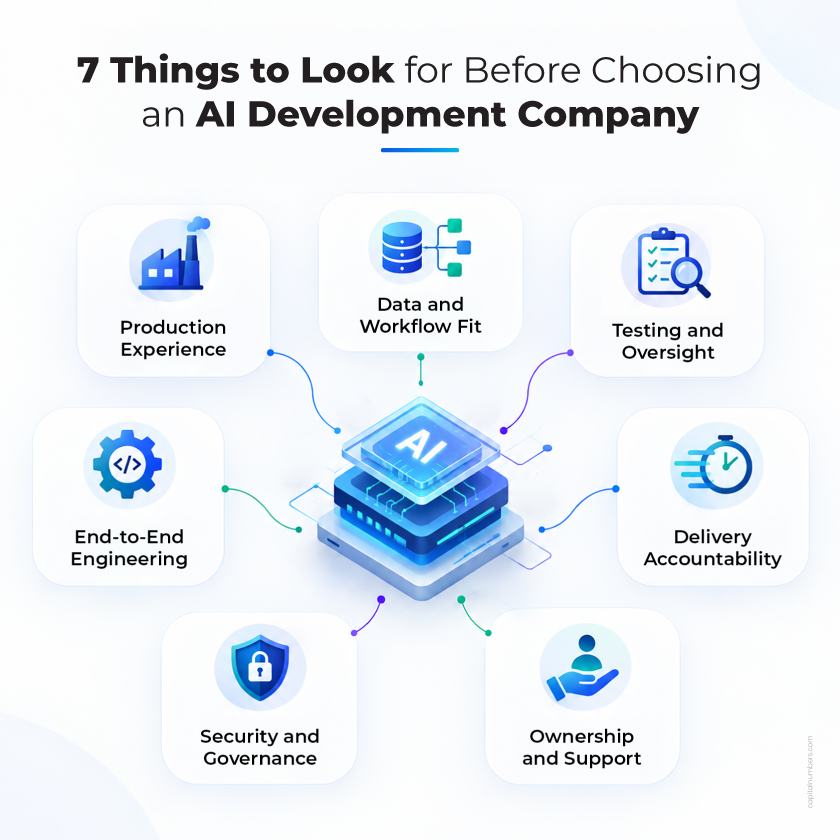
1. Relevant Production Experience, Not Just AI Expertise
A long list of models or frameworks proves technical familiarity, not operational reliability. Look for case studies that explain the business problem, system integrations, human oversight, and measurable outcomes.
For example, Capital Numbers developed an AI-assisted radiology reporting application for a US teleradiology platform. Built using Python and Orthanc, an open-source medical imaging server, the solution supports AI-generated draft reports that radiologists can review and edit.
If a company cannot share a public case study due to confidentiality restrictions, request a redacted architecture walkthrough or a client reference call.
2. Data and Workflow Understanding
An AI assistant might answer customer questions accurately but still struggle to retrieve live order information from your ERP. Your support team would then have to look up the details manually, defeating much of the purpose of automation.
A capable AI development partner examines your workflow before recommending a solution. Look at how they evaluate:
- Data Readiness: Is your data accurate, accessible, and properly governed?
- System Integration: Which CRM, ERP, or internal applications must the AI connect with?
- Human Oversight: Where do employees need to review, approve, or correct outputs?
- Error Handling: What happens when data is missing, or a connected system fails?
In McKinsey’s 2026 State of AI survey, nearly three-quarters of AI high performers (respondents reporting significant AI value and at least 5% of EBIT from AI) said they had fundamentally redesigned workflows around AI. Only about one-quarter of other respondents said the same.
Before choosing a partner, have them walk you through a real business scenario. You should understand how information moves between systems, where employees step in, and how the proposed solution will improve the process.
3. AI Evaluation, Testing, and Human Oversight
Can the proposed AI system handle real-world complexity?
A polished demo on clean data tells you little about production readiness. Real-world workflows involve incomplete information, unexpected formats, and system failures. A meaningful pilot should test these conditions against agreed targets for accuracy, response time, operating costs, and human intervention.
- RAG systems: Evaluate answer correctness, source grounding, and unsupported responses.
- Predictive and vision systems: Measure relevant metrics, such as precision, recall, and false-positive rates.
- AI agents: Test recovery from integration failures, permission boundaries, and safeguards against unauthorized actions.
Define where employees review, approve, correct, override, or investigate AI outputs. These controls are especially important when the system affects customers, financial decisions, sensitive data, or connected business systems.
Use your own representative data for testing, keeping it separate from the data used to tune the system. For RAG applications, evaluate retrieval quality and answer accuracy separately, and repeat relevant tests when the model changes.
4. End-to-End Engineering Beyond Prompt Engineering
Prompts and model selection are only a fraction of production AI. A capable partner brings the wider engineering capability needed to connect data pipelines, legacy systems, security controls, user workflows, and MLOps or LLMOps. MLOps and LLMOps help teams deploy, monitor, evaluate, and maintain AI systems.
They should justify each architectural choice: when to use a commercial API or an open-weight model, when RAG is more appropriate than fine-tuning, and when simpler rules-based logic is cheaper, more predictable, and easier to govern.
Check that the team can manage data permissions, monitor live performance and retrieval quality, control API spending, and safely roll back releases when a change causes problems. Production readiness depends on the engineering systems around the model, including integration, monitoring, evaluation, security, and release controls.
5. Role-Level Delivery Accountability
Team structure should scale with delivery risk. A proof of concept may need a solution architect, AI/ML engineer, and delivery lead. A production system also needs clear ownership for QA, security, DevOps, LLMOps or MLOps, monitoring, and support.
Before signing, ask who will build the system, how their time is allocated, and which roles are shared across accounts. Confirm who owns architecture decisions, data access, AI-output testing, release approvals, and post-launch incident response. A role does not always need to be full-time, but no critical responsibility should be unassigned. This reveals whether the provider has planned for operational accountability, not only development capacity.
6. Security, Privacy, and AI Governance
Who can access your data, and what actions can the AI perform?
Your AI partner must protect sensitive business information, intellectual property, and connected systems. Evaluate four areas:
- Data Privacy: Verify where data is processed, how long it is retained, and whether model providers use it for training. Consider zero-data-retention options where appropriate.
- Agent Permissions: Apply least-privilege access, giving AI agents only the permissions they need. Require human approval for high-impact or irreversible actions.
- Threat Protection: Test for risks identified in the OWASP Top 10 for LLM Applications, including prompt injection, sensitive information disclosure, excessive agency, and unbounded consumption.
- Security and Compliance: Review relevant ISO 27001 certifications and SOC 2 Type II reports. Where applicable, confirm HIPAA Business Associate Agreements (BAAs), GDPR data processing agreements (DPAs), and appropriate data protection safeguards.
Don't settle for a list of certifications. Ask how these controls will protect your specific application.
7. Ownership, Support, and Operational Independence
AI systems need ongoing support as data sources evolve, model behavior changes, and integrations fail. A reliable partner should monitor output quality, latency, errors, and operating costs, with clear responsibilities for incident response and updates. Ask:
Could your internal team or another provider maintain the system after handover?
Confirm that you will receive deployment access and a structured handover process. Your agreement should define ownership and access rights subject to third-party license terms for:
- Custom code
- Prompts
- Retrieval pipelines
- Evaluation assets
- Documentation
- Environments
- Fine-tuned model assets
How Much Does It Cost to Hire an AI Development Company?
The cost of hiring an AI development company depends on data readiness, integration complexity, security requirements, and the scope of evaluation and support. Costs rise with fragmented data, more systems to integrate, stricter compliance, higher usage, and wider testing.
Compare proposals on first-year total cost of ownership, not the initial development quote alone, and separate one-time costs from recurring expenses such as infrastructure, model usage, monitoring, and maintenance.
|
Cost item |
Type |
What buyers should check |
|
Discovery and development |
One-time |
Scope, deliverables, acceptance criteria |
|
Integrations and infrastructure |
One-time / recurring |
Integration fees, hosting costs, cloud ownership |
|
Model and API usage |
Variable |
Usage-based charges, limits, alerts |
|
Monitoring and support |
Recurring |
Maintenance, evaluation, response times |
|
Internal involvement |
Ongoing |
Staff time for reviews, training, and approvals |
|
Changes and transition |
Variable |
Change requests and handover costs |
Ask every vendor to quote against these same rows, so proposals can be compared like for like.
Operating costs can rise as usage grows, particularly with higher API consumption, document volumes, or user activity. Look for a partner who plans for token efficiency, caching where appropriate, usage monitoring, and budget controls.
The technical approach should also leave room for change. Ask whether you can switch models or providers as pricing and requirements evolve, and what that would cost.
Choose an engagement model that fits the level of uncertainty. A fixed-cost model suits a well-defined discovery phase or tightly scoped integration. Staff augmentation suits businesses that have internal delivery leadership but need specialist capacity. A dedicated Agile Pod, a cross-functional team of AI, data, engineering, QA, and delivery specialists, suits projects with evolving requirements.
Compare fixed-cost, staff augmentation, and Agile Pods before signing, and confirm what is included, what counts as a change request, and what can increase recurring costs.
How Can You Evaluate an AI Software Development Company?
Give each shortlisted provider the same business scenario and ask how they would approach it. Compare how they handle your data, system integrations, missing information, and human review rather than relying on a polished demo.
Before making a decision, verify:
- Production Evidence: Request a relevant case study, client reference, or redacted technical walkthrough that demonstrates comparable experience.
- Delivery Accountability: Meet the proposed technical lead and confirm who handles architecture, security, release approvals, and support. Clarify data-processing locations and subcontracting arrangements.
- Validation Plan: Ask for a phased approach with clear decision points, starting with a paid discovery phase and a paid pilot rather than a large upfront commitment. Discovery should confirm feasibility and business value. The pilot should meet agreed acceptance criteria for quality, cost, and performance. Production should include monitoring, rollback, and a named owner. Review actual results before scaling.
- Commercials and Handover: Compare expected timelines, client involvement, one-time and recurring costs, change-request terms, and ownership of code, documentation, and deployment access.
What Are the Red Flags When Choosing an AI Solutions Provider?
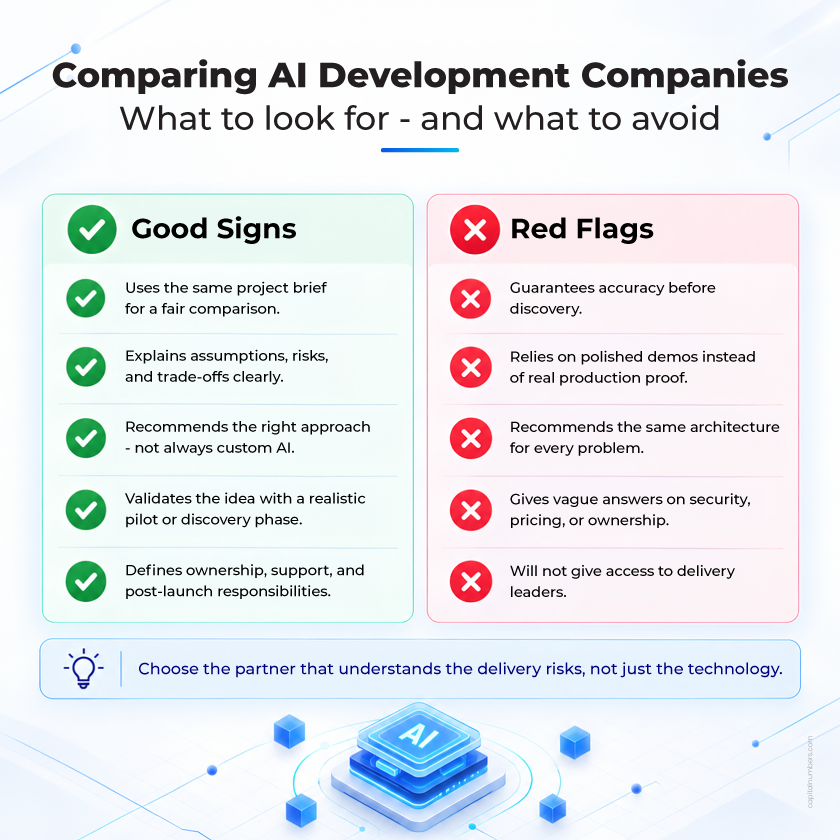
Be cautious when a provider:
- Guarantees accuracy before discovery. Meaningful performance targets require representative data, evaluation criteria, and knowledge of the workflow.
- Shows only demos. A prototype can prove technical feasibility without proving reliability, integration quality, security, or support readiness.
- Recommends the same architecture for every problem. A custom model, RAG system, or agent is not automatically the best answer.
- Is vague about security, pricing, or ownership. Unclear data retention, usage costs, licensing, or IP terms can create difficult surprises later.
- Will not give access to delivery leaders. If you cannot meet the people who will build and support the system, accountability is harder to establish.
No vendor can remove every risk. A credible one identifies uncertainty early, explains the trade-offs, and shows how the team will manage the risks that remain.
Choose a Partner That Can Deliver Beyond the Demo
The right AI development partner helps you make the right decision before it starts building. It challenges a weak use case, recommends SaaS or integration when custom development is unnecessary, and designs for the operational realities that come after launch.
Choose a partner that understands the workflow, tests against real conditions, makes security and ownership explicit, and leaves your team in control. At Capital Numbers, we combine AI systems and automation with product engineering, cloud, data, and DevOps to help businesses build integrated, maintainable AI solutions. Discuss Your AI Project
Frequently Asked Questions
What should I look for in an AI development company?
Look for production evidence, workflow and integration understanding, a clear evaluation approach, practical security controls, and post-launch support. Ask the company to explain one comparable delivery and how it would handle your data, exceptions, quality targets, costs, and handover.
How do I verify an AI vendor's claims?
Ask for relevant production case studies, client references, or a redacted technical walkthrough. Check whether the company can explain its role, integrations, testing methods, and measurable outcomes. Meet the proposed technical lead and request evidence of security practices, delivery processes, and post-launch support.
Should I build AI in-house or outsource it?
Build in-house when the capability is central to your product, and you can sustain a specialist team. Outsource when you need targeted expertise or faster validation. A hybrid approach lets a partner deliver while your internal owner retains knowledge, access, and decision-making authority.
How long does it take to develop and deploy an AI solution?
AI development timelines depend on project complexity, data readiness, integrations, and testing requirements. A simple proof of concept may take a few weeks, while a production-ready AI solution can take several months. Ask your AI development partner for a phased timeline covering discovery, development, testing, deployment, and post-launch support.

Preeti BiswasSoftware Engineer
An AI/ML Engineer with 3 years of experience, Preeti specializes in NLP, Computer Vision, and Generative AI. With extensive expertise in Large Language Models (LLMs), she builds intelligent, real-world applications. She is also experienced in designing and deploying scalable machine learning solutions across cloud platforms like AWS, GCP, and Azure.