
What “AI-Native Delivery” Actually Means When You’re Evaluating Software Engineering Partners

Project Manager
28th September, 2026

When a software engineering partner describes its delivery model as “AI-native,” the important question is not how many AI tools it uses.
It is what changes for your project.
Will accepted features reach production sooner? Will engineering quality hold as output increases? Will your team inherit maintainable software rather than a larger review burden? And when an AI-assisted change causes a problem, who is accountable for finding and fixing it?
These questions matter because faster code generation does not automatically mean faster software delivery. A team can produce code quickly and still lose time in requirements clarification, review, integration, testing, security checks, or release.
For CTOs, CIOs, product leaders, and engineering executives evaluating a custom software development partner, AI-native delivery should therefore be evaluated as an engineering operating model, not a toolset.
The real test is whether AI improves how dependable software moves from business requirement to supported production system - without weakening accountability, security, or control.
Quick Summary
- AI-native delivery is an operating model, not simply AI-assisted coding.
- AI should improve connected stages of the software lifecycle, not isolated tasks alone.
- Experienced professionals must remain accountable for architecture, security, business correctness, quality, and release decisions.
- Measure accepted delivery, reliability, rework, review effort, and total cost - not AI activity.
- Test the model on representative project work before expanding its use.
What Does AI-Native Software Delivery Actually Mean?
A practical definition is:
AI-native software delivery is an engineering operating model that integrates approved AI capabilities into connected software delivery workflows while maintaining project context, enforceable quality controls, human accountability, and measurable outcomes.
That is different from simply giving developers access to coding assistants.
In AI-assisted development, AI may help an engineer draft code, prepare test cases, summarize requirements, investigate failures, or create documentation. Those activities can save time. But if requirements remain unclear, design decisions are poorly documented, reviews become overloaded, or deployments remain unreliable, the overall delivery system may not improve.
This distinction matters because AI-native delivery should change more than individual productivity.
It should improve how work moves across the software development lifecycle.
It also does not mean using AI everywhere. A mature engineering team should know where AI adds value, where conventional automation is more predictable, where experienced judgment is essential, and where AI would create more verification effort than benefit.
Traditional vs. AI-Assisted vs. AI-Native Delivery
These terms are often used interchangeably, but they represent different levels of change.
|
Delivery Model |
How AI Is Used |
Workflow Impact |
Human Role |
|---|---|---|---|
|
Traditional Delivery |
AI may not be materially involved |
Established engineering and automation practices |
Engineers perform and own the work |
|
AI-Assisted Delivery |
AI supports individual activities such as coding, testing, research, or documentation |
Core workflow remains largely unchanged |
Engineers review and integrate AI output |
|
AI-Native Delivery |
AI supports connected stages across the lifecycle |
Context, handoffs, verification, and governance adapt around AI-supported work |
Engineers direct, verify, and remain accountable |
A long list of AI products in a proposal does not demonstrate AI-native maturity.
Buyers should instead ask: What actually changes in the way our software will be delivered?
Four Signals of a Mature AI-Native Delivery Model
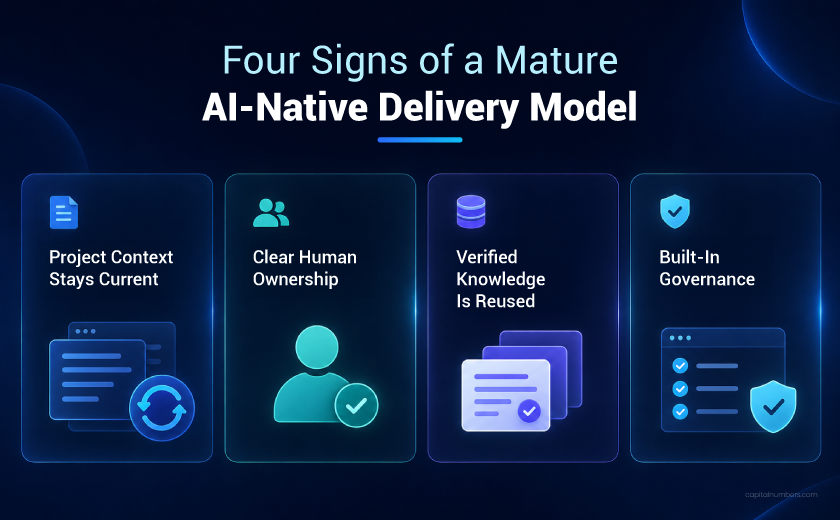
A useful way to evaluate the answer is to look for four characteristics.
1. Project Context Stays Current
AI can only work with the context available to it.
Business rules, architectural decisions, acceptance criteria, integration requirements, security constraints, and development conventions need to remain accurate and accessible to the people and approved systems involved in delivery.
If that context becomes outdated, AI can accelerate the wrong work just as effectively as the right work.
Buyers should therefore ask who maintains project knowledge and how a change in one area flows into implementation, testing, documentation, and support.
2. Human Ownership Is Explicit
AI can assist with analysis, implementation, testing, documentation, troubleshooting, and review.
Responsibility still needs to sit with people.
Experienced professionals should remain accountable for areas such as:
- architecture and technical trade-offs
- security decisions
- business correctness
- code and test review
- integration behavior
- production readiness
- release acceptance
“Human in the loop” means more than adding an approval checkbox after a large body of generated work.
Reviewers need sufficient expertise, context, capacity, and authority to challenge or reject AI output.
3. Verified Knowledge Is Reused
An AI-native model should improve as the delivery team learns.
Validated tests, approved implementation patterns, architecture decisions, incident findings, coding conventions, and operating instructions can reduce repeated effort.
But reuse only helps when the underlying knowledge is trustworthy.
If an incorrect assumption becomes part of the reusable context, AI can propagate that mistake across multiple tasks.
Good AI-native delivery therefore requires both reuse and verification.
4. Governance Is Part of the Workflow
Governance should not be an approval exercise added after development.
Access controls, testing requirements, security checks, code review, exception handling, and release permissions should be embedded into normal engineering workflows.
Buyers need to understand:
- what information AI tools may access
- what actions they may perform
- which environments they can reach
- what they can change without approval
- where a named person must make the decision
The more autonomy AI receives, the more important these boundaries become.
Evaluate the Full Journey: Intent, Build, and Operate
Intent: Is the Team Solving the Right Problem?
Another useful way to evaluate AI-native delivery is through three connected areas: Intent, Build, and Operate.
Before AI generates anything, the team needs a reliable understanding of the problem.
That includes users, workflows, business rules, integrations, constraints, failure scenarios, risks, and acceptance criteria.
AI can help organize information, identify inconsistencies, explore alternatives, and prepare requirements.
People still need to clarify ambiguity and approve consequential decisions.
The buyer should be able to ask:
How do you demonstrate that what you are building matches our actual requirements?
Build: Is Faster Output Independently Verified?
During implementation, AI may assist with scaffolding, refactoring, debugging, technical research, documentation, and test preparation.
But generated software still needs testing and verification independent of the assumptions that produced it.
Consider a billing feature.
An AI system implements an incorrect rounding rule and then generates tests from the same assumption.
Every generated test passes.
The software is still wrong.
Expected behavior must therefore come from an independent source of truth - approved requirements, examples, domain rules, architectural constraints, or security requirements.
The objective is not simply to verify that the software does what the code says.
It is to verify that the code does what the business requires.
Operate: Does Production Learning Flow Back Into Engineering?
AI-native delivery should not end when code reaches production.
Monitoring, support tickets, incidents, user behavior, failed deployments, performance issues, and production exceptions can reveal gaps in requirements and testing.
Those lessons should flow back into engineering context and future delivery.
Software ultimately proves its value in production.
An AI-native operating model should become better informed by what happens there.
Why Faster Coding Does Not Automatically Mean Faster Delivery
This is one of the most important distinctions for buyers.
Software delivery time includes more than implementation.
It also includes waiting, clarification, review, integration, testing, security checks, approvals, deployment, and rework.
Accelerating one step can simply move the bottleneck somewhere else.
For example:
- Faster coding + slow code review = a review backlog
- Faster implementation + weak testing = more rework
- Faster development + unreliable CI/CD = release delays
- Faster execution + unclear requirements = faster delivery of the wrong thing
DORA's research on AI-assisted engineering has highlighted this tension: productivity gains in one activity can be accompanied by additional verification and review work.
That is why lines of code, prompt volume, AI adoption rates, or percentages of generated code are weak measures of success.
The stronger question is:
How quickly does accepted, reliable change move from requirement to production?
Governance, Security, and IP Protection Need to Be Specific
AI coding governance should explain what AI systems can access, what actions they can take, and who approves consequential changes.
Existing secure software development practices still apply. NIST's Secure Software Development Framework (SSDF) provides a useful reference for integrating security practices across the software lifecycle. AI introduces additional access and execution considerations rather than replacing established controls.
Before delivery begins, buyers should understand four areas.
Data Controls
Which AI providers and tools are approved?
- Can source code, project documentation, customer data, or prompts be retained?
- Can any of that information be used for model training?
- How are secrets and sensitive information excluded?
Execution Controls
What repositories, APIs, systems, or environments can AI agents reach?
- Are credentials scoped using least privilege?
- Can an AI agent commit or deploy changes directly, or is human approval required?
Verification Controls
Which tests, security checks, dependency scans, code reviews, and approval gates are mandatory?
- What happens when a check fails?
- Who can approve an exception?
IP and Continuity Controls
Who owns generated deliverables and reusable components?
- How are third-party licensing risks handled?
- Will repositories, architecture records, tests, build instructions, workflow configuration, and operating documentation remain portable if the engagement or AI tooling changes?
A company-level security credential is useful evidence, but project-level implementation still matters.
Buyers should verify how controls apply to the actual people, systems, and workflows involved in their engagement.
Measure Outcomes, Not AI Activity
AI adoption by itself does not establish business value.
Start with a baseline and compare representative work.
Useful measures can include:
- requirement-to-acceptance time
- review and waiting time
- escaped defects
- failed deployments
- recovery time
- unplanned rework
- release frequency
- reviewer effort
- total cost per comparable accepted outcome.
Then connect engineering performance to an outcome the business cares about.
That may be earlier market entry, faster customer onboarding, improved operational efficiency, more frequent releases, or reduced support effort.
Cost also needs to be measured carefully.
Total delivery economics can include engineering time, AI subscriptions, model consumption, infrastructure, CI execution, review effort, remediation, maintenance, and support.
AI may lower effort in one activity without lowering total project cost.
The benefit may instead appear as additional scope, stronger testing, faster acceptance, or shorter time to market.
Agree on the expected benefit before trying to prove it.
Prove the Model Before Scaling It
A polished AI demonstration tells you little about real software delivery.
A better evaluation uses representative work under real constraints.
Choose a feature, integration, modernization task, or maintenance change that includes enough of the actual delivery lifecycle to be meaningful.
Then:
- Baseline: Define the existing delivery problem and relevant measurements.
- Authorize: Agree on approved tools, data access, human owners, permissions, and prohibited actions.
- Observe: Inspect traceability, review effort, failures, quality, delivery time, and total cost.
- Decide: Expand the model only when delivery improvements coexist with acceptable quality and control.
The evaluation should include a clear owner and a decision date.
Where test coverage, documentation, or access controls are weak, starting with limited AI assistance may be more responsible than immediately introducing greater autonomy.
AI should earn broader responsibility through evidence.
Questions to Ask an AI-Native Engineering Partner
Ask for completed examples and inspectable evidence rather than broad claims.
Useful questions include:
1. What changes in your delivery workflow when AI is introduced?
2. What does AI handle, and what remains explicitly human-owned?
3. How do you keep project context accurate as requirements and architecture change?
4. What repositories, systems, or environments can AI agents access?
5. Which consequential actions require human approval?
6. How is generated work validated independently of generated tests?
7. Can we inspect required checks, reviewer decisions, failed runs, and release evidence?
8. How do you evaluate changes to AI models or tools before using them on project work?
9. How will delivery improvements, costs, and client dependencies be reported?
10. What project knowledge and workflow assets remain available if we change partners or tools?
Specific answers should identify an owner, a control, and evidence.
Red Flags That “AI-Native” Is Mostly Marketing
Treat the claim cautiously when:
- tool licenses are presented as the main evidence of maturity
- productivity claims have no meaningful baseline
- the discussion focuses almost entirely on coding speed
- senior engineering oversight is reduced because “AI handles it”
- AI-generated tests are treated as sufficient proof of correctness
- AI tools receive broader access than the task requires
- quality measures disappear from productivity discussions
- critical project knowledge remains locked inside proprietary vendor systems.
AI-native delivery should make engineering more disciplined, not less accountable.
Evaluate the Delivery Evidence
AI-native software delivery is valuable when it produces outcomes that buyers can inspect and measure.
The goal is not to maximize AI usage.
It is to improve the path from business requirement to reliable production software while maintaining clear responsibility for architecture, quality, security, and operational decisions.
As an AI-native digital engineering partner, Capital Numbers uses AI across selected stages of planning, engineering, testing, review, documentation, and delivery, while experienced professionals remain accountable for the resulting software.
For buyers, the most useful starting point is therefore not an AI demo.
Bring a representative requirement. Identify the bottleneck you want to improve. Define the controls that matter. Agree on how the result will be measured.
Then evaluate the evidence.
Discuss Your Software Engineering Requirements
Frequently Asked Questions
Can AI-Native Delivery Work With Legacy Software?
Yes. The team first needs trustworthy context around the existing system. Reproducible builds, dependency understanding, tests around critical behavior, and knowledge of undocumented integrations become particularly important. Start with bounded work before changing tightly coupled or poorly understood components.
Does the Product Itself Need AI Features?
No. AI-native delivery describes how software is engineered and delivered, not whether the finished product contains AI. A conventional business application can be built using AI-supported delivery workflows, while an AI-powered product can still be built through a largely traditional development process.
Should AI-Native Delivery Cost Less?
Possibly, but lower coding effort does not automatically mean a lower total project cost. AI may reduce effort in some activities while increasing investment in tools, verification, infrastructure, or senior oversight. Evaluate total delivery economics and agree whether the expected benefit is lower cost, faster delivery, additional scope, or less rework.
Can AI-Native Delivery Work for Security-Sensitive Software?
Yes, when access boundaries and approval requirements are clearly defined. Buyers should establish which data and systems AI can access, what actions it can perform, which security checks remain mandatory, and where human authorization is required.
What Happens if We Change Partners or AI Tools?
Project knowledge should remain portable. Repositories, tests, architecture records, build instructions, approved workflow configuration, and operating documentation should remain accessible. Avoid making essential delivery knowledge dependent on one vendor's private AI environment or an individual's prompt history.

Soutrick SurProject Manager
Project Manager at Capital Numbers, specializing in driving project success through different methodologies. As a LinkedIn-PMI-certified Scrum Master & Atlassian-certified Project Manager, I leverage Jira, Confluence, and Advanced Roadmaps to transform complex project goals into streamlined realities. By merging advanced roadmaps with AI prompt engineering and insights, I deliver streamlined, impactful digital solutions for global clients.