
How to Choose a Software Development Company: 8 Steps

Project Manager
9th November, 2026
|
Quick Summary The right software development partner combines relevant engineering capability with clear responsibility for delivery.
|
Three proposals arrive. Each promises experienced developers, agile delivery, and excellent communication. One offers the lowest price. Another proposes more people. The third promises faster delivery with AI.
Which company should you trust?
To choose a software development company, follow eight steps: verify relevant delivery experience, meet the proposed team, review engineering and security practices, compare total costs, agree on acceptance criteria, confirm ownership, plan for support, and set how changes will be handled.
For mid-sized businesses and enterprise teams, the decision reaches beyond launch. Your software may connect customer orders, financial records, and daily operations. A polished demo tells you little about what happens when an integration fails or priorities change.
Choose a software development company by verifying relevant delivery experience, meeting the proposed team, reviewing engineering and security practices, and comparing total costs. Before signing, agree on acceptance criteria, ownership, support, and how changes will be handled.
Key Steps to Choose a Software Development Company
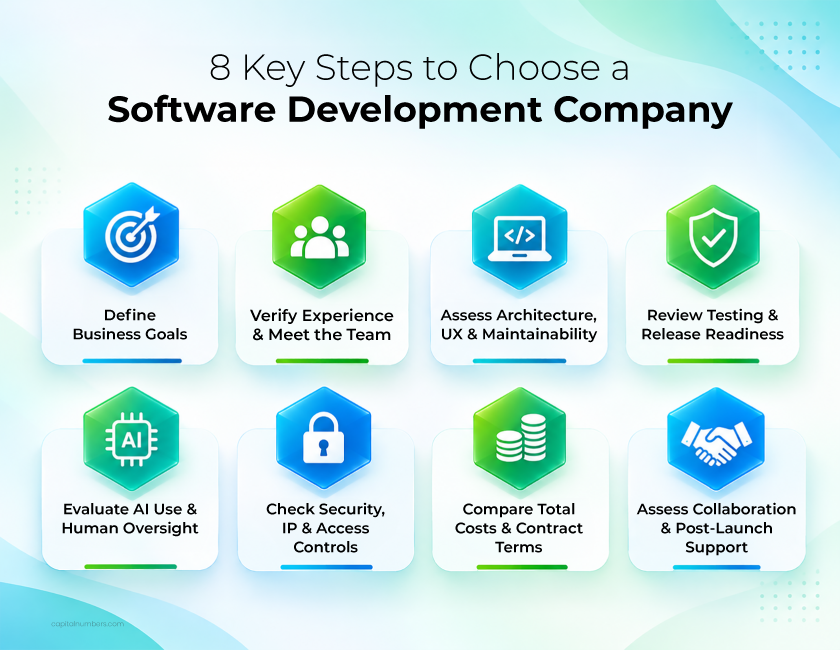
Start with your must-haves, then use these software development company selection criteria to compare shortlisted companies against the same requirements.
1. Define the Business Outcome Before Shortlisting Software Development Companies
Define the business outcome before contacting software development companies. Prepare a short brief explaining what should improve, how you will measure success, which workflows must ship first, and who will approve the work.
For example, “Build a customer portal” describes what you want to develop, while “Help customers manage orders without contacting support” explains the business outcome you want to achieve.
Include the following details:
- Outcome: What should improve, and how will you measure it?
- First release: Which workflows and features are essential?
- Dependencies: Which systems, data sources, and integrations are involved?
- Constraints: What budget, deadlines, security needs, and internal availability apply?
- Decision ownership: Who sets priorities and accepts completed work?
When evaluating a software development company, clarify whether you need a new product, modernization, or additional engineering capacity. Each requires different experience and responsibilities.
Ask whether existing software can meet the need before commissioning custom development. A credible partner should explain when configuration or integration would be sufficient.
Give every shortlisted company the same brief. Ask each to identify assumptions and unresolved questions before estimating.
2. Verify Relevant Experience and Meet the Delivery Team
Verify a software development company's experience through comparable projects, not just client logos. Meet the technical lead and delivery manager assigned to your project, and ask what their team delivered, which challenges arose, and what happened after launch.
Comparable complexity can matter as much as industry experience. Look for evidence involving legacy code, sensitive data, demanding integrations, or multiple user roles.
When you meet the delivery team, confirm:
- Who covers development, UX, QA, DevOps, and security
- Whether team members are employees or subcontractors
- Their availability and replacement arrangements
- How project knowledge will be documented and transferred
Request a relevant reference where permitted. Ask about difficult weeks, scope changes, and support, not only whether the client liked the team.
An example of comparable complexity:
For an Australian client, we modernized a stock market analysis application by resolving data synchronization issues, improving integrations, and fixing incomplete report downloads. The rebuilt platform fills missing market data in the background, exports complete multi-page PDF reports, and supports live stock details and side-by-side comparisons.
3. Examine Architecture, UX, and Maintainability
Evaluate a software development partner's architecture, UX, and maintainability practices using a real project challenge. Ask the team to explain its approach, technical trade-offs, and long-term maintenance considerations in language your stakeholders understand.
For an order-management migration, useful questions include: How will orders continue flowing during the transition? How will missing or duplicated records be detected? What happens if an external service is unavailable?
Explore three areas:
- Discovery and UX: How do user research, prototypes, accessibility, and usability testing shape development?
- Architecture and integrations: Why does the proposed technology fit your workload, operating budget, and internal skills?
- Maintainability: How are code reviews, dependencies, technical debt, and architectural decisions managed?
Request a sample architecture explanation or anonymized decision record. Look for clear trade-offs and alternatives, including simpler options.
Ask whether another team could maintain the application later. The answer should cover documentation, deployment instructions, and practical access to the system.
4. Check Testing, Milestones, and Release Readiness
Check release readiness by asking how the company tests critical workflows, integrations, and business requirements. Verify who approves releases, which risks could delay launch, and whether monitoring, rollback, and recovery plans are in place.
Discuss performance, security, accessibility, and user acceptance testing according to your requirements.
Request a sample release checklist showing which requirements were tested, what passed, and which defects remain open. It should also identify who approves the release. Clarify who supplies test data and confirms that the software meets your business requirements.
Ask: “What would make you recommend delaying a release?” A credible answer names specific risks and who makes the call.
Review the proposed timeline by milestone. Discovery, integrations, migration, user acceptance, and launch should have explicit dependencies. Ask what could change the estimate and how delays in your approvals or third-party access would affect it.
5. Evaluate AI Use and Human Accountability
Evaluate a software development company's use of AI by asking which tasks it supports, how generated outputs are reviewed, and who remains accountable. Human oversight should cover requirements, architecture, code review, testing, and release approval.
Veracode's 2025 GenAI Code Security Report found that AI models introduced detectable security vulnerabilities associated with OWASP Top 10 categories in 45% of test cases. Researchers evaluated more than 100 models on 80 coding tasks in four programming languages. These controlled results do not represent every AI-assisted project, but they reinforce the need for human review and security testing.
Use this framework to examine responsibility:
|
Delivery stage |
Potential AI contribution |
Human responsibility to verify |
|
Discovery |
Draft requirements and identify gaps |
Validate needs, priorities, and acceptance criteria |
|
Architecture |
Explore options and prepare documentation |
Approve design decisions and trade-offs |
|
Development |
Suggest code and refactoring |
Review correctness, dependencies, and maintainability |
|
Testing |
Generate test cases and assist analysis |
Check coverage against real requirements |
|
Release |
Draft release notes and assist incident analysis |
Authorize changes and manage recovery |
Confirm approved tools, data restrictions, agent permissions, and production-access controls. Apply agreed acceptance standards to both human-written and AI-generated work.
Where confidentiality permits, request a redacted walkthrough showing a change, its review, the tests run, and release approval. Assess AI’s contribution against comparable work, accounting for scope, complexity, and quality requirements. Track delivery time, accepted features, defects, and rework—not just code volume.
6. Review Security, Intellectual Property, and Access
Assess a software development company's security by examining its access controls, vulnerability management, subcontractor oversight, and assurance reports, such as SOC 2 Type II. Agree in writing who owns the source code, repositories, cloud accounts, and deployment assets.
Verizon's 2026 Data Breach Investigations Report found that third parties were involved in 48% of breaches analyzed. While this figure covers more than software development vendors, it highlights the importance of assessing third-party security risks.
Ask how the company manages:
- Credentials, least-privilege access, and access removal
- Vulnerability remediation and incident notification
- Subcontractors, data-processing locations, and approved tools
- Security requirements relevant to your data and operating environment
Ask for relevant certifications or assurance reports, such as a SOC 2 Type II report, which assesses how effectively security and other applicable controls operated over a specified period. Check the report’s scope, review period, and any exceptions, and ask how the controls apply to your project.
Confirm your access to repositories, cloud accounts, documentation, and deployment pipelines during development and at handover.
Differentiate custom deliverables from pre-existing components and third-party licenses. Have legal counsel review IP transfer, confidentiality, liability, indemnity, and termination terms. Agree on handover responsibilities, access rights, and any additional costs.
7. Compare Complete Costs and Choose Suitable Terms
Compare software development proposals by the total cost of equivalent scope over the same period, not just the quoted price. Include discovery, migration, testing, infrastructure, licenses, ongoing support, and your internal team's time, because excluded expenses can make a lower quote more expensive.
Which proposal actually costs less?
Consider this illustrative delivery-cost comparison. It shows how excluded services can affect the final price, but does not include ongoing hosting, licensing, or support costs. Include those expenses when comparing total ownership costs.
|
Cost component |
Proposal A |
Proposal B |
|
Quoted price |
$60,000 |
$75,000 |
|
Migration |
+ $12,000 |
Included |
|
Security testing |
+ $8,000 |
Included |
|
Total for compared delivery scope |
$80,000 |
$75,000 |
Proposal A has a quoted price $15,000 lower, but its total for the compared delivery items is $5,000 higher. Compare what each proposal includes before deciding which offers better value.
Choose fixed price for a clearly defined scope, staff augmentation to add specialists to an existing team, and an Agile Pod (a dedicated cross-functional team) when requirements will evolve and you want managed engineering delivery.
Software Development Engagement Models Comparison
|
Model |
Best for |
Who manages delivery |
Cost and scope changes |
Main risk |
|
Fixed Price |
Defined scope, deliverables, and acceptance criteria |
Vendor |
Predictable within agreed scope; changes follow approval and pricing procedures |
Hidden exclusions or assumptions |
|
Staff Augmentation |
Adding specialists to an existing engineering team |
Client |
Typically billed against agreed team capacity or effort; changes depend on contract terms |
Internal management overhead and continuity |
|
Agile Pod |
Evolving product requirements requiring cross-functional delivery |
Vendor manages engineering; client owns priorities |
Typically monthly team-based costs; priorities can evolve within agreed capacity |
Scope drift without clear priorities |
What should you ask before choosing an engagement model?
- Fixed Price: What is excluded, which assumptions affect the estimate, and how are change requests priced and approved?
- Staff Augmentation: What are the onboarding fees, management costs, minimum commitments, notice periods, and replacement arrangements?
- Agile Pod: Who is assigned to the team, how is progress demonstrated, and what are the minimum commitment and exit terms?
Whichever model you choose, confirm delivery responsibilities, commercial terms, and exit arrangements in writing. When comparing offshore software development costs, also account for your team's coordination and review time.
8. Test Collaboration and Plan Beyond Launch
Test collaboration by asking how the company handles changing priorities, budget pressure, delays, and disagreements. Before committing, clarify decision ownership, communication expectations, working-hour overlap, and escalation procedures.
Try this scenario: “If we lost 20% of the budget, what would you recommend changing?”
A thoughtful team should discuss priorities and protect essential workflows. This reveals more about collaboration than promises of excellent communication.
Before launch, agree on support hours, issue priorities, and maintenance responsibilities. Clarify how quickly the team will acknowledge a problem, restore service, and resolve the issue. Also check which fixes are covered by warranty and which work costs extra.
If major uncertainty remains, consider paid discovery or a focused pilot. Agree on outputs, success criteria, access requirements, and a decision point before further investment. Useful outputs might include a tested integration, prioritized backlog, architecture recommendation, and revised estimate.
How to Compare Software Development Vendors with a Scorecard
Compare software development vendors using a weighted scorecard. First, confirm that each company meets your mandatory security and ownership requirements. Then evaluate the remaining vendors across six evidence-based areas, using weights set before scoring and calculating a final score out of 100.
|
Evaluation area |
Weight |
Evidence to request |
|
Business understanding and relevant experience |
20% |
Response to your brief, comparable work, references |
|
Team and engineering quality |
25% |
Team interviews, architecture reasoning, review and testing practices |
|
Delivery and collaboration |
15% |
Milestones, reporting, escalation, change control |
|
Security, AI governance, and ownership |
20% |
Access controls, review records, written terms |
|
Commercial clarity |
10% |
Aligned scope, exclusions, recurring costs |
|
Support and continuity |
10% |
Maintenance, replacement arrangements, handover |
Rate each category from 1 to 5: 1 = weak or unsupported, 3 = adequate evidence, and 5 = strong evidence relevant to your project. Mark unanswered items as pending and resolve mandatory requirements before making your final choice.
Divide each rating by 5, then multiply by the category weight. For example, a rating of 4 in a category weighted at 20% earns 4 ÷ 5 × 20 = 16 points. Add the category scores for a total out of 100.
Use the scores to compare vendors, then investigate important differences between your finalists.
What Are the Red Flags When Hiring a Software Development Company?
The main red flags when hiring a software development company include fixed deadlines without assumptions, unsupported AI savings, an unidentified delivery team, ambiguous ownership, and a vague post-launch plan. If a vendor repeatedly gives vague answers to specific questions, reconsider whether it is the right partner.
- Fixed deadlines without assumptions: No discussion of integrations, data quality, or approvals.
- Unsupported AI savings: Promises that omit review effort and rework.
- An unidentified delivery team: Sales presentations without access to technical leadership.
- Ambiguous ownership: Unclear rights to code, accounts, or deployment assets.
- A vague post-launch plan: No named support responsibilities or exit arrangements.
Discuss Your Software Project with Capital Numbers
Capital Numbers is an AI-native digital engineering company with 600+ in-house professionals working across custom software, modernization, AI, cloud, and data. We offer Fixed Price, Staff Augmentation, and Agile Pods based on your project needs.
Our development practices include quality checks, security reviews, and human oversight of AI-assisted work, supported by SOC 2 Type II controls. We align responsibilities, release requirements, and support arrangements with each engagement.
Share your business goal, existing systems, priorities, and constraints. We can help you assess the technical approach and delivery model that fit your project. Book a consultation.
Frequently Asked Questions
Who owns the code when you outsource software development?
Code ownership depends on the intellectual property terms agreed upon in your contract. Generally, custom-developed code is transferred to the client under the agreed IP assignment terms, while pre-existing components, third-party libraries, and licensed tools may remain subject to separate ownership or usage rights. Before signing, clarify who owns the source code, repositories, documentation, and deployment assets, and ensure the agreement covers IP transfer and handover responsibilities.
How many software development companies should you shortlist?
Three to five is a practical starting point, rather than a fixed rule. Share the same brief with each company, then investigate the strongest candidates more deeply. Keep the shortlist manageable enough to meet delivery leads, review comparable work, and clarify commercial terms before choosing.
How much should custom software development cost?
Custom software development cost depends on scope, integrations, migration, quality requirements, team composition, and support. Request an estimate with clear assumptions and exclusions, then compare equivalent scope over the same ownership period. If you're considering offshore development, our cost breakdown by region and role can help you understand typical rates. Use discovery to reduce uncertainty before committing.
Should you choose an offshore software development company?
Offshore delivery can suit businesses seeking specialist skills or additional capacity. Evaluate the actual team, working-hour overlap, communication, security, and internal management effort. Agree on decision ownership and escalation arrangements. Location matters, but it should be assessed alongside the partner’s delivery capability and fit for your project.
What questions should you ask before hiring a software development company?
Ask who will deliver the work, what comparable projects they have completed, how quality is verified, and what the estimate excludes. Clarify how changes are approved, who owns the code and accounts, what support includes, and how the project would transfer to your internal team or another provider.

Srijeeb ChakrabortyProject Manager
An IT Project Manager at Capital Numbers Infotech Ltd., Srijeeb manages multiple simultaneous client engagements spanning web, mobile, AI/ML, Salesforce, and Power BI projects. He serves as the primary bridge between internal development teams and external clients, driving smooth delivery, clear communication, and strong client relationships across diverse technology initiatives.