
Does AI-Assisted Software Development Reduce Costs? An Honest Look

Project Manager
25th October, 2026
Quick SummaryAI-assisted software development can reduce costs, but not automatically. Savings depend on total engineering effort, tool and review costs, and how efficiency affects what you pay. More output at the same price or an earlier launch can improve value without lowering spending. Compare equivalent proposals over the same ownership period and test productivity claims on representative work before committing. |
You receive two proposals for the same software project. One team estimates 12 months. Another proposes nine months, using AI for development and testing. The faster proposal could cost less, the same, or more. How do you tell whether AI will reduce your spending or improve delivery value?
AI tools can reduce effort in custom software development, but the savings may stay with the provider instead of appearing on your invoice. Lower spending and better ROI are different outcomes. Launching earlier can create business value even when the project fee is higher.
This article covers the costs, evidence, and calculations you need to compare AI-assisted proposals without confusing lower development effort with lower total cost.
What Is AI-Assisted Software Development?
AI-assisted software development means engineers use coding assistants and other AI tools during design, coding, testing, and documentation. People remain accountable for architecture, security, quality, and release decisions. This differs from AI-powered software, where the finished product itself includes AI capabilities.
See our guide to AI-assisted development versus AI-powered software
AI-native delivery goes further. It connects AI-supported workflows across planning, development, testing, review, and delivery rather than treating AI as an isolated coding tool. Human accountability remains essential.
Read more about AI-native software delivery
When Does AI-Assisted Software Development Actually Reduce Costs?
Whether efficiency lowers your spending depends largely on your engagement model:
- Time-based billing: Fewer billable hours may lower invoices, subject to contractual minimums. Include review and rework in the recorded effort.
- Fixed-price projects: The benefit may appear as a lower quote, added scope, or an earlier delivery commitment, not necessarily a refund. Compare equivalent acceptance standards and delivery commitments.
- Dedicated teams: The monthly fee may stay unchanged while the team delivers more accepted work. That is productive capacity, not a cash saving unless it avoids a documented expense.
Costs may stay flat or rise if AI output needs heavy review, extra governance, or rework. Faster coding also will not speed up a release waiting on customer approvals or integrations.
Distinguish three financial outcomes:
- Direct cost reduction: You pay less for equivalent accepted work after accounting for additional tool, integration, review, and support costs.
- Avoided cost: Useful productivity gains remove a documented future expense, such as a planned hire or additional contractor work.
- Productive capacity: The same budget delivers more worthwhile work. This is business value, not automatically lower spending.
Count each benefit only once. For example, if developers use time saved through AI to build additional features, don't also count that time as a reduction in labor costs.
A Simple Cost-Saving Example
For illustration, suppose equivalent accepted work falls from 1,000 to 800 billable hours at $100 per hour, including review and rework. With $2,000 in additional AI and integration costs, spending falls from $100,000 to $82,000: a direct saving of $18,000.
This is a hypothetical calculation, not a Capital Numbers result or a forecast. It assumes no other ownership-cost differences; a pilot must establish whether the effort reduction is achievable.
What Does AI-Assisted Software Development Really Cost?
A project quote is only one part of total cost of ownership (TCO). Compare proposals over the same period, such as 24 months from project start. Include internal oversight, production operations, maintenance, and handover. An earlier launch may mean more months of hosting costs and more months of business benefit.
Use the same scope, quality expectations, support commitments, and ownership period for every quote. Then compare the provider fee, your internal management time, separately billed AI usage, integration and security work, ongoing operations, and handover. Without the same assumptions, a cheaper quote can hide a more expensive engagement.
Delivery responsibilities matter. With staff augmentation, your own technical leadership typically directs the developers, so include your managers' time and review capacity. A managed team proposal should instead say who owns architecture, QA, delivery coordination, releases, and support. If those roles are missing from the price, the comparison is incomplete.
On a large project, seat licenses can be a small part of total spending. For illustration, four developers on a $100-per-person monthly AI plan for nine months would cost $3,600. That is under 1% of the $390,000 hypothetical proposal below, not a benchmark for other projects. Actual plans and usage charges vary. Review effort, training, integration, and heavy usage can matter more than seat licenses.
Check the less visible costs:
- Verification: Senior engineering review, QA, security checks, and rework.
- Usage and integration: Consumption beyond plan limits, repository connections, and access controls.
- Onboarding: Team training and agreement on how AI-assisted work is reviewed.
- Handover and internal time: Documentation, accounts, maintenance readiness, and your own team's involvement.
Ask whether the provider absorbs these costs or passes them through, including what happens when usage exceeds expectations.
Does Higher Developer Productivity Mean Lower Costs?
A study covering field experiments at Microsoft, Accenture, and an anonymous Fortune 100 company found a pooled increase of about 26% in completed tasks when developers had an AI coding assistant. That result concerns task completion. It does not guarantee a lower project price or a smaller team.
Results depend on the tools, tasks, and developers involved. In a 2025 study of 16 experienced open-source developers working in repositories they knew well, METR found that using AI tools increased task completion time by 19%. Its February 2026 update suggests newer tools may improve outcomes, but selection and measurement problems prevent a reliable estimate of the gain. Measure results on your own work rather than applying either study's headline percentage to a project budget.
For a buying decision, measure accepted, integrated, tested work, not just code generated or tickets closed. Review and rework can absorb the apparent gain. Look for completed features that meet acceptance criteria and stay maintainable after handover. Do not set a deadline, fixed price, or headcount on a benchmark of isolated coding tasks.
A Higher-Priced AI-Assisted Proposal Can Still Offer Better Value
Consider two hypothetical provider proposals for equivalent scope and acceptance standards. This is a buying scenario, not a controlled comparison of AI productivity:
|
Buyer consideration |
Conventional team |
AI-assisted team |
|
Team size |
6 people |
4 people |
|
Delivery timeline |
12 months |
9 months |
|
Quoted delivery cost |
$360,000 |
$390,000 |
|
AI tools |
Included or not required |
Included in quote |
|
Quality requirements |
Same agreed criteria |
Same agreed criteria |
These figures are illustrative, not Capital Numbers prices or market benchmarks. The assumed reduction from 72 to 36 person-months is not evidence that AI halves project effort; seniority, role mix, specialist coverage, and provider pricing may also differ.
The conventional proposal represents 72 person-months (six people for 12 months), or $5,000 per person-month. The AI-assisted proposal represents 36 person-months (four people for nine months), or about $10,833 per person-month.
That higher blended rate could reflect a more senior team or shared specialists, not just the cost of AI tools. Do not judge value from headcount or blended rates alone; compare the roles, specialist coverage, deliverables, and acceptance standards included.
A four-person managed team might include two developers, a technical lead, and a QA engineer. The quote must also explain who covers delivery management, design, DevOps, and security, including any shared specialist charges.
What Is an Earlier Launch Worth?
The AI-assisted team costs $30,000 more but could deliver three months earlier. For this simplified launch-timing illustration, suppose the earlier launch produces $15,000 in additional net business benefit per month, after associated operating costs.
- Additional delivery spending: $390,000 − $360,000 = $30,000.
- Earlier business benefit: $15,000 × 3 = $45,000.
- Net benefit after the premium: $45,000 − $30,000 = $15,000.
- Minimum average monthly benefit to break even over three months: $30,000 ÷ 3 = $10,000.
- ROI on the extra $30,000: $15,000 ÷ $30,000 × 100 = 50%.
This is a return on the delivery premium, not on the entire project or a complete TCO calculation. Assume other ownership costs are equal. Any differences in oversight, maintenance, support, or handover must be included separately. Operating costs already deducted from the monthly benefit must not be counted again. Count additional contribution or realized savings, not gross revenue; assess benefits from payment timing separately.
Test delayed launch and adoption ramp-up as well as lower monthly benefit. If the earlier launch produces only $8,000 a month, the three-month benefit is $24,000, and the buyer is $6,000 behind after paying the premium.
The chart shows the base case month by month. At $15,000 per month, cumulative benefit equals the $30,000 premium at the end of month 2 and finishes month 3, $15,000 ahead. This is the base-case payback point; $10,000 is the minimum average monthly benefit needed to break even by month 3.
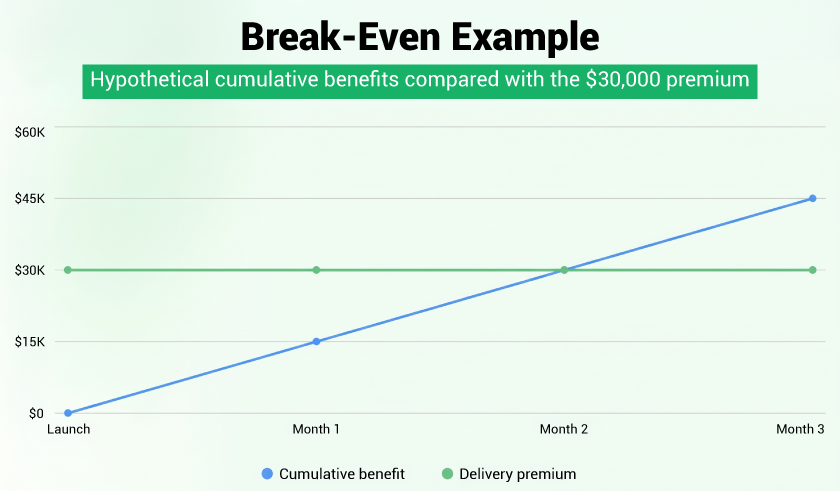
Figure 1. Hypothetical cumulative benefit versus the $30,000 delivery premium. Break-even occurs at the end of month 2.
The conclusion: The faster proposal can be the better commercial decision even though development spending is higher. Cost reduction and better ROI are different outcomes.
How Should Buyers Verify the Delivery Model?
Look beyond delivery labels to the actual workflow and accountability. Experienced engineers must check business requirements, error handling, integration, and security, with independent QA before release.
DORA's analysis of 1,110 open-ended responses from Google software engineers in Q3 2025 highlights verification overhead. This qualitative evidence supports measuring review effort; it is not a forecast of project cost savings.
Before hiring a provider, confirm who will be responsible for technical decisions, security, software releases, and fixing issues after launch. Also, make sure you receive the source code, test files, deployment instructions, and necessary account access when the project is handed over. This allows your team or another provider to maintain the software without depending entirely on the original development team.
Test the Proposal Against Your Backlog
- Choose a pilot involving a real integration or complex business requirement, not just a polished demo.
- Set success criteria before starting, including accepted outcomes, total engineering effort, quality, and release readiness.
- Compare total engineering effort, including code review and rework, per accepted outcome against similar work. Track defects and release readiness as well; do not use generated code volume or raw ticket counts as the productivity measure.
- Identify where AI improved efficiency and where engineers needed to correct or rework its output.
A useful pilot should show whether AI improves the delivery process without weakening quality, and how any gain affects your spending or useful capacity.
Before Signing, Ask the Provider:
- If AI reduces effort, how will that affect our price, billable hours, delivery commitment, or accepted output, and how will we verify the benefit?
- Which tasks will use AI, and who is responsible for architecture, security, QA, and releases?
- What does the price include, such as AI tools, specialist support, verification, and post-launch maintenance?
- Which AI tools can access our code and data, and will any project information be stored or used for AI training?
- Who owns the source code and documentation, and who handles deployment access, incidents, and handover?
The Bottom Line
AI-assisted software development reduces costs only when lower spending or avoided expense exceeds the added cost of tools, oversight, and support. Earlier delivery or more accepted work at the same price can improve business value without lowering costs. Compare equivalent scope and quality over the same ownership period, validate claims through a pilot, and agree how efficiency will affect your commercial arrangement.
At Capital Numbers, our AI-native software delivery model uses AI across selected stages of planning, engineering, testing, review, documentation, and delivery, while experienced engineers remain accountable for architecture, security, quality, and releases. Our dedicated development teams combine engineering execution with delivery coordination, and clients keep product direction and business priorities.
Evaluating an AI-assisted development proposal?
Talk to Capital Numbers about a representative pilot for your backlog. We can help define the baseline, measures of total effort and quality, and the calculations needed to evaluate costs and ROI.
Frequently Asked Questions
Does AI-Assisted Software Development Reduce Costs?
Sometimes. AI-assisted development reduces costs when it lowers development spending or avoids a documented expense by more than the added cost of tools, review, integration, and ongoing support. Faster delivery or more output at the same price can improve business value without reducing costs. Compare equivalent scope and quality over the same ownership period.
How Much Do AI Coding Tools Cost per Developer?
As of October 2026, subscription examples include GitHub Copilot Pro at $10 per month and Pro+ at $39, while Claude Max plans are $100 or $200 per month. These examples are not a ceiling on project costs. Confirm the organizational plan, usage allowance, additional charges, and security requirements. Training and verification effort also affect total cost.
Does AI-Assisted Software Development Mean the Product Contains AI?
No. AI-assisted software development describes AI used by engineers while building software. The finished application may contain no AI features. AI-powered products bring separate costs for model inference, evaluation, and operation.
Can AI Reduce the Number of Developers You Need?
Possibly, for suitable work. Validate the proposed team against your backlog and account for review, integration, leadership, and support. Faster completion of individual tasks does not automatically justify a smaller team.
Can We Hire an AI-Assisted Team Without In-House Engineers?
Yes, if the provider covers technical leadership and delivery management. Your organization still needs to set priorities, clarify business requirements, and make acceptance decisions.
How Long Should an AI-Assisted Software Development Pilot Run?
Allow for onboarding, enough comparable delivery cycles to evaluate total effort and quality, and a post-release check where the project's risks warrant it. A one-off demo is not enough. Agree the baseline, measures, and observation period before starting; there is no universal pilot duration.

Srijeeb ChakrabortyProject Manager
An IT Project Manager at Capital Numbers Infotech Ltd., Srijeeb manages multiple simultaneous client engagements spanning web, mobile, AI/ML, Salesforce, and Power BI projects. He serves as the primary bridge between internal development teams and external clients, driving smooth delivery, clear communication, and strong client relationships across diverse technology initiatives.