
Custom AI Agent Development: Process, Cost & Timeline

AI Engineer
26th November, 2026
|
Key Takeaways
|
Building a custom AI agent sounds promising. But before investing, businesses need answers to practical questions. What should the agent do? How much will development cost? And how long will it take to become production-ready?
Development costs and timelines depend on the workflow's complexity, required integrations, level of autonomy, and security needs. Identifying these requirements early helps businesses estimate the engineering effort, set realistic budgets, and avoid unnecessary development costs.
This guide explains the six-step custom AI agent development process, estimated costs, ongoing expenses, and implementation timelines. It also covers what to ask a development partner before starting a project.
What Is a Custom AI Agent?
A custom AI agent is AI-powered software designed to understand information, use approved tools, and perform tasks within specific business workflows. Unlike fixed workflows, agents choose approved steps and tools as new information emerges, within defined permissions and human approval limits.
Custom AI agent development involves building these capabilities around business needs, including system integrations, task execution, and human oversight.
For a deeper technical explanation, explore the architecture and components of AI agents
When Should You Build a Custom AI Agent?
Custom development makes sense when ready-made AI tools or conventional automation cannot adequately support your business requirements.
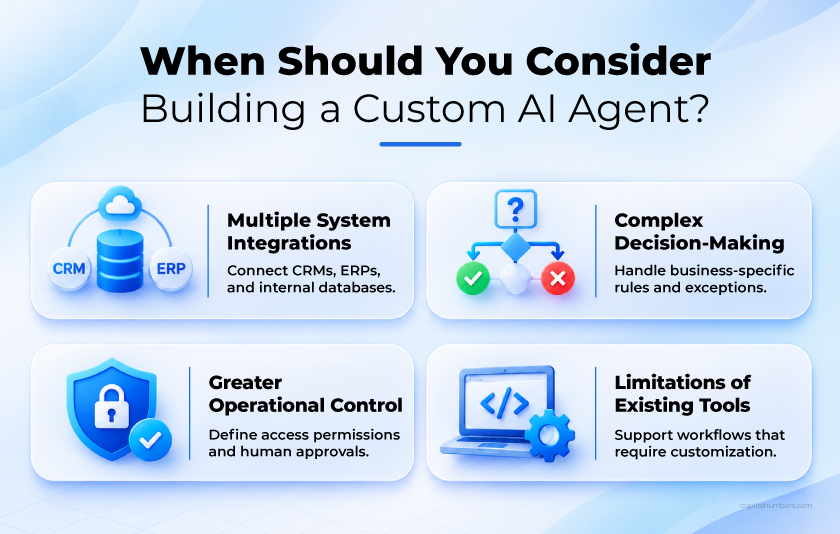
Consider building a custom agent when:
- Multiple systems are involved: Workflows require access to CRMs, ERPs, internal databases, or proprietary information.
- Complex decisions are required: Tasks involve variable inputs, exceptions, or business-specific rules that fixed automation cannot easily handle.
- Greater control is necessary: The agent needs defined permissions, human approvals, audit trails, or specific security controls.
- Existing tools have limitations: Available platforms cannot support the required integrations, workflows, or customization.
For predictable, rule-based tasks, conventional automation or a configurable AI platform may be more economical. The decision should depend on the workflow's complexity, integration needs, and expected business value. For example, a support agent could inspect CRM information, update a ticket, or escalate a sensitive request for human approval.
6 Steps in the Custom AI Agent Development Process
Building a custom AI agent involves defining business workflows, designing the architecture, developing core capabilities, integrating systems, testing, and deploying the solution. Each stage addresses requirements that affect the agent's reliability, security, and production readiness.
Step 1: Discovery and Requirements
Development begins by identifying the target business workflow, existing challenges, and expected outcomes. The team reviews current processes, system dependencies, and tasks suitable for automation. Organizations still deciding where agents fit can start with an AI opportunity assessment to validate use cases, check readiness, and define a roadmap before committing to a build.
This stage also defines measurable success criteria, including task completion rates, processing time, errors, and the frequency of human intervention.
Key deliverable: Requirements document outlining workflows, system dependencies, operating boundaries, and acceptance criteria.
Step 2: Architecture and Agent Design
Engineers determine how the agent will process information, select actions, and interact with business systems. This includes choosing an AI model, defining available tools, designing task orchestration, and deciding whether retrieval-augmented generation (RAG) or memory is needed.
The team also evaluates whether a single agent can handle the workflow or multiple specialized agents are necessary. Anthropic's guidance on building effective agents recommends starting with simpler approaches and adding complexity only when it improves results.
Production-ready agent architecture also requires state management to track workflow progress, observability to monitor agent behavior, and failure recovery mechanisms. These capabilities help agents resume interrupted tasks safely, enable teams to diagnose issues, and prevent repeated or incomplete actions.
Based on these decisions, engineers define access permissions, security requirements, and human approval points. Engineers also plan how to evaluate task success, tool choices, failures, and human escalations.
Key deliverable: Architecture blueprint and evaluation plan covering model selection, tool integrations, orchestration, state management, observability, failure recovery, security controls, human approvals, and testing criteria.
Step 3: AI Agent Development
Developers build the agent's core capabilities by configuring AI models, creating instructions, implementing workflow logic, and connecting tools for task execution.
They also define how the agent handles incomplete information, failed API requests, and unexpected responses. These controls help manage repeated actions, execution failures, and unnecessary operating costs.
Key deliverable: Working agent implementation capable of performing defined tasks in a controlled environment.
Step 4: Enterprise Integrations
The agent connects to business applications and data sources through AI integrations with CRM, ERP, and other systems. These may include internal databases, document repositories, and third-party APIs.
Developers configure authentication, manage data formats, and enforce access permissions. Integration testing helps identify failures and reduce the risk of unauthorized actions or duplicate records.
Key deliverable: Integrated workflows supporting approved data access and task execution across connected systems.
Step 5: Testing and Evaluation
Before deployment, engineers evaluate the agent against realistic business scenarios and the acceptance criteria defined during discovery.
Testing covers task completion, output quality, tool-use accuracy, security vulnerabilities such as prompt injection and unauthorized tool access, response latency, and execution costs. Engineers also check how the agent handles incomplete information, failed actions, and situations requiring human intervention.
These evaluations should examine both the final result and the actions the agent takes to achieve it. Microsoft Foundry’s agent evaluators follow a similar approach, assessing task completion, tool selection, and tool-call accuracy.
Reliability is the main reason this stage matters. In LangChain’s State of Agent Engineering survey of more than 1,300 respondents, 32% cited quality as a top barrier to deploying agents in production.
Key deliverable: Evaluation report documenting test results, identified risks, limitations, and production-readiness findings.
Step 6: Production Deployment
Once the agent meets its acceptance criteria, the team deploys it into the intended business environment with monitoring, tool-call tracing, access controls, logging, and incident-response procedures.
The organization also establishes operational ownership and support responsibilities. A phased rollout may begin with human approvals before allowing the agent to perform selected low-risk tasks independently within defined limits.
Performance monitoring and evaluation continue after deployment as workflows and requirements evolve.
Key deliverable: Deployed AI agent with monitoring, operational documentation, escalation procedures, and defined support ownership.
These six stages establish what is required to move an AI agent into production. However, the engineering effort involved varies significantly depending on the workflow and enterprise systems. Understanding those differences is essential when estimating development costs.
Planning a Custom AI Agent?
Capital Numbers helps businesses evaluate AI agent opportunities, define technical requirements, and build solutions aligned with existing workflows. See how our AI agent development services take a workflow from discovery to production.
Custom AI Agent Development: Cost, ROI, and Timeline
Building a custom AI agent involves more than choosing a model and connecting a few tools. Businesses must decide how much automation they need, what systems the agent will access, and how they will measure its performance.
These decisions influence three important questions:
How much should you invest? How soon can the agent start working? And will the results justify the cost?
Understanding the relationship between cost, timeline, and expected returns helps businesses plan an AI agent project without investing in unnecessary capabilities.
How Much Does Custom AI Agent Development Cost?
Custom AI agent development can cost approximately $15,000 to $400,000 or more. The investment largely depends on what the agent needs to do and how much engineering the workflow requires.
An agent that handles one defined task with limited integrations will generally cost less than a system that coordinates multiple workflows, accesses enterprise applications, and requires advanced security controls.
|
Project Complexity |
Estimated Cost (USD) |
Typical Scope |
|
Basic / Focused |
$15,000–$40,000 |
Single workflow, limited tools, simple integrations, and basic testing |
|
Moderate / Integrated |
$40,000–$150,000 |
Multi-step workflows, CRM/ERP integrations, and human approvals |
|
Advanced / Enterprise |
$150,000–$400,000+ |
Complex workflows, multiple enterprise integrations, advanced security, extensive testing, and scalability requirements |
These are indicative ranges, not fixed quotes. The example above uses a blended rate of $35/hour, within an illustrative range of $25–$40/hour for a multi-tier team. Actual costs vary by project.
The stage of development also makes a difference. A proof of concept (PoC) focuses on validating whether an agent can perform the intended task. A production-ready solution requires additional work around integrations, security, testing, and ongoing operations.
Rather than choosing a budget based on a broad price range, businesses should calculate the engineering effort their specific workflow requires.
How to Calculate Custom AI Agent Development Cost
Businesses can estimate the initial development budget by calculating engineering effort and adding setup expenses and contingency.
Initial development budget = (Engineering hours × Hourly rate) + Setup costs + Contingency
Consider a hypothetical moderately integrated AI agent requiring 1,250 engineering hours. At an illustrative blended rate of $35/hour, the engineering cost would be $43,750. Adding $4,000 for setup and $5,000 for contingency brings the initial development budget to $52,750.
At a blended rate of $25–$40/hour, the estimated budget would range from $40,250–$59,000. These figures are illustrative planning assumptions, not actual project quotes. The estimate excludes recurring operating expenses, internal employee time, taxes, and major scope changes.
However, the initial development budget represents only part of the investment. Businesses must also consider the expenses that continue after deployment.
What Are the Ongoing Costs After Deployment?
Every AI agent creates some recurring costs, even when it automates a large portion of the workflow.
The main expenses include:
- Model and API usage: Costs associated with model calls, token consumption, and tool execution.
- Infrastructure: Cloud hosting, databases, and secure storage.
- Third-party services: External APIs, enterprise applications, and subscriptions.
- Maintenance and support: Monitoring, observability tooling, software and model updates, issue resolution, and recurring evaluations.
Consider the same hypothetical agent with an initial development budget of $52,750. Suppose it costs $1,500 per month to operate, including routine support, and successfully completes 10,000 tasks monthly.
Its monthly operating cost per completed task would be:
$1,500 ÷ 10,000 tasks = $0.15 per completed task
Initial development plus 12 months of agent operating expenses would total $70,750 ($52,750 + $18,000). Under the broader illustrative rate assumptions, this would range from $58,250–$77,000.
This calculation excludes additional employee review time and major enhancements. Actual expenses will depend on usage volumes, model selection, infrastructure, and third-party pricing.
These numbers reveal the cost of operating the agent, but not whether the investment makes financial sense. To answer that question, businesses must compare the new workflow with the process they use today.
How to Evaluate the Return on Investment
An AI agent delivers financial value when the benefits of automation outweigh the costs of building and operating it.
Start by calculating how much the existing workflow costs. Then estimate what the same workflow will cost after introducing the agent.
Estimated monthly net benefit = Current workflow cost − Post-automation workflow cost
The post-automation cost must include AI operating expenses, remaining employee effort, human approvals, and exception handling.
For example, an agent may handle routine requests faster and reduce manual processing time. However, employees may still need to review unusual cases, approve sensitive actions, and resolve exceptions.
The difference between the original and new workflow costs provides an estimate of monthly financial benefit.
Businesses can then estimate the payback period:
Estimated payback period (months) = Initial development investment ÷ Positive monthly net benefit
Suppose the existing workflow handles 10,000 tasks monthly at $1 per task, costing $10,000. At an assumed labor cost of $25/hour, this represents approximately 2.4 minutes of human work per task.
After automation, consider $1,500 in monthly agent operating costs and $3,500 for employee reviews and exception handling.
Monthly net benefit = $10,000 − ($1,500 + $3,500) = $5,000.
With an initial investment of $52,750 and an estimated monthly net benefit of $5,000, the payback period would be approximately 11 months after deployment (8–12 months under the broader illustrative cost range).
This is hypothetical, not a guaranteed return; actual benefits depend on adoption, exception rates, and measurable value from time saved.
Want to estimate the ROI of your AI agent project?
Capital Numbers can help you assess workflow costs, estimate development investment, and identify potential business returns. Book an AI strategy consultation to evaluate your use case.
How Long Does Custom AI Agent Development Take?
A focused AI agent may take 4–8 weeks to develop, while complex enterprise implementations can require 6–12 months or longer.
The AI agent development timeline depends on engineering effort, integration complexity, testing requirements, and business approvals.
|
Project Complexity |
Illustrative Timeline |
Typical Requirements |
|
Basic / Focused Agent |
4–8 weeks |
Limited workflow, accessible data, minimal integration |
|
Moderate / Integrated Agent |
8–16 weeks |
Multiple steps, business-system integration, evaluation, and approvals |
|
Advanced / Enterprise Agent |
6–12+ months |
Complex systems, multiple integrations, advanced governance, and production requirements |
These timelines are illustrative. Actual schedules depend on project scope, integration readiness, resource availability, and business approvals.
Development does not always follow a strictly sequential schedule. Engineers may work on integrations while building the agent's core capabilities, and testing can begin before development finishes.
The bigger delays often arise from dependencies that require business input. For example, an ERP integration may need additional API permissions, data preparation, or security approvals before engineers can complete the workflow.
Enterprise projects may also require stakeholder reviews and phased rollouts before production release.
A realistic AI agent development roadmap should account for engineering milestones alongside the access, decisions, and approvals the business needs to provide.
Identifying these requirements early can reduce delays and help teams avoid unnecessary development expenses.
How to Reduce Development Cost and Time
The most effective way to control development costs is to avoid building more than the workflow needs.
Businesses can take several practical steps:
- Start with one measurable workflow. Validate its performance before expanding the agent into additional business functions.
- Use existing models and frameworks. Avoid building capabilities from scratch when established components meet the requirements.
- Check integration readiness early. Confirm data quality, API access, and security requirements before development begins.
- Keep the architecture focused. Use a single agent when multiple specialized agents offer no clear technical advantage.
- Control model and tool usage. Set reasonable limits on API calls, retries, and execution to manage ongoing expenses.
- Test throughout development. Identify unreliable behavior and integration issues before they create costly rework.
- Match the engagement model to the scope. A fixed-price engagement gives budget certainty when the workflow and acceptance criteria are well defined. A dedicated team suits projects with evolving requirements or plans to develop multiple agents. Compare different software development engagement models to determine which approach fits your budget and delivery requirements.
These measures help teams spend time on capabilities that directly support the business objective. Cost reduction should not come at the expense of security, acceptance testing, or human oversight. Those controls help prevent failures that could cost more to resolve after deployment.
A well-scoped AI agent project balances development cost, delivery speed, and operational reliability rather than optimizing only one of them.
What Should You Ask an AI Agent Development Partner Before Signing?
Choosing an AI agent development partner requires evaluating more than technical expertise and cost. Quality, reliability, and production readiness should be demonstrated through measurable evidence. To reduce implementation risks and ensure long-term reliability, businesses should ask:
- Have you assessed whether this workflow needs a custom agent? The partner should explain when conventional automation or an existing AI platform could meet the requirements.
- Have you reviewed our systems and data before estimating delivery? The proposed schedule should account for API availability, data readiness, access permissions, and integration dependencies.
- How will you evaluate reliability and security? Ask about task-success criteria, prompt-injection defenses, tool permissions, human approval requirements, and failure recovery.
- How will monthly operating costs be estimated? The proposal should account for model usage, infrastructure, third-party services, maintenance, and expected changes as workload volumes increase.
- Who owns and supports the agent after deployment? Clarify intellectual property ownership, documentation, monitoring access, incident response, and responsibility for future changes.
The answers should be reflected in the proposal, delivery milestones, and acceptance criteria. This gives businesses a more reliable basis for comparing development partners beyond the initial quoted price.
For a broader view of vendor selection, see our guide to choosing the right AI development company.
Building a Custom AI Agent Starts With the Right Scope
Building a custom AI agent is not just about choosing the right technology. It starts with identifying a business problem worth solving and determining how AI can deliver measurable value.
A successful project requires a clearly defined workflow, realistic budget, and practical development roadmap. Businesses also need to consider integration requirements, ongoing operating costs, and the level of human oversight the agent will need.
Starting with a focused use case helps validate performance and business value before expanding into more complex workflows. Equally important is choosing a development partner who can support the agent beyond deployment.
Capital Numbers, certified in the Claude Partner Network Services Track, helps businesses move AI agent projects from discovery through enterprise integration and deployment. Connect with our experts to define your AI agent requirements and build a practical implementation roadmap.
Frequently Asked Questions
1. How much does it cost to build a custom AI agent?
Indicative custom AI agent development costs range from $15,000–$40,000 for focused implementations, $40,000–$150,000 for moderately integrated systems, and $150,000–$400,000+ for complex enterprise solutions. Actual budgets depend on engineering effort, integrations, security, and testing requirements. Businesses should also account for recurring infrastructure, model usage, and maintenance costs.
2. What is the monthly running cost of a custom AI agent?
Monthly operating costs depend on AI model usage, task volume, infrastructure, third-party services, and ongoing maintenance. Businesses should estimate these expenses based on expected usage and calculate the operating cost per completed task before scaling.
3. How long does custom AI agent development take?
A focused AI agent may take around 4–8 weeks, while moderately integrated systems can require 8–16 weeks. Complex enterprise implementations may take 6–12 months or longer. Actual timelines depend on data readiness, integrations, stakeholder approvals, security requirements, and production acceptance criteria.
4. How do you build a custom AI agent?
To build a custom AI agent, start by defining the business workflow, requirements, and success criteria. Next, design the agent's architecture, develop its core capabilities, and integrate it with the necessary business systems. Test its accuracy, security, and task execution before deploying it with monitoring and human oversight.
5. Is custom AI agent development better than using a ready-made platform?
Custom development offers greater flexibility over workflows, integrations, permissions, and architecture. Ready-made platforms may provide faster implementation and lower initial costs when their capabilities meet the requirements. The better choice depends on functionality, integration complexity, ownership needs, recurring costs, and long-term operational control.

Mayur GohaneAI Engineer
With expertise in Generative AI, Agentic AI, and Large Language Model applications, Mayur is an AI/ML Engineer specializing in production-ready AI solutions. A Claude Certified Architect – Foundations, he excels in developing intelligent AI agents, multi-agent systems, and Retrieval-Augmented Generation (RAG) applications. Committed to innovation and technical excellence, he focuses on building scalable and reliable AI solutions that address real-world business challenges.