
Is Your Data Safe with an Offshore AI Partner? What CXOs Should Verify

Delivery Manager
24th November, 2026
|
Quick Summary
|
Confidential information can leave your control without a cyberattack. A developer troubleshooting an AI workflow might paste a production log into an unapproved AI assistant, exposing customer data or credentials. This risk exists in-house, too, but offshore development adds vendor relationships and potential cross-border access.
According to IBM’s 2026 Cost of a Data Breach analysis, 21% of the organizations studied reported security incidents involving AI models or applications. Among those reporting AI-related breaches, 92% lacked proper AI access controls. The study covered organizations that had experienced data breaches, not businesses in general.
For CXOs, evaluating an offshore AI partner's data security comes down to three questions: Where does your data go? Who can access it? And what safeguards can your partner demonstrate?
Where Can Your Data Be Exposed When Working with an Offshore AI Partner?
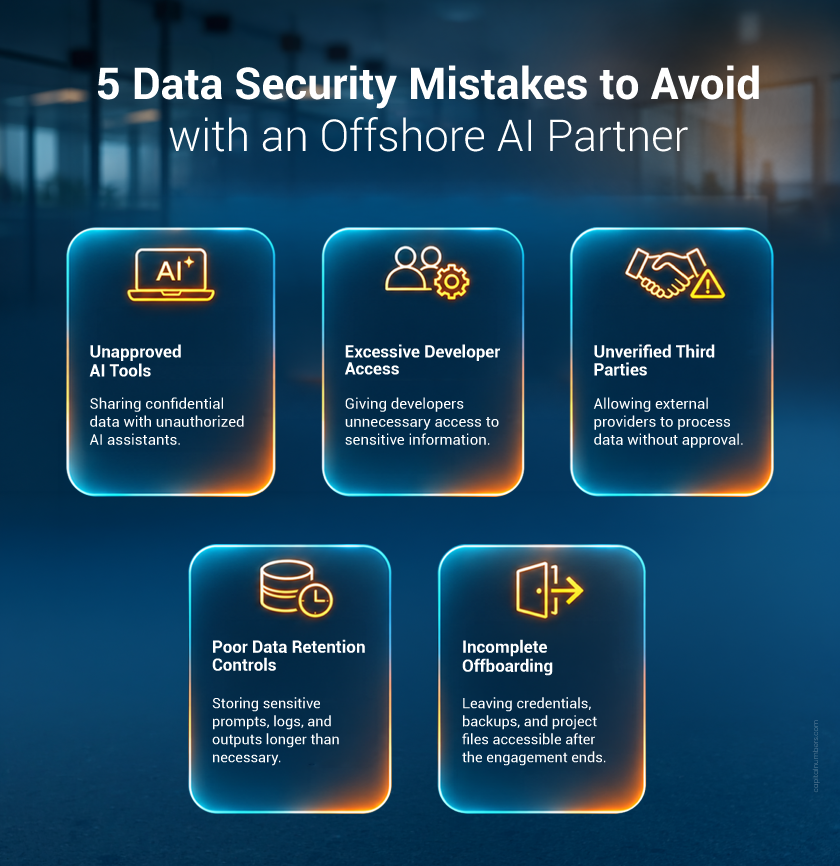
Many AI development security risks arise during ordinary work: debugging, testing, model evaluation, and collaboration. Confidential information can pass through services outside the project’s agreed boundaries. Start with five exposure points, then examine the added permissions that AI applications and agents require.
- AI prompts: staff paste contracts, customer records, or source code into unapproved assistants.
- Excessive access: developers receive production permissions unrelated to their assigned tasks.
- Third-party tools: model providers, analytics services, and subcontractors process data in unexpected locations.
- Logs and outputs: prompts, responses, and debugging records keep sensitive information beyond the agreed period.
- Offboarding gaps: credentials, backups, and project files stay accessible after delivery ends.
AI systems can introduce additional risks. Consider a RAG assistant that retrieves insurance policy documents. If it doesn't check user permissions, an employee could receive information they aren't authorized to see.
Other risks are less obvious. Hidden instructions in retrieved documents can manipulate AI responses through prompt injection. An AI agent with excessive permissions might even modify customer records when it was supposed to retrieve information.
These risks are covered in the OWASP Top 10 for LLM Applications and deserve attention during vendor evaluation.
What Security Evidence Should Your Offshore AI Partner Provide?
A credible AI vendor security assessment goes beyond certificates and policy documents. Ask for evidence that covers the people, infrastructure, and AI tools assigned to your project. A partner should be able to explain its controls and demonstrate them through redacted records or a non-sensitive walkthrough.
Check Independent Assurance and Its Scope
SOC 2 Type II reports examine specified controls over an audit period. ISO/IEC 27001 certifies an information security management system. Neither automatically covers every cloud account, AI assistant, or subcontractor. Request scope statements, audit periods, material exceptions and remediation progress, and arrange a controlled review under an NDA if reports are confidential.
Also ask what AI-specific assurance exists, such as ISO/IEC 42001, the AI management system standard. Not every capable vendor holds it, but each should explain how it covers the gap.
Inspect Everyday Engineering Practices
What happens when a new developer joins your project halfway through a sprint? Who approves their access, what information can they see, and how quickly can those permissions be removed?
These everyday situations reveal whether security policies actually work. Ask for evidence of multifactor authentication, least-privilege access, protected repositories, secrets scanning, peer reviews, and vulnerability remediation.
A redacted access approval, sample security ticket, or anonymized test report can help you assess these practices without exposing another client's information.
Test Incident Readiness
Confirm the named incident owner, escalation path, contractual notification window, and responsibility for coordinating with model providers. Ask for a recent tabletop-exercise summary or a redacted incident review. A written plan alone does not show whether teams can follow it.
Under EU GDPR, controllers and processors have different breach-notification responsibilities. A controller must notify the relevant supervisory authority without undue delay and, where feasible, within 72 hours of becoming aware of a personal data breach, unless the breach is unlikely to result in a risk to individuals.
A processor must notify its controller without undue delay after becoming aware of a breach. Your contract should specify a clear notification window so the controller has enough time to assess the incident and meet applicable reporting requirements.
At Capital Numbers, our SOC 2 Type II-attested and ISO 27001-compliant practices provide a foundation for project-level safeguards. On our engagements, we typically agree on approved tools, access boundaries, and escalation responsibilities before production deployment, with relevant assurance evidence reviewed under NDA where appropriate.
How Should an Offshore Partner Use AI Tools and Your Data?
Model providers, coding assistants, and knowledge-retrieval tools handle information differently. Your contract and acceptable-use policy should identify approved tools, data types, accounts, processing locations, and retention settings. AI outsourcing data security requires verifying provider settings as well as the offshore team’s own controls.
- Inference: approve model providers, processing regions, and prompt or response retention settings.
- Fine-tuning: authorize the training datasets and define rights to any resulting model assets.
- RAG search: enforce document-level permissions and test whether restricted content stays restricted.
- Coding assistants: use approved enterprise accounts and prohibit confidential inputs in unapproved tools.
Do not assume that a provider’s promise not to train on prompts also means it retains no logs. Check both separately. If an AI agent can update accounts, approve payments, or send communications, restrict its permissions and require human approval for sensitive actions.
Named engineers must review AI-generated code before release. See our guide to human accountability in AI-assisted software development for practical approval boundaries.
What Should Your Offshore AI Partner's Contract Include?
An NDA is important, but it doesn't settle everything. Your contract should clearly state who owns a customized AI model, whether your development partner can reuse project code, and who is responsible for subcontractor access.
Agree on these terms before sharing sensitive information. Involve legal, security, engineering, and procurement teams so these decisions don't rest with the delivery manager alone.
- Data boundaries: define permitted datasets, cloud environments, access roles, logging, retention, and any justified use of production data.
- IP and reuse: specify ownership of code, prompts, datasets, customized models, and documentation, and restrict unauthorized reuse.
- Accountability: define incident contacts, notification windows, audit access, and remediation ownership. Negotiate liability and indemnity proportionate to the risks.
- Third parties: require advance notice and a right to object before new subprocessors, model providers, or processing locations are added.
- Exit: specify asset handover, credential revocation, deletion confirmation, and dates for clearing retained backups.
Where feasible, use synthetic or masked data instead of live customer records. Also establish who will maintain the system, rotate credentials, and respond to issues after handover. The contract should clearly define which responsibilities continue after handover or termination.
For a deeper look at ownership, licensing and vendor reuse, see our guide to protecting intellectual property when outsourcing.
Which Regulations and Cross-Border Rules Apply?
Which rules apply depends on the data, the activities, the organizations and the jurisdictions involved, not simply where the development team works. AI data protection compliance is shared: you and your partner may hold different legal roles, and data privacy in AI development is rarely the vendor’s responsibility alone. The table is a screening guide, not a legal determination. Your privacy and legal teams should confirm each party’s role and obligations.
|
Regulation |
When It Applies |
|
EU GDPR |
Personal data is processed in the context of an EU establishment's activities, or a non-EU organization offers goods or services to people in the EU or monitors their behavior there. |
|
UK GDPR |
Personal data is processed in the context of a UK establishment's activities, or a non-UK organization offers goods or services to people in the UK or monitors their behavior there. |
|
India's DPDP Act |
Digital personal data is processed in India, or processing outside India is connected to offering goods or services to people in India. The principal obligations take effect in phases, with many applying from 13 May 2027. |
|
EU AI Act |
You place an AI system on the EU market, deploy it in the EU, or its outputs are used in the EU in circumstances covered by the Act. The relevant obligations depend on your role and the system's risk classification. |
The stakes are financial. GDPR fines reach €20 million or 4% of worldwide annual turnover, whichever is higher, and unlawful international transfers fall in that top tier.
Cloud-region selection alone does not settle cross-border access. Offshore engineers, model providers and monitoring platforms may process or view information elsewhere. The European Data Protection Board’s transfer guidance explains when remote access by a separate organization may count as an international transfer under GDPR.
India does not currently have an EU adequacy decision. Where GDPR international-transfer rules apply, organizations commonly use standard contractual clauses, supported by a transfer impact assessment and additional safeguards where necessary.
Request a data-flow map naming storage and processing locations, access routes, subprocessors and agreed transfer safeguards. A vendor’s general compliance statement cannot establish compliance for your project.
This section provides general information, not legal advice.
10 Questions to Ask Before Hiring an Offshore AI Partner
A confident answer from a vendor isn't necessarily a verified answer. Use the following questions during discussions involving your CTO or CISO, procurement lead, and legal team. For each response, ask who owns the control and what evidence supports it.
Pay particular attention to data flows, model-provider data use, incident response, and intellectual property ownership. Unresolved gaps in these areas should prevent sensitive information from being shared until the responsibilities are clarified in writing.
|
Ask the vendor |
A credible answer includes |
Warning sign |
|---|---|---|
|
1. Where do our records, prompts, logs, and backups go? |
A data-flow map naming regions, providers, and subprocessors. |
“A secure cloud,” with no map. |
|
2. Who can access production data? |
Named roles, MFA, approvals, and timely revocation. |
Shared accounts or blanket access. |
|
3. Which AI tools can developers use? |
Approved tool list, enterprise accounts, monitoring. |
No restrictions or tool inventory. |
|
4. Can providers train on our inputs? |
Written terms plus training and retention settings. |
Unclear model-provider data use. |
|
5. Which audits cover our project? |
Scope, audit period, exceptions, and remediation. |
A badge without project relevance. |
|
6. How is AI-generated code reviewed? |
Human approval, dependency and secrets checks. |
Optional review or unchecked code. |
|
7. Who responds to incidents, and when? |
Named owner, tested escalation, notice in hours. |
“As soon as possible,” without detail. |
|
8. Who owns prompts, code, and tuned models? |
Express ownership and licensing provisions. |
Unclear rights or unrestricted reuse. |
|
9. What happens at handover and exit? |
Asset checklist, access revocation, deletion evidence. |
No exit or backup-retention plan. |
|
10. Which third-party changes need approval? |
Notice and an agreed approval or objection process. |
Unilateral provider or location changes. |
How Should CXOs Monitor Security After Kickoff?
Offshore AI development security doesn't end with vendor assessment. New developers, model releases, integrations, and production data flows can change the risk profile. Agree on a reporting cadence and named owners for exceptions, and tie security reviews to delivery milestones rather than waiting for an annual audit.
- Before kickoff: approve data sources, tools, environments, permissions, and incident ownership.
- Before launch: review testing, access logs, credentials, recovery plans and unresolved findings.
- After launch: reassess new models, suppliers, integrations, privileged access and policy exceptions.
Ask for a short, regular report on privileged-access changes, open vulnerabilities, new third parties and policy exceptions.
Experience also matters. In a European AI-powered insurance platform engagement, Capital Numbers implemented response validation against source policy documents, explainability dashboards and model failover. The work shows how traceability and resilience can be engineered into an AI system. These features complement, rather than replace, contractual data-protection safeguards.
The Bottom Line
Offshore AI development is not inherently unsafe. The real test is whether an offshore AI development company can demonstrate control over your data, tools, people, and third parties. For CXOs, a documented data-flow map, practical security evidence, clear ownership terms, and ongoing oversight are worth more than assurances alone.
If you're evaluating an offshore AI partner, contact Capital Numbers to discuss your project's sensitive data and security requirements. Where appropriate, we can show you examples of how we protect data and control access, without revealing confidential information.
Frequently Asked Questions
Is it safe to outsource AI development to an offshore company?
Yes, when the engagement is governed properly. Location alone does not determine security. Before sharing sensitive information, verify how data is processed, which providers can access it, what independent assurance applies, and how incidents and intellectual property are handled. Keep monitoring after the project begins.
What security controls should an offshore AI partner have?
At minimum: multifactor authentication, least-privilege access, encryption, secure code review, vulnerability testing, audit logs, tested incident procedures, and documented deletion rules. For AI work, also verify approved model providers, prompt retention, RAG permissions, AI-agent privileges, and human approval for sensitive actions.
Can offshore AI developers use our data to train models?
Only when your organization has authorized it, the law permits it, and the contract allows it. Address training, fine-tuning, evaluation, logging, retention, and onward sharing separately, and verify the settings and terms of every third-party model service.
How can we address GDPR compliance in offshore AI development?
Confirm whether GDPR applies and define each party's role. Where required for a controller-processor arrangement, put an Article 28 agreement in place. Document subprocessors and international transfers, restrict access, and have legal and privacy specialists review the safeguards.
How do we protect intellectual property when outsourcing AI development?
Define ownership and licensing for source code, prompts, datasets, customized models, and documentation in writing. Restrict reuse, review third-party code obligations, control repositories, and agree on handover and deletion terms. An NDA supports confidentiality, but technical controls and precise contracts remain essential.

Subhajit DasDelivery Manager
With around two decades of experience in IT, Subhajit is an accomplished Delivery Manager specializing in web and mobile app development. Transitioning from a developer role, his profound technical expertise ensures the success of projects from inception to completion. Committed to fostering team collaboration and ongoing growth, his leadership consistently delivers innovation and excellence in the dynamic tech industry.