
How to Choose the Right AI Agent Development Company

Project Manager
19th November, 2026
|
Quick Summary
|
To choose an AI agent development company, define one workflow, shortlist providers with relevant delivery evidence, test them against the same scenarios, and compare security, ownership, support, and operating costs. A convincing demo is useful, but the decision should depend on what the system can do safely in your environment.
An agent that answers questions in a polished demonstration is different from one that updates customer records, retrieves sensitive information, and triggers actions across business systems. Your selection process must establish who controls those actions, how errors are handled, and who remains accountable.
The following decision guide gives buyers a practical way to compare shortlisted teams using verifiable evidence rather than presentation claims.
Before You Shortlist: Do You Need an AI Agent at All?
A reliable provider will ask this question before proposing anything: does the work need an AI agent, or would simpler automation do? If a vendor recommends an agent for every row below, treat that as a warning sign.
|
Business requirement |
Consider first |
Why |
|
Answer questions from approved documents |
Search or a retrieval-augmented AI assistant |
The task may not require the system to take actions. |
|
Move data between systems using fixed rules |
Conventional workflow automation |
Predictable steps are usually easier to test and maintain. |
|
Investigate a request, use several tools, and adapt the next step |
A bounded AI agent |
The path can change based on information gathered. |
|
Execute high-impact actions, such as payments or account changes |
An agent with explicit approval gates—or a rules-based workflow |
Control and auditability matter more than autonomy. |
4 Steps to Choose an AI Agent Development Company
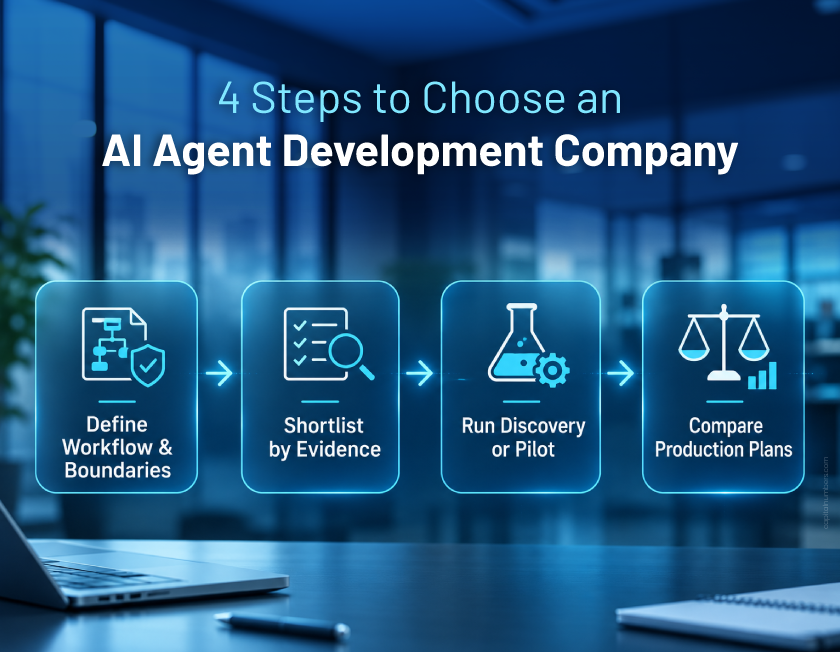
Before you compare AI agent development services from different companies, agree on how you’ll evaluate them. The four steps below give you one set of written criteria to apply to every provider, so you can compare their proposals like for like.
1. Define the Workflow and Boundaries
Choose one business process and document its starting point, systems, users, exceptions, and desired outcome. Specify what the agent may read, what it may change, and which actions require human approval. Give every shortlisted provider the same one-page brief: approved data sources, integrations, agent boundaries, current baseline, success criteria, and constraints.
For example, “reduce support workload” is vague. “Draft responses using approved policy documents and prepare CRM updates for a support representative’s approval” is testable.
2. Shortlist Partners Using Relevant Proof
Ask for case studies involving similar integrations, data sensitivity, or operational complexity. Separate an AI chatbot, a retrieval-based assistant, and a tool-using agent: experience in one does not automatically establish expertise in another.
Request a discussion with the proposed architect or technical lead, not just a sales representative.
3. Run a Scoped Discovery or Pilot
Give shortlisted vendors the same approved test scenarios, including exceptions and failures, and agree on pass criteria before the pilot starts. Ask for the full results, not just a polished demonstration. A paid discovery phase can be useful when access and requirements must be investigated before pricing is credible.
4. Compare the Production Plan
Use the scorecard in the next section to compare each provider’s production plan, including architecture, security, monitoring, handover, and cost. Compare assumptions and exclusions alongside price. A pilot that depends on undocumented vendor intervention will be hard to support after launch.
What Evidence Should You Request from Shortlisted AI Agent Partners?
When a company describes its solution as “enterprise-ready,” ask what that actually means. The following scorecard outlines the evidence you should request and the criteria you can use to compare every AI agent development partner on your shortlist.
|
Evaluation area |
Evidence to request |
What a strong answer includes |
|
Relevant delivery experience |
A comparable case study and engineering walkthrough |
The business problem, actual agent responsibilities, constraints, and lessons learned. |
|
Architecture choices |
A proposed workflow and tool-access diagram |
Why an agent is needed, why one or several agents are appropriate, and where approvals sit. |
|
Enterprise integration |
API and data-access plan |
Authentication, permissions, rate limits, error handling, and rollback options. |
|
Evaluation discipline |
Sample test set, results, and failure analysis |
Measures for correct task completion, unsafe actions, escalation, and regression testing. |
|
Security and governance |
Access-control design and security evidence |
Least-privilege tool access (the agent gets only the permissions its task needs), audit logs, protected secrets, and risk-based human oversight. |
|
Production operations |
Monitoring and incident-response plan |
Traces, alerts, fallback behavior, model-change testing, and named support owners. |
|
Commercial transparency |
Itemized scope and operating-cost estimates |
Development versus ongoing costs, cost per successful workflow, model usage, infrastructure, third-party dependencies, and clearly stated exclusions. |
Use the scorecard consistently: assign 0 when a provider supplies no evidence, 1 for partial evidence, and 2 for a demonstrated capability. Do not average away a critical gap in access control, data protection, or ownership. Record the reason for every score and resolve high-risk gaps before signing.
Be cautious about impressive technology lists. Familiarity with LangGraph, orchestration tools, retrieval systems, or the Model Context Protocol (MCP) is useful, but it does not prove that a team can operate an agent safely in your environment.
Consider a simple vendor comparison. Suppose two companies propose an AI agent for processing customer support requests. One focuses on its preferred models, frameworks, and automation capabilities. The other explains how the agent will retrieve approved information, prepare responses, update CRM records, handle missing data, and request human approval before sensitive changes. The second proposal gives you more to evaluate because it connects the technology to the actual workflow, safeguards, and expected outcomes.
When comparing vendors, look beyond what they plan to build. Examine how they intend to handle situations in which the system cannot complete a task as expected.
How Can You Evaluate an AI Agent Development Company’s Technical Expertise?
One of the best ways to assess a vendor's technical expertise is to see how its proposed agent handles a real business workflow. Ask the team to demonstrate the process using representative, authorized data. If live data cannot be shared, sanitized examples should still preserve important exceptions. Pay attention to the actions the agent takes, the tools it uses, and how it responds when something goes wrong.
Test at least these situations:
- Missing information: Does the agent ask for clarification or escalate instead of inventing a fact?
- Unauthorized action: Can it be prevented from changing a record it is only allowed to read?
- Tool failure: What happens when an API times out, rejects a request, or returns inconsistent data?
- Conflicting instructions: Will it ignore malicious directions hidden inside a retrieved document?
- Repeated workload: How do task completion, the response time that 95% of requests beat (p95 latency), and cost per successful workflow change under expected volume?
Ask for a repeatable evaluation report, not a single successful run. It should define the test cases, pass criteria, failure categories, and who signs off. Compare results with the existing human or automated process.
For example, we helped a European insurance client stabilize a multilingual, retrieval-based AI platform using multi-LLM failover, response validation, and observability. The same production engineering practices matter when evaluating an AI agent system.
What Security and Compliance Capabilities Should an Enterprise AI Agent Development Partner Have?
The key issue is not simply whether a model can answer securely. It is whether the entire system limits what the agent can access and do.
Look for:
- Role-based access controls and permissions scoped to each tool and action.
- Human approval before irreversible or financially sensitive steps.
- Protection of credentials, personal information, and confidential business data.
- Structured logs of tool calls, approvals, and outcomes, with sensitive data redacted where appropriate.
- Testing for prompt injection, excessive permissions, data leakage, and unsafe tool use.
- Incident response, rollback, retention, and deletion arrangements.
The OWASP Top 10 for Agentic Applications for 2026 is a useful reference for the security risks specific to agentic systems, from tool misuse to memory poisoning.
For regulated work, request evidence relevant to your data and jurisdiction. ISO 27001 certification or a SOC 2 Type II report can inform due diligence, but neither alone proves that a particular agent workflow meets your legal or security requirements. Confirm scope, applicable controls, data terms, and responsibilities with your security and legal teams.
Governance matters most for high-autonomy systems. In May 2026, Gartner forecast that 40% of enterprises would demote or decommission autonomous AI agents by 2027 because of governance gaps identified after production incidents. This is a prediction, not an observed failure rate. Gartner’s recommended fix is proportional governance: classify agents by autonomy, from agents that only observe or advise, to agents that act after human approval, to agents that act autonomously within guardrails, and match controls to each level. A good vendor should be able to explain where your agent sits on that scale and which controls follow.
What Should an AI Agent Development Contract Include Regarding Ownership, Maintenance, and Support?
Delivering the AI agent is only one part of the engagement. Your contract should also explain what happens after launch, who is responsible for maintaining the system, and what you can expect if you decide to change providers. Before signing, clarify the following:
- Ownership and access: Rights to custom code, prompts, configurations, evaluation sets, documentation, and project-specific assets; access to repositories and deployment environments.
- Third-party dependencies: Model, cloud, framework, and data-service licenses; usage terms; and any restrictions on changing providers.
- Acceptance criteria: Agreed test scenarios, quality and security thresholds, performance targets, and the process for resolving failed tests.
- Responsibilities: Who owns credentials, data permissions, approvals, monitoring, and incident decisions.
- Ongoing costs: Hosting, model usage, retrieval, observability, vendor fees, and expected support work.
- Maintenance and exit: Support response expectations, model or API updates, regression testing, knowledge transfer, transition assistance, and termination rights.
Specify data-use and confidentiality terms, including whether your inputs or outputs may be used to train third-party models. Have legal counsel review intellectual property, privacy, liability, and service terms for the relevant jurisdiction; ownership does not automatically transfer merely because development is paid for.
What Are the Red Flags When Choosing an AI Agent Development Vendor?
Watch for warning signs that directly affect delivery:
- Every demonstration works, but no one can show failure cases or test results.
- The vendor promises flawless accuracy or fully autonomous operation without discussing exceptions.
- They recommend multiple agents without explaining why one agent or conventional automation will not do.
- Integration effort is treated as trivial despite legacy systems or limited APIs.
- Security is reduced to a generic claim of being “compliant,” with no evidence or scope.
- Quotes omit production monitoring, token costs, or maintenance responsibilities.
- You cannot identify who owns the code, environments, data, and ongoing support.
One red flag does not always disqualify a vendor. An unwillingness to investigate it should.
Next Steps for Your Vendor Selection
Start with the one-page brief from Step 1, send it to every shortlisted provider, and score their answers with the same scorecard. Agree on ownership and support before committing beyond discovery. An impressive demo can start the conversation, but it should not settle the decision.
At Capital Numbers, we help businesses assess AI workflows, define practical system boundaries, and develop production-ready solutions with integration, security, and ongoing support. The selection criteria in this guide should apply to our team just as they do to other providers.
Are you considering an AI agent for a specific business process but unsure how to approach its development? Contact our team to discuss your requirements and explore the right way to move forward.
Frequently Asked Questions
What Questions Should You Ask Before Hiring an AI Agent Development Partner?
Ask what similar systems the team has delivered, which tools the agent will access, how it will be evaluated, when people must approve actions, and what happens when a tool fails. Also ask for estimated ongoing costs, the proposed team, ownership terms, and post-launch support responsibilities.
How Can You Verify That an AI Agent Development Company Can Deliver Production-Ready AI Agents?
Run a pilot on representative workflows with predefined acceptance criteria, then review the evaluation results, failure handling, access controls, activity logs, monitoring, and rollback procedures. Production-ready means controlled and supportable in your environment, not impressive in a single demonstration.
Is a Custom AI Agent Better Than an Off-the-Shelf Agent Platform?
Not necessarily. A platform may be sufficient for a standard process with supported integrations and manageable permissions. Custom development becomes more attractive when workflows, data access, business rules, or approval requirements cannot be handled adequately by existing products. Compare total ownership and maintenance costs, not just license fees.
How Should You Compare AI Agent Development Quotes?
Ask every provider to separate discovery, engineering, integrations, data preparation, testing, security reviews, infrastructure, model usage, and maintenance. Compare the assumptions and exclusions behind each figure, including the projected cost per successful workflow. A lower initial estimate is not necessarily the better option if monitoring, support, or handover work is omitted.
What Timeline Commitments Should You Request from a Provider?
Request a phase-by-phase plan showing discovery, integration readiness, pilot evaluation, security approval, production rollout, and handover. Ask which milestones depend on API access, data quality, stakeholder decisions, and test coverage. Compare providers against the same milestones instead of accepting an unsupported single delivery date.

Soutrick SurProject Manager
Project Manager at Capital Numbers, specializing in driving project success through different methodologies. As a LinkedIn-PMI-certified Scrum Master & Atlassian-certified Project Manager, I leverage Jira, Confluence, and Advanced Roadmaps to transform complex project goals into streamlined realities. By merging advanced roadmaps with AI prompt engineering and insights, I deliver streamlined, impactful digital solutions for global clients.