
Salesforce Data Management: Ensuring Data Quality and Security

Salesforce Developer
25th March, 2026
In an increasingly digital and data-centric environment, businesses depend on having accurate, timely, and secure information to function smoothly. Salesforce, a top player in the customer relationship management (CRM) arena, is at the heart of this data ecosystem for countless organizations. It gathers and links data across various departments like sales, service, marketing, and operations, making it an essential system for record-keeping. But here’s the thing: the real power of Salesforce isn’t just about how much data it holds; it’s all about the quality, reliability, and security of that data. Without solid data management practices in place, even the best Salesforce setup can fall short when it comes to providing valuable insights or aiding in smart decision-making. That is why many businesses invest in a more tailored Salesforce implementation approach to ensure the platform supports both data quality and long-term operational goals. That’s why managing data in Salesforce isn’t merely a technical issue - it’s a crucial business priority. It calls for a careful mix of governance, user behavior, automation, and security measures to ensure that data stays trustworthy and safeguarded throughout its entire lifecycle.
Why Data Management Is Critical in Salesforce
For countless organizations, Salesforce serves as the go-to hub for all customer and business information. Sales teams rely on it to keep tabs on leads and opportunities; service teams use it to tackle customer issues swiftly; marketing teams depend on it for effective segmentation and campaigns; and leadership turns to it for performance analysis and growth forecasting. When the data in Salesforce is accurate and well-managed, it paves the way for smoother operations, stronger customer relationships, and more informed strategic decisions. Conversely, poor data management can result in inaccurate reports, duplicated efforts, lower user adoption, and a general loss of trust in the system. Data security is just as crucial. Salesforce often holds sensitive information, including personal customer details, contract values, and internal business data. A single security lapse can expose organizations to regulatory risks, hefty fines, and damage to their reputation. Effective data management ensures that information remains both accessible and secure.
Understanding Data Quality in Salesforce
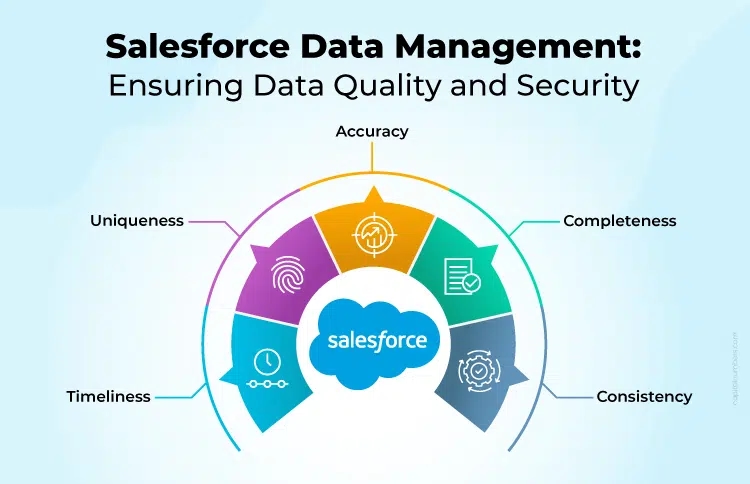
Data quality is all about how well your data meets its intended goals. In Salesforce, having high-quality data means that teams can rely on reports, streamline processes effectively, and connect with customers confidently. Several important aspects define data quality:
- Accuracy: This means the data accurately represents real-world information.
- Completeness: All necessary and meaningful fields should be filled out properly.
- Consistency: Data should adhere to standardized formats and definitions.
- Timeliness: Information needs to be up-to-date and refreshed whenever changes happen.
- Uniqueness: It's important to keep duplicate records to a minimum.
When any of these aspects are lacking, using Salesforce can become more challenging and less dependable as a tool for making decisions.
Common Data Quality Challenges in Salesforce
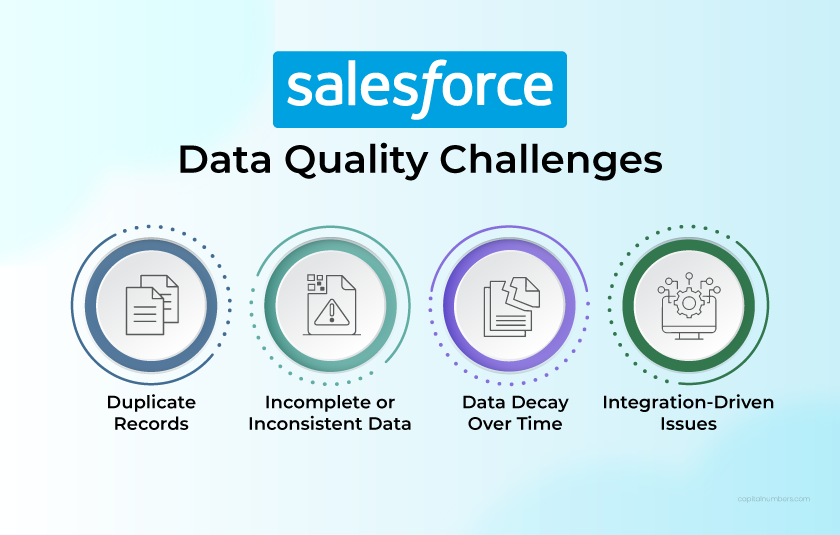
Even though Salesforce is a powerhouse, many organizations, big and small, face data quality hurdles. These issues often arise from a mix of process gaps, system integrations, and how users interact with the platform.
Duplicate Records
You know those pesky duplicate accounts, contacts, or leads? They often pop up from various data entry points like web forms, imports, integrations, or even manual entries by users. Duplicates can create a lot of confusion, skew metrics, and lead to mixed messages when communicating with customers.
Incomplete or Inconsistent Data
Sometimes, users might skip optional fields, use shorthand, or stick to inconsistent naming conventions. Over time, this can lead to fragmented data that’s tough to analyze or report on effectively.
Data Decay Over Time
Customer data isn’t static; it naturally becomes outdated as people switch jobs, companies merge, and contact details change. If you don’t keep up with regular maintenance, even data that was once spot-on can lose its value.
Integration-Driven Issues
Salesforce often plays nice with external systems like ERPs, marketing platforms, and third-party apps. But if these integrations aren’t well thought out or managed, they can bring in conflicting or inaccurate data, muddying the waters in Salesforce.
Best Practices for Ensuring High Data Quality
Keeping data quality in Salesforce is more of a continuous journey than a one-off task. Organizations that excel in this area usually blend governance, automation, and user involvement.
Establish Clear Data Governance
Data governance outlines how data is created, maintained, and owned. By assigning data owners or stewards for key objects, you ensure accountability and help uphold consistent standards throughout the organization.
Standardize Data Entry
Utilizing picklists, standardized formats, and predefined values minimizes variation and boosts consistency. This not only makes reporting more dependable but also streamlines integrations with other systems.
Implement Validation Rules Thoughtfully
Validation rules are essential for preventing incomplete or incorrect data from slipping into Salesforce. When crafted with user experience in mind, they can guide users effectively without causing unnecessary hassle.
Leverage Duplicate Management
Salesforce comes equipped with built-in tools to spot and manage duplicates. When matching and duplicate rules are set up correctly, they help keep data clean while allowing users to work efficiently.
Automate Data Maintenance
Automation can significantly enhance data quality. Scheduled processes, workflows, and audits can help standardize data, fill in missing fields, and flag any anomalies for review.
Invest in User Training
Users are the frontline defenders of data quality. Regular training and clear communication empower users to understand the importance of accurate data and how their actions influence the system as a whole.
The Importance of Data Security in Salesforce
While ensuring data quality is crucial for making Salesforce effective, data security is what builds trust. Organizations rely on Salesforce to store sensitive customer and business information, so safeguarding that data from unauthorized access or misuse is absolutely vital. A robust security framework not only minimizes the chances of data breaches but also helps organizations comply with regulatory standards and boosts customer confidence. It’s important to weave data security into the very fabric of Salesforce design, rather than treating it as an afterthought.
Key Elements of Salesforce Data Security
Authentication and Login Controls
Implementing secure authentication methods like multi-factor authentication (MFA) and singlesign-on (SSO) is essential to ensure that only authorized users can access Salesforce.
Access Control and Permissions
Salesforce’s security framework is built on profiles, permission sets, role hierarchies, andsharing rules. These elements dictate what users can see and do. A well-structured access model adheres to the principle of least privilege, ensuring users only have access to what they truly need.
Field-Level Security
Not all information is created equal. Field-level security allows organizations to limit access to specific fields, safeguarding confidential or regulated data.
Data Encryption
Encryption is key to protecting data both at rest and in transit. This is especially critical fororganizations that handle sensitive customer or financial information.
Monitoring and Auditing
Audit logs, field history tracking, and monitoring tools offer insights into data access andmodifications. These features are crucial for spotting suspicious activity and supporting both internal and external audits.
Supporting Compliance Through Strong Data Management
As data protection and privacy regulations continue to change around the world, staying compliant is becoming more crucial for organizations. Effective data management in Salesforce plays a key role in supporting compliance by ensuring that:
- Access to personal and sensitive data is properly controlled
- Data retention and deletion policies are adhered to
- Privacy preferences and consent are honored
- Audit trails are readily available when needed
Compliance should be viewed as an ongoing journey, closely aligned with both regulatory demands and business operations.
The Role of Automation and Intelligence
Today’s Salesforce platforms are increasingly incorporating automation and smart features to enhance data management. With automated validations, intelligent duplicate detection, and data enrichment, organizations can cut down on manual tasks while boosting accuracy and consistency. These features empower teams to spend less time resolving data issues and more time leveraging data to gain insights, enhance customer experiences, and support strategic objectives.
Conclusion
Managing data effectively in Salesforce is a vital foundation for any organization aiming to get the most out of its CRM investment. High-quality data fosters confident decision-making, streamlines operations, and encourages meaningful customer engagement. Robust data security safeguards sensitive information, supports compliance, and builds trust with customers and stakeholders. By establishing clear governance, enforcing standards, utilizing automation, and nurturing a culture of data responsibility, organizations can ensure their Salesforce data remains accurate, secure, and dependable over time. In a world where data is a key driver of competitive advantage, effective Salesforce data management isn’t just a nice-to-have - it’s essential for long-term success. Looking to improve data quality, strengthen security, and get more value from your Salesforce environment? Capital Numbers can help you build a more reliable and well-governed Salesforce setup that supports smarter operations, stronger compliance, and better business outcomes. Get in touch with our team to discuss your requirements.

Shubham SaxenaSalesforce Developer
With 4.5 years of Salesforce development experience, Shubham helps businesses design and optimize Salesforce solutions that improve efficiency and support growth. At Capital Numbers, he focuses on customization, automation, and performance tuning to build reliable CRM applications that align with real-world workflows and user needs.