
Freelance vs Dedicated AI Development Team: Speed, Cost, and Risk Compared

Software Engineer
12th March, 2026
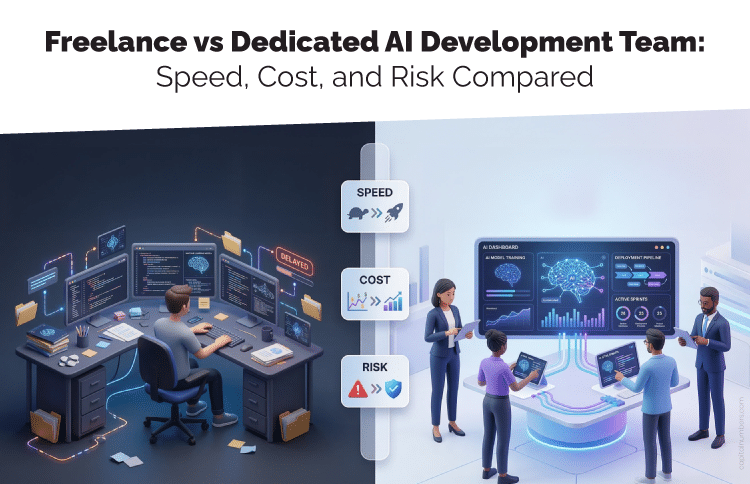
Choosing between freelance AI developers and a dedicated AI development team can make a big difference in how fast your AI project moves, how much it costs, and how much risk your business takes on. Freelancers are flexible and quick to start, making them ideal for short-term tasks, prototypes, or experiments.
A dedicated team, on the other hand, provides full ownership, structured workflows, and ongoing support, which are important for production-ready AI and business-critical solutions.
In this blog, we’ll compare freelance AI developers and dedicated AI teams across speed, cost, and risk. It will help you pick the right approach for your AI initiative and ensure it delivers value efficiently and reliably.
Why the Hiring Decision Matters More in 2026
AI projects today are no longer simple exercises in model building. Businesses are now under pressure to turn promising AI use cases into secure, scalable, and usable solutions. Modern AI initiatives often require a combination of:
- Data preparation and cleaning
- Model selection and tuning
- Workflow design and automation
- System integration with existing software
- Security, compliance, and governance
- Testing, monitoring, and optimization
- Continuous improvement post-launch
In 2026, many businesses are no longer focused only on chatbots or isolated AI features. They are starting to build AI copilots, autonomous agents, and agentic workflows that interact with multiple tools, systems, and decision points. This raises the delivery bar because these solutions often require agentic orchestration across prompts, models, APIs, business rules, human approvals, and fallback paths.
It also increases the need for LLMOps, where teams must monitor output quality, track model behavior, manage prompt updates, and maintain reliability after launch. This is one reason dedicated teams often have an advantage in 2026.
A single freelancer may be able to build one part of the solution well, but may not have the bandwidth to manage both complex delivery and ongoing operational oversight. With these requirements, the delivery model you choose directly influences your project’s outcome, including:
- Speed of rollout: How quickly your idea moves from concept to live solution
- Internal coordination: How much time your team spends guiding, reviewing, and integrating work
- Solution performance: How well the AI works in real business scenarios
- Scalability: How easily the solution can grow or adapt after launch
In other words, choosing between a freelancer and a dedicated team from a reputable AI development company is no longer just a staffing decision; it’s a delivery decision that impacts long-term value, stability, and ROI.
Speed Comparison: Freelance vs Dedicated AI Development Team
Speed is often the first concern for businesses. Many owners assume freelancers are always faster because they can be hired quickly and start immediately. That can be true in some cases, but only at the beginning. The real question is not who starts faster, but who delivers business value faster with fewer delays later.
Where Freelancers Can Be Faster
Freelancers can move quickly when:
- The scope is small and clearly defined
- The business needs one specific skill
- The project is a PoC or prototype
- Internal teams can provide direction and review
Examples:
- A startup wants to build a basic AI chatbot to test customer engagement.
- A product manager wants a recommendation engine demo for early stakeholder approval.
- A team wants to explore LLM prompt engineering for a single workflow before committing to a broader rollout.
In these cases, a skilled freelancer can deliver a usable version quickly, and the hiring cycle is shorter due to minimal onboarding, fewer stakeholders, and lower process overhead.
Where Dedicated Teams Are Faster
A dedicated team is often faster when:
- The AI software development involves multiple workstreams
- Data, backend, UX, testing, and deployment must happen together
- The scope is likely to evolve
- The solution needs production readiness
- The business wants consistent momentum across phases
Examples:
- Launching an AI-powered website integrated with CRM and internal systems.
- Building a custom AI assistant for internal operations, including workflow automation and analytics.
- Developing predictive analytics solutions tied directly to business decisions.
Dedicated teams reduce the waiting time between software development stages. One person does not need to handle discovery, architecture, development, testing, and deployment alone.
Tasks can happen in parallel. A dedicated AI team also tends to spot delivery blockers earlier. If data quality is poor, infrastructure is missing, or the workflow design is weak, the team can respond before these issues become expensive delays.
Takeaway: Freelance AI developers may start fast, but dedicated teams often finish faster on complex, multi-stage projects.
Cost Compared: Upfront Price vs Total Delivery Cost
Cost is a key factor many businesses consider when considering freelancers. On paper, the freelance route often looks more affordable. But business owners should look beyond hourly or monthly rates. The better question is, what will this model cost by the time the solution is live, stable, and ready to scale?
Why Freelancers Often Look Affordable
Freelancers usually have:
- Lower hourly or project-based rates than full teams
- No long-term engagement commitment
- No bundled delivery overhead
- Flexibility for short-term assignments
For smaller experiments, this can be a smart use of budget. If you only need one narrow capability for a limited time, paying for a full team may not be justified.
Where Hidden Costs Can Appear with Freelancers
The lower upfront cost can become misleading when businesses overlook:
- Time spent coordinating multiple freelancers
- Delays caused by unclear ownership
- Rework due to inconsistent architecture or coding standards
- Quality issues were found late in the project
- Added the cost of replacing unavailable freelancers
- Lack of documentation for future scaling
- Internal management time from founders or senior staff
This becomes even more expensive when a business hires three separate freelance specialists, such as one for model development, one for backend integration, and one for prompt or workflow design.
In practice, someone on the client side then has to coordinate tasks, manage dependencies, review progress, resolve blockers, and keep the entire effort aligned. That can become close to a full-time job in project management.
For example, a business building an AI assistant with separate freelance specialists may initially see lower delivery costs. But once the client has to manage handoffs, priorities, testing, and coordination across the whole project, those hidden costs can quickly outweigh the expected savings.
Why Dedicated Teams Can Cost More Upfront
A dedicated AI team usually costs more at the start because you are paying for a broader delivery structure. That may include project management, QA, architecture, DevOps, and documentation support.
That same structure also removes much of the management tax from the client side. Instead of the business coordinating multiple individual contributors, the team usually includes a project manager or delivery lead who keeps work moving across roles, milestones, and dependencies. But this structure often reduces:
- Delivery delays
- Handoff issues
- Costly fixes later
- Dependence on one person
- Scaling problems after launch
Looking at Total Value
For short, narrow tasks, freelancers may be the more cost-efficient option. For larger or business-critical initiatives, a dedicated team may offer better overall value because it reduces the risk of failure, delays, and costly corrections later.
The cheapest delivery model is not always the one with the lowest rate. It is the one that gets the right solution live with the least avoidable waste. That is why many businesses evaluating AI development outsourcing look beyond price alone and compare delivery maturity, accountability, and long-term support.
Risk Compared: The Biggest Difference Between Freelance and Dedicated AI Hiring
Risk is where the gap between freelancers and dedicated teams becomes more visible. In AI projects, risk is not just about whether the code works. It includes:
- Delivery continuity
- Data security
- Model reliability
- Documentation quality
- Compliance readiness
- Post-launch support
- Knowledge retention
- Business dependency on specific individuals
Common Risks in Freelance AI Engagements
Freelancers can be excellent specialists, but the model carries some common risks.
1. Single-point dependency
If one freelancer owns critical parts of the AI workflow, your project may slow down or stall if that person becomes unavailable.
2. Limited cross-functional coverage
A freelancer may be strong in model development but weaker in product design, MLOps, integration, testing, or deployment.
3. Inconsistent ownership
If multiple freelancers are hired separately, it may be unclear who owns the architecture, quality, security, or final delivery.
4. Documentation gaps
Freelancers working under tight timelines may prioritize output over long-term maintainability. This can make future updates harder and more expensive.
5. Security and compliance concerns
AI projects often involve sensitive business data, customer data, or proprietary workflows. Smaller freelance setups may not always provide strong governance practices.
6. Compliance and governance gaps
As AI regulations (such as the EU AI Act) tighten, businesses need audit trails, governance records, and stronger documentation. A dedicated team is usually better equipped than a freelancer to consistently meet these requirements.
How Dedicated Teams Reduce Risk
A dedicated AI development team lowers risk through structure:
- Shared ownership instead of one-person dependency
- Defined roles and responsibilities
- Stronger review and QA processes
- Delivery management and milestone tracking
- Better documentation and knowledge transfer
- More stable support after launch
- Broader governance around security and deployment
For business owners, this creates more predictability. Even if one team member changes, the project does not lose all context. That continuity matters a lot in AI, where tuning, retraining, integration updates, and workflow improvements often continue long after the first release. If your business is investing in AI for real operational use, not just testing, then delivery stability matters just as much as technical skill.
AI Technical Debt: The Hidden Cost of Quick Wins
Freelancers can be a good fit for a quick demo or early PoC. But if the first version is built mainly for speed, it can create AI technical debt that becomes harder and more expensive to fix later. This often shows up as:
- Weak documentation
- Fragile prompt flows
- Limited testing
- Poor monitoring
- Integration issues
A dedicated team is usually better equipped to build with maintainability, smoother handover, and future improvements in mind. That helps prevent a quick win from becoming a long-term delivery problem.
When a Freelancer Is the Right Choice
A freelancer can be the right fit when your business needs focused, short-term AI support and the project does not require a full execution ecosystem. This model works best if:
- You are testing an idea before investing further
- You need a quick prototype or PoC
- Your in-house team already handles architecture and deployment
- The work is specialized but limited in scope
- The business can actively manage the project
When a Dedicated AI Development Team Is the Better Choice
A dedicated team is usually the better choice when AI is tied to real business operations, customer experience, or long-term growth. This model makes more sense if:
- You are building a production-ready AI solution
- The project affects revenue, support, operations, or customer trust
- Multiple skills are needed at the same time
- You expect the scope to evolve
- The business needs consistent support after launch
- Security and delivery accountability matter
Practical Tips for Business Leaders
Below are some tips that help you make a wise choice:
- Map project scope and risk: Identify whether your initiative is a small experiment or a mission-critical system.
- Evaluate internal capabilities: Determine how much your team can manage directly.
- Consider total cost: Include coordination, rework, and management overhead, not just hourly rates.
- Plan for post-launch support: AI solutions often require ongoing improvements, monitoring, and tuning.
- Assess timeline: Rapid prototypes may favor freelancers; complex, multi-phase projects benefit from dedicated teams.
- Check security and compliance needs: Production systems may require governance that freelancers cannot provide.
You May Also Read: How to Choose an AI Software Development Company: 12 Criteria That Matter
Make the Right AI Hiring Model Work for Your Growth
Freelance AI developers can work well for smaller, clearly defined tasks. But long-term value depends on choosing a model that supports reliable delivery, smoother execution, and future growth. Freelancers can be a smart fit for narrow experiments and early PoCs.
But when the initiative involves multiple workstreams, ongoing support, compliance needs, or long-term maintainability, a dedicated AI development team is often the stronger choice. Making the right decision early can help reduce risk, avoid unnecessary technical debt, and build with more confidence.
Want clarity on the best hiring model for your AI initiative?
Book a 30-minute discovery call with our experts. We’ll review your goals and recommend the right team structure for your next phase of growth.
Frequently Asked Questions
1. Is it cheaper to hire a freelance AI developer?
Yes, hiring a freelance AI developer is often cheaper up front, especially for small tasks or a clearly defined scope. You may pay less at the start, but the total cost can rise later if the project needs rework, more coordination, or extra support after launch. This model usually works best when:
- You need one specialist for a specific task
- The scope is limited
- Your internal team can manage the work
2. What are the benefits of a dedicated AI team for enterprise projects?
A dedicated AI team gives you access to a wider set of skills, better project ownership, and stronger support across the full delivery cycle. Instead of relying on one person, you get a team that can handle planning, development, testing, integration, and ongoing improvement in a more structured way. This is useful when you need:
- Better quality control
- Smoother collaboration across stages
- Stronger support for security, scaling, and long-term delivery
3. What are the hidden risks of outsourcing AI development to freelancers?
The biggest risk is that you may end up depending too much on one person for a project that needs broader support. You can also face issues like weak documentation, delivery delays, skill gaps, or limited help once the first version is live. These risks become more noticeable when:
- The project grows in scope
- Multiple systems need to be connected
- You need continuous updates or support
4. How to scale an AI project with a dedicated team?
A dedicated team helps you scale by bringing in the right people at the right stage of the project. As your needs grow, you can add support across development, testing, deployment, monitoring, and ongoing improvements without losing delivery continuity. This makes it easier for you to:
- Expand features
- Improve performance over time
- Support new business needs and integrations
5. When should a business choose a dedicated AI development team over freelancers?
A business should choose a dedicated AI development team when the project involves multiple stages, integrations, or ongoing improvement. It is usually the better choice for larger and more important AI initiatives.

Preeti BiswasSoftware Engineer
An AI/ML Engineer with 3 years of experience, Preeti specializes in NLP, Computer Vision, and Generative AI. With extensive expertise in Large Language Models (LLMs), she builds intelligent, real-world applications. She is also experienced in designing and deploying scalable machine learning solutions across cloud platforms like AWS, GCP, and Azure.